
Betty Cooper started Riverdale as the picture of All-American innocence – the sweet, blonde girl next door with a flawless ponytail and a smile as wholesome as apple pie. But if you expected Betty to remain the sane center of a small-town teen drama, think again. Over seven seasons of teen noir mayhem, Betty’s journey spiraled into a dark and deliriously entertaining saga featuring serial killers, cults, and even a surprise detour to the 1950s. Through it all, actress Lili Reinhart anchored the madness with a performance that was sharp, soulful, and increasingly unhinged – in the best way. Reinhart embodied Betty’s transformation from earnest girl detective to a young woman scarred by trauma yet wielding her inner darkness like a weapon, keeping us magnetically drawn to her every step. It’s no wonder the series finale positioned Betty as the true central hero of Riverdale, highlighting that her character “had been involved in every central plot line” and grew “from a kind girl next door fighting off her dark side to a young woman who has gone through horrible events and come out the other side.” Strap in (like Betty’s iconic ponytail) and join us for a darkly humorous tour through Betty Cooper’s character arc – a wild ride of investigative bravado, flirtations with madness, and one very resilient bobby pin.
Ponytail Perfection and Dark Betty (Seasons 1–2)
When we first meet Betty in Season 1, she seems like Nancy Drew in a cheerleading uniform – a straight-A student, dutiful daughter, and loyal friend with a serious crush on her bestie Archie Andrews. But beneath the Pollyanna exterior lurks a hint of something more volatile. Lili Reinhart deftly drops early clues to Betty’s repressed anger: a clenched fist leaving nail marks in her palms, a flash of rage when Cheryl Blossom pushes her buttons. In one early episode, Betty’s inner pressure cooker blows – she dons lacy black lingerie and a wig, transforming into “Dark Betty” to terrorize school bully Chuck Clayton into confessing his misdeeds. For a moment, Betty literally loses herself in this vengeful alter ego, believing she was her sister Polly enacting retribution. It’s a jarring scene (you can almost hear the collective gasp of the audience), but Reinhart sells it completely, balancing on that knife’s edge between camp and genuine pain. As she later explained, these outbursts are “a nod to Betty’s dark side. It comes out when Betty’s buttons are pushed, especially when it comes to Polly.” In Betty’s world, the girl next door carries a switchblade in her purse – just in case.
Season 1’s central murder mystery (Who killed Jason Blossom?) officially kicks off Betty’s sleuthing career. Teaming up with Jughead Jones – the beanie-wearing, monologue-delivering outsider writer – Betty becomes half of a teen detective duo that would give Sherlock and Watson a run for their money. Their investigation of Jason’s death brings them closer, sparking a romance and the birth of “Bughead”, a pairing of the town’s good girl and “weirdo” boy from the wrong side of the tracks. Their chemistry is undeniable: Betty’s warmth and determination complement Jughead’s cynicism, and together they shine a light on Riverdale’s darkest secrets. By the time they crack the Blossom murder case, Betty has already shown she’s far more than a ponytail prop – she’s formidable, with a hint of steel beneath the sweetness.
Then comes Season 2, and Betty’s life veers from teen noir into full-blown thriller territory. A masked serial shooter called the Black Hood terrorizes Riverdale, and naturally Betty finds herself smack in the middle of the cat-and-mouse game. The Black Hood becomes creepily obsessed with Betty, calling her on the phone (with a voice that sounds like a demonic heavy breather) and forcing her to perform twisted tasks under threat – like cutting off her friendships – to “cleanse” the town of sin. Why Betty? It turns out her impassioned speech at the previous season’s Jubilee inspired this maniac’s killing spree. If that weren’t traumatizing enough, the Black Hood is unmasked as none other than Hal Cooper – Betty’s own father. Yes, the wholesome dad who taught Betty how to ride a bike is secretly a righteous serial killer who literally kept a kill kit in the family basement. Thanksgiving dinners got real awkward after that revelation. In a bravura showdown, Betty faces down Hal and helps take him into custody, even as she processes the horror that “serial killer” runs in her family. Reinhart’s portrayal of Betty’s terror and resolve in these scenes is riveting – you can see the devastation in her eyes, but also the steely conviction that she won’t become like him. Still, the psychological toll is heavy. Betty is left wondering if darkness is her birthright, a fear the show will revisit (with characteristic absurdity) later on. For now, she copes as any traumatized teen sleuth would: by enrolling in therapy with her dad’s secret serial-killer mentor… but we’re getting ahead of ourselves.
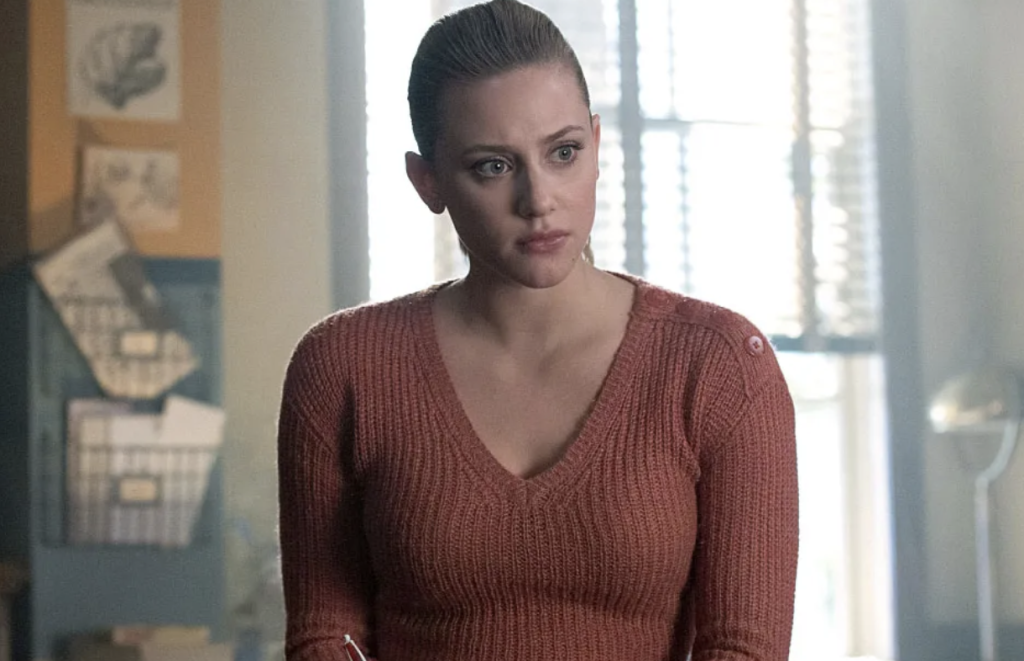
Cults, Organs and Gargoyles – Oh My! (Seasons 3–4)
Having survived one serial killer, Betty charges into Season 3 facing an even wackier threat: a cult of organ-harvesting hippies. (You read that right.) The Farm, led by the perma-smiling Edgar Evernever, ensnares Betty’s mother Alice and sister Polly in its new-age clutches. Betty smells something rotten in this pseudo-spiritual movement and discovers, to her horror (but not ours, we’re having a blast), that “The Farm is actually an organ farm masquerading as a hippy-dippy wellness cult.” Edgar is conning his followers into “voluntarily” donating organs – and he’s got a literal freezer full of kidneys and other body parts to prove it. Betty blows the whistle on this macabre scam, nearly getting herself lobotomized in the process. (Edgar straps Betty to an operating table and prepares to remove her brain under the guise of extracting “mental pain” – because of course the villain wants a piece of Betty’s mind… literally.) It’s bonkers, Grand Guignol stuff, and Riverdale knows it – the show’s chaos quotient is off the charts this season. But Reinhart keeps Betty’s reactions emotionally grounded and even darkly funny amid the insanity. Whether she’s trading barbs with Edgar or rolling her eyes at the cult’s deranged rituals, Betty remains the snarky voice of reason – even as she’s fending off a shady hipster about to DIY-surgery her brain.
Meanwhile, another bizarre threat has Riverdale’s teens drinking fresh-aid: the role-playing game “Gryphons & Gargoyles.” This Dungeons-and-Dragons-meets-death-cult craze claims multiple lives and introduces the Gargoyle King, a mysterious figure orchestrating murders. Naturally, Betty is on the case with Jughead. In one standout episode, the show plunges into full film-noir mode: Betty gets her own hardboiled voiceover as she investigates a corrupt nun-run asylum linked to the game. “Betty carries the best act of the episode, a dark and darkly funny crime noir” that leans into her detective skills with a “PI voiceover that’s cutting, snarky, and insightful.” It’s a stylistic high point – Nancy Drew meets Veronica Mars – and Reinhart clearly relishes the chance to flex her inner noir gumshoe, delivering rapid-fire lines with a cool, sarcastic bite. By the end of Season 3, Betty has stared down her demons both literal and figurative: she even faces off with her father Hal one last time when he escapes custody (because one Black Hood showdown wasn’t enough). In a scene straight out of Silence of the Lambs, Betty confronts Hal in the woods at gunpoint, ultimately watching as another foe guns him down. Casualties this season: Betty’s remaining trust in her family. By now her family tree looks more like a true-crime anthology – dad’s a killer, mom was in a cult (albeit undercover, as Betty learns later), sister was brainwashed, secret half-brother Chic is an imposter and murderer, and even her real half-brother Charles has homicidal tendencies. The Cooper DNA is not FDA-approved.
Season 4 keeps the pedal on the floor. Betty, now a senior, contends with a pretentious prep school conspiracy that fakes Jughead’s death, as well as her long-lost half-brother Charles (an FBI agent… supposedly) mentoring her in crime-solving. Betty’s drive to fight evil is stronger than ever – so much so that she starts consulting her imprisoned father for advice on catching another serial killer, à la Clarice Starling visiting Hannibal Lecter. (If that sounds unhealthy, it was.) At one point, Betty fears she herself might have murdered Jughead during a hypnotic fugue – the show literally tests her sanity with a trigger word, “Tangerine,” intended to make her disassociate. She resists, proving her willpower. Riverdaleeven drops the term “serial killer genes” this season, revealing Betty was born with a genetic predisposition to violence (the dubious MAOA gene, for science fans keeping score). Betty is understandably horrified to learn she has the so-called “serial killer gene” – because having one psycho parent wasn’t enough, now her very blood is branded evil. The writers play it for high drama (and some unintentional comedy), even weaving this into a bizarre hypnotism plot where Betty nearly bludgeons herself on command. Reinhart makes the angst feel real, but she’s also winking at the absurdity; you can sense Betty’s exasperation that even her DNA is melodramatic. By graduation, Betty has survived mind control, taken down a cabal of privileged murderers at school, and said a poignant goodbye to Jughead as they head to separate colleges. The teen detective era ends with tears and hope – Betty might finally get a breather. Ha, just kidding.
From FBI Trainee to Serial Killer Slayer (Season 5–6)
After a midseason time jump, Season 5 propels Betty (and the audience) seven years into the future. Our girl returns to Riverdale as a young FBI trainee – tougher, wearier, and haunted by a serial killer known as the Trash Bag Killer (TBK) who kidnapped her during her training. Betty in her mid-20s is essentially channeling Clarice from The Silence of the Lambs: she has nightmares of chainsaws and bodies, and she’s dead set on catching TBK before he hurts anyone else. Reinhart plays adult Betty with a hardened edge – her voice a little lower, her eyes carrying the weight of what Betty’s seen. Still, some things haven’t changed: when Archie calls the gang back to save their decaying hometown, Betty jumps right back into hero mode (FBI badge and all) to clean up Riverdale. She even finds time for a friends-with-benefits fling with Archie – a steamy union of the girl next door and the boy next door that had been teased since episode one. (They literally set Betty’s childhood diary on fire in one lusty scene – symbolism, anyone?) But the real emotional gut-punch this season is Polly’s death. Betty’s sister falls victim to a trucker serial killer operating on the Lonely Highway, sending Betty into a spiral of guilt and grief. In one chilling scene, Betty corners a suspect in a junkyard and nearly takes a chainsaw to him in retribution for Polly – a moment where we truly see how thin the line has gotten between Betty’s righteous anger and outright violence. The “serial killer gene” plot comes back to bite, as Betty fears she could cross into darkness for good. Yet, she doesn’t. Instead, she helps dismantle the grim trucker murder ring (involving, of all things, an incestuous Blossom-offshoot family living in the woods – even Betty is like “Seriously?” at this point). By the end of Season 5, Betty has avenged Polly, put many bad guys behind bars, and earned her status as a full FBI agent. She also rekindles a real romance with Archie, stepping out of the shadow of “Bughead” – a big move that would have been shocking in Season 1, but by now feels like natural growth. Betty is trying to build a normal life from the wreckage of her past. Key word: trying.
Season 6 promptly blows “normal” to smithereens – literally. Hiram Lodge plants a bomb under Archie’s bed which Betty narrowly survives. The explosion has a side effect that only Riverdale would attempt to sell with a straight face: Betty (and Archie and Jughead) develop supernatural powers. Yes, welcome to the Riverdale superhero era. Betty’s new ability is a kind of psychic Serial Killer Detector – she can see auras of evil in people, glowing red halos that alert her if someone has murderous intent. It’s as if her long-dreaded “killer gene” turned into an X-Men mutation. Rather than balking at the absurdity, Reinhart leans in, playing Betty’s reaction as a mix of “Are you kidding me?” and “Well, might as well use it”. And use it she does: this power actually helps Betty identify creeps (very handy when your town is crawling with them) and even sense that her pretty-boy FBI boss is a threat. Betty also teams up with a British-accented witch-hunter villain named Percival Pickens who is bent on mind-controlling the town – but let’s be honest, by this point Riverdale’s plot has eaten several dozen psychedelic brownies. The tone of the show is full supernatural horror/fantasy now, complete with witches (hi, Cheryl!), demons, curses, and not a wink of self-consciousness. As one reviewer aptly summarized, Riverdale evolved into an “increasingly chaotic supernatural horror show featuring alternate timelines, witches, superpowers, ghosts, possessions, cannibalism, and resurrections.” You know, the usual milestones of small-town adolescence.
Amazingly, Betty stays true to herself amid the chaos. She even gets closure on her white whale: the Trash Bag Killer returns for a final showdown, setting up a twisted mind game where he tries to convince Betty they’re soulmates in darkness. Betty’s not having it. In a cheer-worthy moment, she declares “I’m not like you” and promptly shoots TBK dead with her father’s old gun. It’s the culmination of all Betty’s growth – rejecting the notion that her inner darkness controls her. She chose her own identity in that moment, and it’s a hero’s. (A slightly unhinged hero who sees murder auras, but a hero nonetheless.) Immediately after, the season hurtles into an apocalyptic endgame: a comet is about to obliterate Riverdale (you read that right) until Cheryl harnesses phoenix powers to stop it. The catch? Doing so yeets the entire gang back in time to 1955. Cue Twilight Zone music.
Back to the ’50s and Beyond (Season 7)
In its final season, Riverdale goes full circle by sending its characters back to high school – except this time it’s the 1950s, complete with varsity jackets, milkshakes, and very repressed social norms. Betty wakes up as a teenager in 1955 with no memory of her future self, essentially rebooted to an earlier version. At first, only Jughead recalls their real timeline (because of course Jughead becomes the meta-narrator paradox who remembers everything). Soon, however, the truth resurfaces and Betty regains her memories of all those wild experiences. Imagine the therapy bills: one day you’re worrying about prom, the next you recall you shot a guy named Trash Bag Killer and once traded notes with your serial-killer dad. To Betty’s credit, she handles this existential whiplash with trademark pluck and a sense of purpose.
1950s Betty is initially back to Pleasantville mode – she’s dating Kevin Keller (a closeted crooner in this timeline), writing for the school paper, and chafing against her parents’ ultra-conservative expectations. But the old fire in her hasn’t died. In fact, being in the Eisenhower era only galvanizes Betty’s rebellious, progressive streak. She starts an underground feminist magazine (cheekily titled Teenage Mystique), champions sexual liberation, and challenges authority at every turn. Lili Reinhart clearly has fun with the throwback setting – giving Betty a perky, can-do attitude on the surface while letting the more modern, enlightened persona peek out in sly smirks. An example: Betty helps her friend Toni publish an article about the real-life murder of Emmett Till, directly defying her town’s attempts to keep such issues silent. It’s a poignant storyline that shows Betty’s core integrity transcends time. Even in an alternate timeline, Betty’s going to fight the good fight and speak truth to power.
Of course, it wouldn’t be Riverdale without relationship drama. Throughout the final season, Betty finds herself intrigued by the possibility of Barchie (Betty+Archie) while also surprisingly drawn to Veronica Lodge – exploring a flirty friendship that hints at more. The show, never shy about going OTT, eventually reveals a jaw-dropping twist: in the original timeline’s final year, Betty, Archie, Veronica, and Jughead decided to eschew the usual love triangle squabbles and just date each other. All of each other. That’s right – Betty was in a romantic “quad relationship” with the other three leads during their senior year. (Apparently Betty and Veronica became quite… close BFFs, as “they were open with each other’s bodies.” The boys, not so much with each other – small mercies, perhaps.) This revelation is delivered with a straight face, and you have to admire Riverdale’s chutzpah. It’s the show’s final mic drop in a long history of insane swings, and somehow it feels fitting that Betty – who began as the eternal second fiddle in Archie’s love life – ends up having all her cake and eating it too. Dark Betty would be proud.
The series finale centers on an elderly Betty (86 years old) looking back on her technicolor life. In a touching wrap-up, she is effectively the last survivor of the gang, making Betty the storyteller who carries everyone’s memories. We see that she lived a rich life – running a progressive women’s magazine, adopting a daughter, never marrying but truly fulfilling herself on her own terms. In her final moments, Betty’s spirit joins her friends in a heavenly Pop’s Diner, greeted with cheers as she walks through the door – the last one to arrive. It’s an emotional capstone that underscores how central Betty has been all along. The show literally couldn’t end until Betty Cooper took her seat.
The Irrepressible Lili Reinhart – Betty’s Magnetic Presence
What makes Betty’s batshit-crazy journey so compelling (instead of just perplexing) is the humanity Lili Reinhart brought to every iteration of the character. Whether Betty was a bookish teen sleuth in a poodle skirt or a battle-hardened FBI agent with smoke in her eyes, Reinhart made sure she still felt like Betty. She navigated Riverdale’s notorious tonal whiplash with aplomb: one week playing campy pulp horror, the next delivering genuine gut-wrenching drama. Her performance remained the steady heartbeat of the show, even as the surrounding story went increasingly, delightfully off the rails. Critics and fans alike often praised Reinhart as one of the strongest actors in the cast, able to make even the wildest plots believable. She could do a chilling thousand-yard stare worthy of a Hitchcock heroine, then turn on a dime and give us a warm, earnest Betty pep talk that reminds you this is a girl who cares deeply about her loved ones. Take the Season 3 noir episode – her wry voiceover had big Lauren Bacall energy, showing off impeccable comic timing. Contrast that with the raw intensity of Betty confronting TBK in Season 6, trembling with contained fury as she pulls the trigger. Reinhart sells both as two sides of the same Betty: the smart, kind-hearted young woman who’s had to become a little bit feral to survive.
Through serial killers (caught or killed), cult leaders (exposed and vanquished), and supernatural insanity (tamed with a raised eyebrow), Betty Cooper remained the soul of Riverdale. She was the character who consistently did something – investigating, saving, avenging – while others sang in musicals or joined mafia schemes or what-have-you. It’s little wonder the writers made Betty the window through which we say goodbye in the end. In a town where literally anything could happen, Betty’s evolution provided a strange kind of anchor and authenticity. And in a show that oscillated between irony and sincerity, Reinhart played Betty’s arc remarkably straight – with just a glint of knowing humor in her eyes. Betty’s increasing boldness (okay, occasional madness) never alienated us because Reinhart made her magnetic, even relatable. We cheered when she embraced her darkness to protect others, because we felt the conviction behind it.
In the end, Betty Cooper’s journey across seven seasons can be described as nothing short of epic – epically bizarre and epically engaging. She started as the good girl who “hates that phrase” but truly was one, and ended as a complicated, self-realized woman who had seen the literal end of the world and still kept her heart intact. Along the way, Betty juggled teen detective duties, foil-wrapped a few serial killers (including both her father and her erstwhile kidnapper), joined a biker gang via a steamy striptease, got hypnotized (more than once), led prison breakouts and paramilitary raids on organ farms, gained psychic powers, and spearheaded a sexual revolution in an alternate 1950s timeline. If that sounds like a lot… well, it is. Betty’s life was extra, as she herself might quip with a sardonic smile. But thanks to Lili Reinhart’s sharp and irreverent portrayal, we bought into every twist, transfixed by Betty’s resilience and spirit.
Betty Cooper will be remembered as a character who refused to be pigeonholed – not by the “perfect girl” stereotype, and not even by the laws of reality. She embraced her inner darkness without letting it define her, turning trauma into strength. And she did it all while rocking that eternal ponytail (when she wasn’t letting her hair down to sing an occasional musical number or, you know, don a black wig to scare the devil). In the pantheon of TV teen queens, Betty stands out as the one who started assembling a murder board in chapter one and never let up, even as the mysteries got insane. Super-duper, indeed. Betty’s wild ride may be over, but her legacy – a weird, witty, wonderful testament to surviving anything with your integrity (mostly) intact – lives on.
