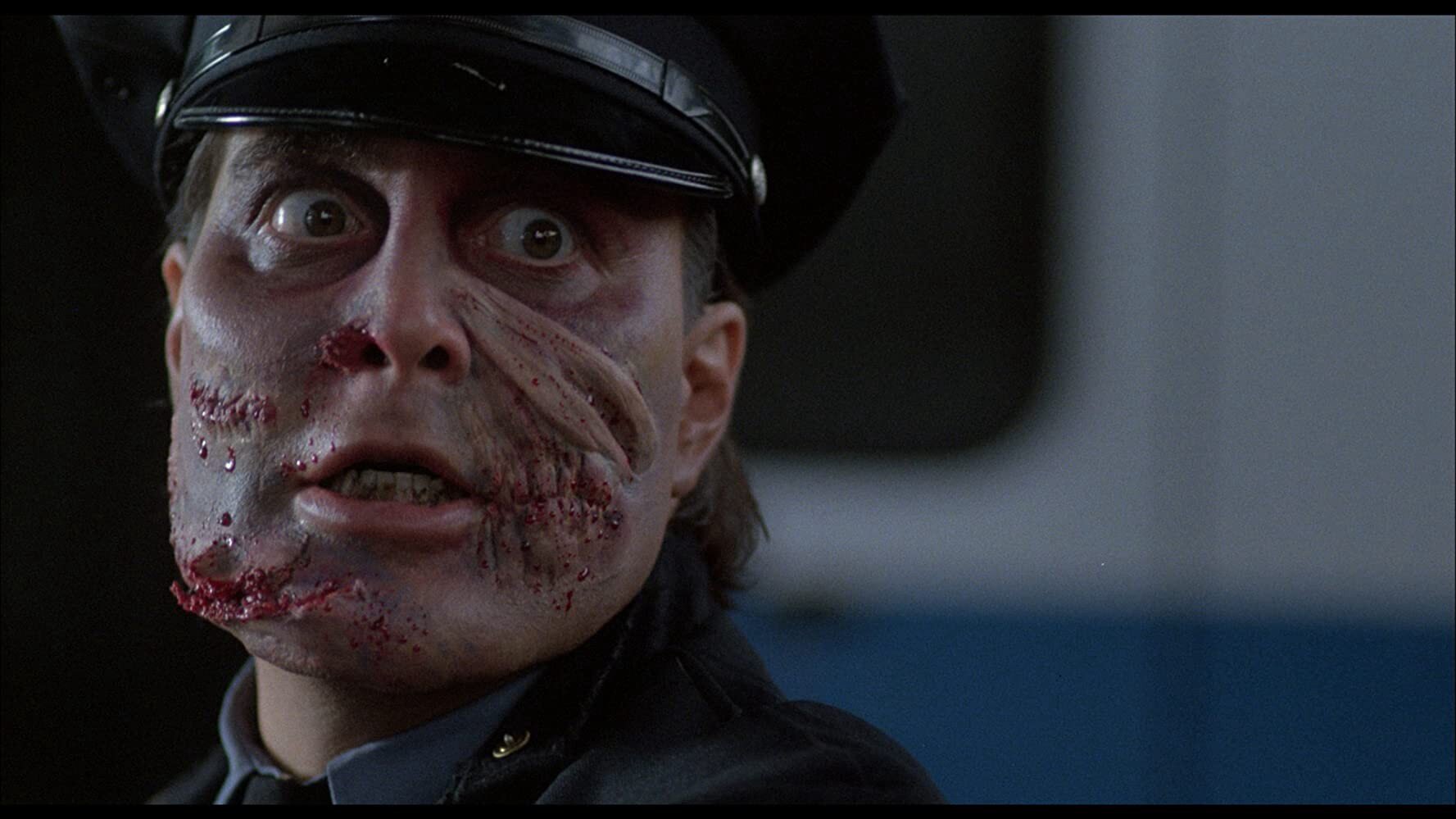
The Activated Man feels like the kind of movie you’d find at 2 a.m., halfway through a bag of stale chips, and suddenly realize: “Oh, this is actually trying—and somehow, it’s kind of working.”
It’s scrappy, ambitious, weirdly sincere, and just unhinged enough to be fun. Think low-budget sci-fi thriller with big ideas, a body count, and a cast full of genre royalty who show up like they’ve been waiting their whole lives to monologue about consciousness and murder in fluorescent lighting.
Sci-Fi, But Make It Midlife Crisis
Nicholas Gyeney writes and directs this thing like a man who’s had one too many late-night arguments about free will. The premise plays like a dark mash-up of psychological thriller and comic-book origin story: a troubled man, experimental tech, and the kind of “self-improvement” program that really should’ve come with more waivers.
Our central figure—the “activated” man himself—is not some shiny superhero, but a broken human being who’s one bad day away from completely coming apart. Instead of a radioactive spider or a cosmic beam, he gets… an upgrade from people who absolutely should not be trusted with a toaster, let alone the human brain.
The movie leans into that: activation here isn’t about becoming noble and heroic. It’s about having your latent potential cranked up so far past ten that your moral circuit board starts to smoke.
There’s a dark little joke at the heart of it: every self-help ad promises to unlock the “real you.” The Activated Man asks, “Are you sure that’s a good idea?”
Tony Todd, Calmly Owning the Room
Let’s talk about the cast, because this is where the movie flexes way above its weight class.
Tony Todd glides in like a genre godfather, bringing that iconic, measured menace. He could read off a grocery list and make it sound like a curse, so giving him cryptic lines about human potential and control is basically cheating. He doesn’t overplay it, either—his performance is understated, like someone who knows everything and likes watching everyone else realize how doomed they are five minutes too late.
Andrew Keegan, meanwhile, feels like a deliberate wildcard. There’s a “former golden boy gone to somewhere very strange” energy to him that really works for a guy whose inner life is being weaponized. He plays the protagonist not as a traditional badass, but as someone fraying at the edges: frustrated, fragile, and a little too eager to believe that activation will finally fix him.
Spoiler: it does not fix him.
Sab Shimono, Vladimir Kulich, Sean Young, and Kane Hodder round out a supporting cast that feels like a genre convention panel gone rogue. Hodder, famously Jason Voorhees, stomping through any scene is an automatic threat level upgrade. Sean Young brings that off-kilter gravitas that suggests she knows more than everyone and might stab you with a file folder if necessary.
This is one of those movies where half the enjoyment is, “Oh my god, they’re in this?” right before someone gets psychologically obliterated.
Small Budget, Big Mood
You can see the production limitations—this isn’t pretending to be some massive studio tentpole. But instead of chasing scale it can’t afford, the film leans into close quarters: labs, offices, empty streets, and industrial locations that all feel a little too anonymous and cold.
Cinematographer William Hellmuth shoots everything with an eye for unease. Lighting shifts from stark, clinical whites in the “science” scenes to moody, shadow-heavy frames when things go sideways—which is often. There’s a lot of glass, reflections, and lonely wide shots where the protagonist looks very small and very screwed.
The score by Cesar Beitia does what good low-budget horror/sci-fi music should: it nudges your nerves instead of drowning you. Pulsing synths, uneasy drones, and the occasional sharp sting let you know when reality is cracking, just in case the look on Andrew Keegan’s face didn’t already sell that.
The editing keeps things moving. At almost two hours, this could’ve dragged, but Chad Eade cuts just enough fat that you don’t get bored. Confused sometimes, yes. Bored, no.
Activation: Empowerment or Instant Red Flag?
The heart of the story is really about control—who has it, who wants it, and who’s delusional enough to think they ever really did.
The “activation” process itself is a blend of neuroscience jargon, fringe tech, and culty self-betterment rhetoric. You don’t need to understand the specifics; what matters is the vibe: a mix of Silicon Valley disruptor nonsense and mad-scientist hubris.
When the protagonist is “activated,” the movie doesn’t turn him into a clean superhero. Instead, it strips away fear and inhibition in a way that feels… deeply unsafe. The violence that follows is less “action set-piece” and more “this is what happens when you give a fragile ego god mode.”
And that’s where the dark humor creeps in: this is what the world keeps selling us as empowerment—no doubt, no guilt, no brakes. The Activated Man simply follows that logic to its horrifying conclusion.
Congratulations, king. Your third eye is open and you’re terrible.
Wobbles, Weirdness, and Why It Still Works
Is the movie messy? Absolutely.
The lore sometimes feels like it’s being written on the fly. Motivations get muddy. A couple of subplots appear, wave, and wander off into the night. There are scenes that tilt so far into melodrama or philosophical monologue that you half expect someone to whip out a whiteboard and draw a diagram labeled “TRAUMA.”
But there’s an earnestness to the chaos that’s kind of endearing. You can tell this isn’t a lazy cash-grab; it’s a filmmaker throwing every idea he has about identity, violence, and manipulation at the screen and seeing what sticks. A surprising amount does.
And when it doesn’t, the misfires are at least interesting misfires. You’re not just sitting there watching gray sludge. You’re watching a movie swing hard, miss sometimes, but always swing.
The Fun of Watching a Man Come Apart
What really sells it is that the film never lets you fully relax around its main character. Even before activation, he’s not okay. Afterwards, he’s the sort of person you absolutely would not want near sharp objects, passwords, or emotional conversations.
There’s tension in every interaction: is he genuinely trying to do the right thing, or is that just the part of his brain that hasn’t been completely hijacked yet? As his sense of self erodes, the movie leans into a kind of bleak comedy: every time he “takes control” of a situation, it somehow becomes more catastrophic.
It’s like watching a walking TED Talk about optimization slowly realize he’s actually the subject of a true-crime documentary.
Final Verdict: Ambitious, Unstable, Weirdly Watchable
The Activated Man is not polished, not perfect, and definitely not for anyone who wants their sci-fi horror neatly labeled and sanded smooth. But it’s alive in a way a lot of bigger, safer films aren’t.
You get:
-
A stacked cult-favorite cast doing committed, strange work
-
A protagonist who is equal parts tragic, dangerous, and darkly funny
-
A concept that doubles as a parody of self-help culture and tech-bro hubris
-
Some sharp, low-budget style that makes the most of limited resources
If your idea of a good time is a clean three-act thriller where everything makes sense and no one overacts by even a millimeter, this will drive you nuts.
But if you’re willing to forgive some narrative wobble in exchange for bold swings, unhinged energy, and Tony Todd calmly explaining why your free will was a bad idea to begin with, The Activated Man is a strangely satisfying ride—a cracked mirror held up to the modern obsession with being “more,” even if that means becoming something monstrous.
After all, who among us hasn’t wondered what we’d be like “fully activated”? This movie’s answer is: probably not someone you’d want to sit next to on the train.