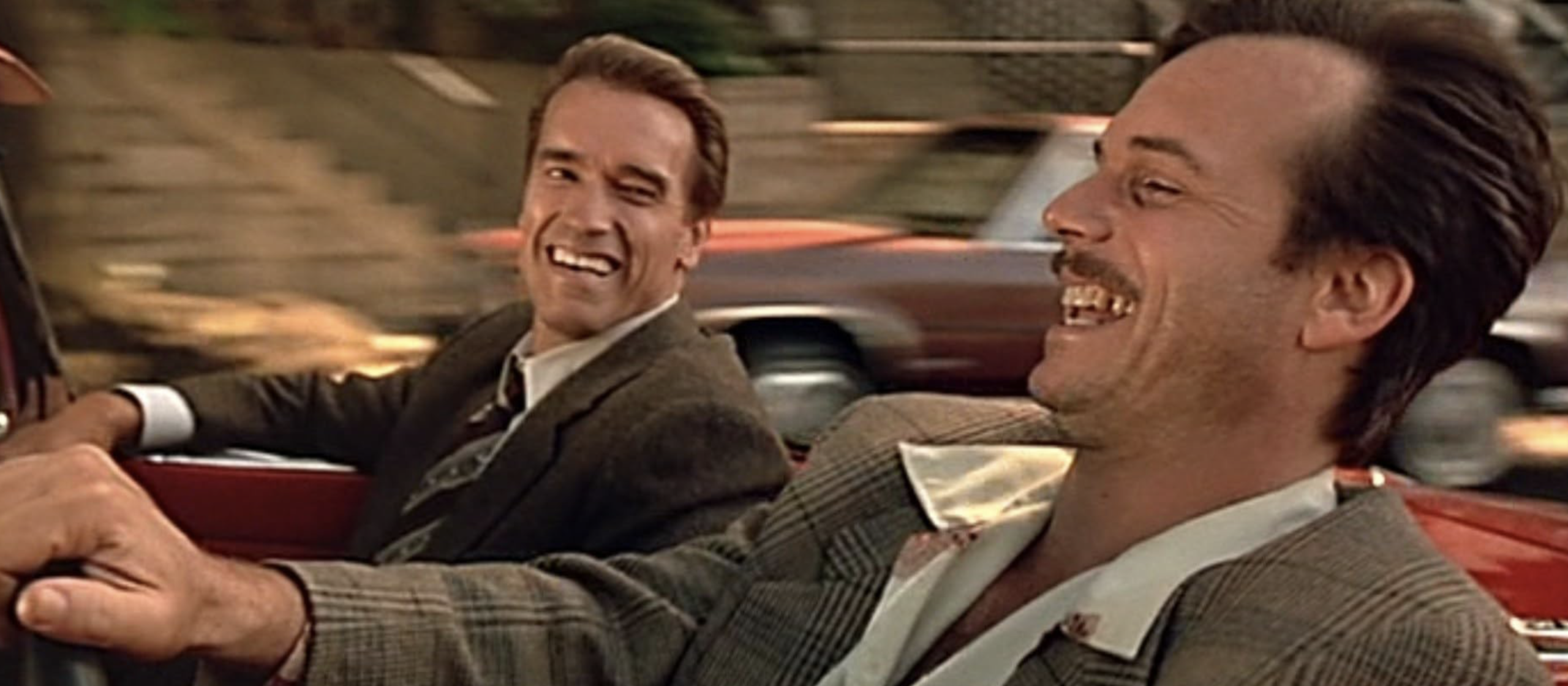
Bride of Chucky is what happens when a horror franchise hits a midlife crisis and decides the solution is black vinyl, ironic needle drops, and giving the killer doll a girlfriend with better comedic timing. It’s loud, trashy, self-aware, and very convinced it’s cooler than it really is—like that guy in high school who quoted Tarantino and wore sunglasses indoors, but somehow as a movie with puppets.
From Child’s Play To Chuck-E-Crackhead
Once upon a time, Child’s Play was about a kid, a cursed doll, and actual suspense. Bride of Chucky looks at that and says, “Cute. What if we did Natural Born Killers, but with molded plastic and glam-rock stitching?” Gone is poor Andy Barclay; in his place, the story now follows Chucky and Tiffany, two sentient collectibles on a cross-country murder honeymoon, dragging a pair of dim, photogenic teens along for the ride.
The tone pivots hard from horror to black-comedy parody, but instead of sharp satire, we mostly get “Wasn’t this other horror movie cool? Here’s a reference to it.” The opening evidence locker—Freddy’s glove, Jason’s mask, etc.—is less clever meta-commentary and more “please like me, I know other movies exist.”
Chucky, ICON™; Everyone Else, Shrug
Brad Dourif’s voice still does the heavy lifting. Chucky himself has personality for days: petty, foul-mouthed, and bizarrely proud of his own mediocrity. He gets the film’s only consistent laughs, purely through sheer force of commitment. When he rants about consumer culture or marriage, you can almost forget you’re watching a film that thinks “doll sex” is a punchline worth building an entire scene around.
Everyone made of flesh fares worse. Nick Stabile’s Jesse and Katherine Heigl’s Jade are theoretically our emotional core, but they have the charisma of two mannequins on layaway. Every time the plot swings back to “Will they survive? Will they prove their love?”, you can feel the movie itself getting impatient. You know you’re in trouble when the dolls have more chemistry than the humans.
Tiffany: Great Idea, Overcooked Execution
Jennifer Tilly as Tiffany—first in human form, then as the goth bride doll—is the one genuinely fresh ingredient. Tilly’s voice is made for deranged rom-com horror, and Tiffany’s whole character—white-trash romantic with a murder hobby and a fondness for bubble baths and murder—is at least conceptually fun.
The problem is the script doesn’t know when to stop. Tiffany is introduced murdering a cop, resurrecting Chucky with voodoo, and keeping Gothic dead boyfriends in her trailer. That’s enough material for an entire movie. Instead, the film immediately shoves her into a doll body and turns her into a punchline-generator who alternates between nagging Chucky and baking cookies. This is the supposed feminist shake-up: the girlboss version of “ball and chain,” but with more kitchen knives.
Voodoo, Now With Less Effort
Speaking of voodoo: remember when it at least vaguely pretended to be a system of rules? Now it’s just a plot teleporter. Need to resurrect a burned doll? Chant a thing, lightning flashes, done. Need Tiffany in doll form? Chant a thing, electrocute her in a bathtub, boom. Need a MacGuffin to justify the road trip? Heart of Damballa, baby—some random amulet Chucky suddenly “forgot to mention” for three films. It’s less mythology, more improv: “Yes, and also magic rock.”
Voodoo here is basically narrative duct tape: ugly, sticky, and slapped on wherever the plot is leaking.
Road Trip To Hackenmurder, New Jersey
Once the dolls hitch a ride with Jesse and Jade, the movie mutates into a low-IQ road movie. The kids think they’re eloping; in reality they’re chauffeuring two homicidal collectibles to a graveyard in Hackensack. Every few miles, someone dies in a way that’s supposed to be creatively grisly but mostly feels like rejected Final Destination concepts.
Uncle Warren gets killed, stuffed into the van, and still nobody notices the smell. A cop gets blown up, a thieving couple gets murdered in a “witty” mirrored-bed gag, and somehow Jesse and Jade’s response to every new corpse is, “Wow, my fiancé is acting weird, but I’m sure that’s fine.” The script relies on them being too dumb to leave, too dumb to call the police, and too dumb to look in the back of their own van. It’s less suspense, more farce—unfortunately without the timing.
Joke, Murder, Joke, Murder, Repeat
Bride of Chucky really wants to be a horror-comedy, but its idea of balance is “insert a kill, then insert a snark, then repeat until credits.” The deaths are ridiculous and cartoonish, which would be fine if the humor supporting them weren’t mostly “Lol, dolls swearing!”
There are occasional good lines—Chucky griping about the 90s, Tiffany complaining about the domestic load—but for every sharp quip, there’s three jokes that play like first-draft ideas no one improved. At a certain point, it starts to feel like you’re watching a 90-minute “edgy” Halloween episode of a sitcom that never got picked up.
The Doll Sex Thing, Because Of Course
We have to talk about the doll sex scene. The movie insists we do. After Tiffany murders a couple in their honeymoon suite with a champagne bottle, she and Chucky get turned on by the carnage and decide to consummate their… plastic?
What could’ve been a very quick, throwaway gag instead becomes an extended sequence with jokes about latex and “Do you have a rubber?” that feels like it was written by a 13-year-old who just discovered both horror movies and Maxim magazine. It’s uncomfortable—not because of prudishness, but because it’s so desperate to shock, and so proud of itself for the idea, that it drags on long past the point of being funny.
The 90s Called, They Want Their Edge Back
Bride of Chucky is soaked in late-90s “attitude”: metal-ish soundtrack blaring over everything, characters who say “cool” and “dude” like it’s mandatory, and a visual style that seems to think blue lighting equals depth. It’s trying so hard to be hip and subversive that it overshoots into “embarrassing time capsule” territory.
The self-referential stuff—characters joking about horror clichés, the franchise winking at itself—might’ve felt fresh once, but here it’s just noise layered on top of noise. Scream did it smarter. Bride of Chucky does it louder.
The Ending, Or: Everyone Shut Up And Die Now
By the time we stagger into the graveyard finale, the film is exhausted and so are we. Chucky digs up his human corpse, grabs the Heart of Damballa, and tries to transfer his and Tiffany’s souls into Jesse and Jade. Tiffany randomly discovers compassion, tries to help the teens, gets stabbed by the doll she still loves, and dies tragically-while-still-being-a-puppet. Jade then unloads a gun into Chucky while he screams about his own indestructible legacy.
The cops finally clear the human couple, who should absolutely be institutionalized for the rest of their lives after this, and the movie throws in one more “shock”: Tiffany giving birth to a horrible doll-baby that leaps at a cop’s throat. It’s less a cliffhanger and more the film saying, “You think this was bad? Just wait until the sequel.”
Verdict: Plastic, Sarcastic, And Mostly Spastic
Bride of Chucky isn’t the worst slasher ever made. It’s brisk, it’s occasionally funny, and the animatronics are impressive enough that you do forget you’re watching rubber for a few seconds at a time. But it’s also a franchise pivot so desperate to be edgy and self-aware that it forgets to be actually clever or scary.
If you love the idea of Chucky as a wisecracking anti-hero and you’re deeply nostalgic for the aesthetic of 1998 mall goth culture, this might play like comfort food. For anyone else, it’s a mildly entertaining but fundamentally hollow plastic road trip: noisy, overconfident, and convinced it’s reinventing itself while it’s really just spinning its tiny doll wheels in a puddle of blood and one-liners.