A Scream Queen in the Shadows
Picture a dimly lit dungeon on a Hammer Films set: an ingenue with blood on her lips lets out a chilling scream as Baron Meinster’s vampire brides close in. In another scene across the ocean, a woman named Buff slaps sense into a wayward nurse in a sordid small-town hospital. These seemingly unconnected nightmares share a common thread – the darkly enchanting presence of Marie Devereux, a British actress whose brief but memorable film career traversed the realms of gothic horror, exploitation shockers, and sultry B-movie melodrama. Devereux’s story is the stuff of cult cinema legend, told in bold splashes of color (and blood). With a wicked grin and a flair for dark humor, let’s journey through the life and films of Marie Devereux – an unsung scream queen who went from 1950s nude pin-up to Hammer horror maiden to Samuel Fuller’s American nightmare, all before bowing out of the limelight. Along the way we’ll meet vampiric brides, man-eating trees, strangler cults, and even hungry piranhas, as we celebrate the gory glory and twisted legacy of this cult cinema icon.
Despite never achieving household-name status, Marie Devereux carved out a unique niche in horror and exploitation history. In the span of roughly a decade, she amassed a résumé that reads like a drive-in movie marathon. Her roles were often brief, but she made an impression – whether writhing in ritual sacrifice, fanging it up as a Transylvanian “bride,” or trading blows in a mental ward. All delivered with a wink and a scream, her performances have aged into cult treasures.

Early Life and Sultry Beginnings
Born as Patricia Sutcliffe on November 27, 1940 in Edmonton, London, the future Marie Devereux had an origin story as provocative as some of her films. In the 1950s, Britain’s post-war pop culture saw a boom in pin-up modeling, and the young Patricia capitalized on it. Under her alluring stage name, Devereux became a popular nude model, gracing magazine pages with an unabashed confidence. She was a favorite subject of famed glamour photographer George Harrison Marks, who captured her beguiling features in her teens. With dark hair, striking eyes and an alluring presence, Marie embodied the very essence of Hammer glamour before ever setting foot on a film set. Modeling notoriety gave her a taste of the spotlight and, more importantly, put her on the radar of filmmakers looking for a fresh face who could exude sex appeal and mystery in equal measure.
At just 17 years old, Devereux made her film debut, proving she wasn’t content to remain a static magazine centrefold. She dove into cinema headlong, quickly finding her niche in the kind of roles that were equal parts sultry and dangerous. By the late 1950s, she was appearing on-screen often as the “sexy girl” – whether in comedies, dramas or, fortuitously, horror films. Unlike many starlets who cut their teeth in respectable theater or innocent ingénue parts, Marie’s early filmography was delightfully pulpy. Her first credits foreshadowed the cult path her career would take. In Womaneater (1958) – a kitschy British shocker about a flesh-eating tree – Marie pops up in a tawdry London dive as a doomed prostitute (yes, a mad scientist actually feeds her to a man-eating plant!). That same year, she danced through Grip of the Strangler (1958) – also known as The Haunted Strangler – starring horror legend Boris Karloff, where she played an uncredited showgirl in a seedy 19th-century nightclub. In one fell swoop, Devereux got to brush shoulders with one of horror’s greatest icons (Karloff) and become plant fertilizer in a schlock classic – not a bad start for a teenager with a taste for the macabre.
These early roles established Marie’s screen persona as a tantalizing beauty in peril. Whether she was the temptressluring men to their doom or the wide-eyed victim of something far worse, audiences took note of the curvy brunette with the knowing smirk. Critics might not have been writing essays about her five-second bits, but those in the cult film circuit were intrigued. Devereux had a presence – a mix of innocence and danger – that fit perfectly into the late-50s exploitation atmosphere. It wasn’t long before bigger opportunities beckoned, and the burgeoning scream queen found herself on the roster of the studio that defined British horror.
Hammer Horror and Vampire Brides
By 1959, Marie Devereux’s trajectory led her to the hallowed halls of Hammer Film Productions, the studio renowned for its lavish gothic horror and melodrama. Under the direction of some distinguished filmmakers, Devereux nabbed roles in three Hammer horror films that would cement her status as a cult figure. Though these roles were not headlining parts, they placed her in iconic horror scenarios that any Fangoria reader would drool over.
Her first Hammer outing was The Stranglers of Bombay (1959), directed by genre master Terence Fisher. This grisly adventure-horror centers on the real-life Thuggee cult in 19th-century India – and Hammer did not skimp on the gruesome details. Devereux appears as Karim, a devoted follower of the goddess Kali, draped in exotic garb and zealotry. In one scene, she fervently assists the cult’s blood-soaked rituals, eyes wide with fanaticism as victims are offered to Kali. For a film from 1959, Stranglers was shockingly violent – eyeball gougings, snake vs. mongoose fights, human sacrifices – all implied if not shown. It had a “mean streak,” as one modern reviewer noted, with an atmosphere of sweaty, sadistic terror. Amid this, Marie’s character lends an eerie feminine touch to the all-male depravity – a beautiful acolyte participating in atrocity. It’s a brief role (blink and you might miss her in the chaos), but indelible: Devereux, decked in ceremonial costume, helps prove that Hammer’s horrors weren’t just inflicted by men, but also abetted by beguiling women. For a young actress who grew up modeling, playing a knife-wielding cultist was probably all in a day’s work – and she did it with zeal.
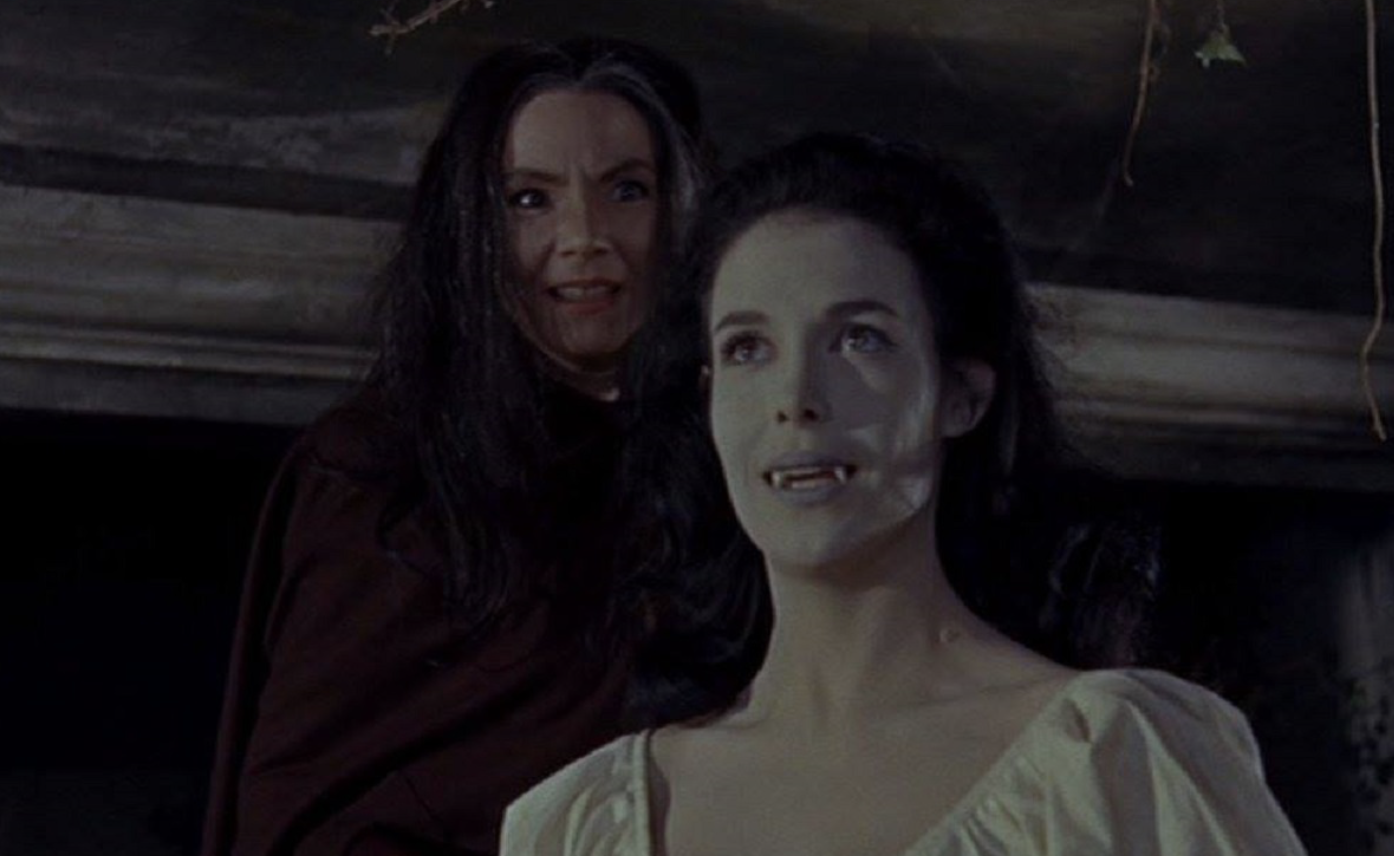
Next, Devereux found herself cast in what would become one of Hammer’s most beloved vampire films: The Brides of Dracula (1960). Now, any Hammer aficionado knows that being a “bride” in a Dracula film is prime scream queen real estate, even if you’re not the top-billed star. The film (directed again by Terence Fisher) is ostensibly about Baron Meinster, a disciple of Dracula, and the heroic Van Helsing (Peter Cushing) who stops him. But ask any fan – it’s the vampire women who steal the show. Marie Devereux appears as one of the village girls caught in the vampire’s clutches – effectively one of Dracula’s would-be “brides.” She’s introduced as a pretty young village maiden, all rosy cheeks and innocence, but that doesn’t last long. Once bitten, Marie’s character transforms into a fanged femme fatale in a flowing white nightgown, stalking through the night in search of prey. In one chilling sequence, her eyes glint with demonic hunger as she closes in on the heroine, only to be thwarted (stake-through-heart style) by Van Helsing at the last second.
Devereux’s stint as a vampire “bride” encapsulates the duality of Hammer’s women – angelic looks with a devilish side. A modern retrospective noted that in Brides of Dracula, female characters were portrayed as “one-dimensional, all-too-typical victims”, with actresses like the “delightful Yvonne Monlaur and Marie Devereux mere fodder for the fangs of Baron Meinster”. Indeed, Marie’s village girl is essentially vamp bait – fodder for the bloodsucker until Van Helsing saves the day. But what glorious fodder she was! In her brief screen time, Devereux exudes both vulnerability and a frightening seductiveness once undead. Horror magazines often champion these unsung “brides” for a reason: they are the spice in the gothic stew. Marie’s image – eyes wild, mouth agape revealing sharp canines – from Brides became one of those stills that pop up in horror magazines for decades (an immortal moment in more ways than one). It’s even preserved in a trailer screenshot, showcasing her uncanny ability to be both gorgeous and terrifying. Not bad for a day’s work in Transylvania.
A scene from Hammer’s The Brides of Dracula (1960) – a mesmerized young woman (one of Dracula’s “brides”) rises from the grave with bloodthirsty intent.
By 1962, Marie Devereux rounded out her Hammer hat-trick with The Pirates of Blood River – a swashbuckling adventure with a streak of horror, directed by John Gilling. Though a pirate movie on the surface, it’s pure Hammer in its violence and moral darkness. Devereux plays Maggie, a character who epitomizes the studio’s love of mixing sex and death. Maggie is a young Huguenot wife in a rigid colonial settlement – and she’s having a steamy affair with the handsome protagonist, Jonathan (Kerwin Matthews). Caught literally with her bodice unlaced (one imagines) by the village elders, the lovers face harsh punishment. Poor Maggie meets a grotesque fate: as she flees from the enraged villagers, she tumbles into the titular river… which happens to be teeming with piranhas. Chomp! Hammer’s lovely Marie Devereux becomes fish food in one of the studio’s most bizarre death scenes. According to one account, Maggie “plunges into the river and gets eaten by those piranha” – the first victim to demonstrate just how the Blood River earned its name. It’s a brief but unforgettable moment: one minute, the curvaceous Devereux is running for her life in a torn dress; the next, the water is frothing red and nothing remains. In true dark-humor fashion, Hammer ensured that even their pirate films had a body count straight out of a horror flick.
Devereux’s roles in these Hammer films were not star turns – she had only a handful of lines, if any – but they were pivotal in establishing her cult status. Fans of Hammer horror in the 1960s would recognize her as part of the studio’s bevy of attractive young actresses (charmingly dubbed “Hammer Glamour”) who added sex appeal and victim-crying chops to the movies. In many ways, Marie was a scream queen in the shadows: never the marquee name, but providing the blood-curdling screams, the sacrificial beauty, or the wicked seductress that a good horror yarn needs. Her work with Terence Fisher and John Gilling placed her in the orbit of horror greats – she shared scenes with Peter Cushing (Van Helsing himself) and even a young Oliver Reed (who appears in Pirates of Blood River). For a model-turned-actress with no formal training, she held her own in these company of horror heavyweights. And with each film, she expanded her range: from cultist to vampire to adulterous prey, proving she could suffer a variety of on-screen deaths with aplomb.
Off-screen, 1960 also saw Marie take a minor detour into lighter fare – a sort of palate cleanser between Hammer horrors. She had bit parts in British comedies like A Weekend with Lulu (1961) and Dentist on the Job (1961), often cast simply as the pretty girl in the room (in Dentist, she’s literally credited as “Brunette,” which tells you enough). But make no mistake, horror was where her heart lay. Even in the crime thriller The Mark (1961), a rare prestigious film she did with director Guy Green, she plays a character named Ellen in a dramatic context – yet it was the lurid, sensational projects that kept calling her name. And Marie answered that call like a true trooper of terror.
By the early 1960s, having survived (on celluloid at least) stranglers, vampires, and carnivorous fish, Marie Devereux’s cult film resume was shining bright. Little did she know, her adventures were about to take an unexpected turn – one that would involve an epic Hollywood production and a partnership with one of America’s most eccentric auteurs. The scream queen of Bray Studios (Hammer’s home base) was headed to Tinseltown, ready to swap her fangs for something even more shocking.
From Hammer to Hollywood: Shock Corridors and Naked Kisses
In a plot twist worthy of a pulp novel, Marie Devereux’s path next crossed with that of Elizabeth Taylor and Cleopatra– and through that, she found her way to Hollywood. In 1962, Hammer lent some of its starlets (and crew) to the gargantuan production of Cleopatra (1963), the notoriously extravagant historical epic starring Elizabeth Taylor. Marie Devereux joined this cinematic circus not in front of the camera, but just out of frame: she served as Liz Taylor’s stand-in during the filming of Cleopatra. Imagine the scene – on the set of one of the most expensive films ever made, amid sphinxes and faux Egyptian splendor, there’s Marie, matching the violet-eyed superstar’s lighting and marks. It must have been surreal for our Hammer horror heroine to suddenly be doubling the most famous actress in the world. Dark humor might suggest that after dealing with fake blood and monsters, wrangling Taylor’s massive costumes and jewelry was the true horror! Jokes aside, this gig was a testament to Devereux’s professionalism and poise. She spent months in Rome’s Cinecittà studios, an observer to Hollywood excess, perhaps dreaming of her own name in lights.
When the Cleopatra production wrapped (or rather, collapsed in Rome, as history records, before moving to finish in London), Devereux seized an opportunity that arose from her time among Hollywood folks. She traveled to Hollywoodin 1963, pivoting from being an anonymous stand-in to acting in front of the camera again – this time in two cult American films directed by the maverick auteur Samuel Fuller. If Hammer was known for its gothic elegance, Sam Fuller’s domain was lurid, hard-boiled shock – and Marie jumped right in.
Fuller cast Devereux in Shock Corridor (1963), a fever-dream thriller about a journalist infiltrating an insane asylum. This film is a delirious mix of social commentary and exploitation; it features famous sequences like a hallucinatory ward of nymphomaniacs attacking the hero. And guess who was among those wild-eyed inmates? Marie Devereux, of course. She’s credited simply as one of the “nymphos” – a role that, while small, is pivotal in delivering the film’s most outrageous jolt. When protagonist Johnny Barrett (Peter Breck) wanders into the women’s ward, he’s swarmed by scantily-clad ladies who proceed to claw and smother him in a frenzied riot. The scene is simultaneously frightening and darkly comic . Fuller reportedly told his actresses to go as unhinged as possible, and one can imagine Marie, with her horror background, relished the chance. She doesn’t have dialogue per se, but she’s front and center in that infamous sequence: hair disheveled, cackling maniacally, helping to pin the hero down as bedlam erupts. In a career full of “victim” parts, Shock Corridor let Devereux briefly be the aggressor – a gleefully crazed one at that. It might not have been Shakespeare, but it became part of cinema legend. Indeed, Shock Corridor is now considered a classic cult film, and Marie’s participation in it gave her a new kind of genre cred beyond Hammer’s cobwebbed castles. If one listens closely during that scene, amid the screams and chaos, perhaps you can pick out Devereux’s distinctive voice giving a shrill, unhinged laugh – her last scream in a horror context, delivered on a different continent entirely.
Fuller was clearly impressed enough to cast Marie again immediately. In The Naked Kiss (1964), she landed a “sizeable supporting role” – a rarity for her – as a character named Buff. The Naked Kiss is another deliciously pulpy melodrama, opening with one of the greatest shock-openings of the 60s: a bald prostitute beating her pimp unconscious with a handbag. The film only gets crazier (touching on themes of redemption and hidden perversion in small-town America), and Devereux’s character Buff is central in the early going. Buff, like the lead character Kelly (Constance Towers), is a former prostitute trying to start anew. The two women work as nurses in a hospital for disabled children – an oddly wholesome detour in an otherwise sordid tale. Marie brings a warmth and earthiness to Buff; she’s the confidante who has also seen the gutter and is striving for a better life. Of course, being a Sam Fuller film, even the good intentions are met with lurid twists – there’s scandal, murder, and taboo subjects that push the envelope. In one memorable scene, Buff and another friend dress up in their old brothel finery to drunkenly celebrate Kelly’s supposed engagement, a moment both funny and a touch tragic. Devereux handles the dark humor expertly, delivering lines with a playful smirk. Later, her character helps Kelly uncover the film’s horrifying secret (involving a pedophiliac philanthropist – truly boundary-pushing content for 1964). Through it all, Marie proves she can do more than just scream and faint; as Buff she is sympathetic, witty, and utterly believable as a woman with a checkered past but a big heart. It’s safe to say Fuller got the best actual acting performance of her career out of her here. The film itself, though not a box-office hit, became a cult favorite – the kind of film directors like Quentin Tarantino or John Waters might geek out about in interviews – and Marie Devereux is right there in the mix, holding her own among a cast of seasoned character actors.
Working with Samuel Fuller was like attending a masterclass in cinematic insanity, and Marie seemed to thrive in it. One could argue these two Fuller films showed what she might have done had she continued acting – perhaps moving into more substantial character roles in edgy dramas. But fate had other plans. By the mid-1960s, Marie Devereux had spent nearly a decade in showbiz, navigated two continents of film production, and survived more on-screen horrors than most could dream of. It was time for a curtain call – one she performed without regret.
The Final Reel: Retirement and Later Life
In 1964, after the release of The Naked Kiss, Marie Devereux made a decision as bold as some of her roles: she retired from acting. At the young age of 24, just as she was gaining momentum in cult cinema, she stepped away entirely. Why would a scream queen hang up her fangs so soon? By her own account (and those of her family), Marie chose love and a normal life over the unpredictable whirlwind of film. She had met an American man (during or after her Fuller film sojourn) and decided to marry and raise a family. It’s almost poetic – the woman who had played prostitutes and vamps seeking redemption found her own happy ending in domestic bliss.
Marie’s exit from the screen was sudden and complete. Unlike some actresses who dip back in for a cameo or do stage work, Devereux disappeared from public life entirely. She moved to the United States, ultimately settling in Meridian, Idaho, of all peaceful places. One imagines her trading London fog and Hollywood lights for the quiet of the American Northwest – possibly the biggest plot twist in her story. There in Idaho, she lived under her married name, largely anonymous save to the most die-hard cult film detectives. For decades, she was essentially a “lost” scream queen, one of those names that pops up in horror magazines’ “Where are they now?” columns with little info to offer. And truth be told, Marie seemed perfectly content with that. She had survived the terrors of cinema, and now she wanted reality – something simpler, even wholesome.
Though out of the spotlight, Marie Devereux wasn’t entirely forgotten. The rise of the VHS and later DVD era brought Hammer horror films and Fuller’s cult classics to new generations. Fans seeing Brides of Dracula or Shock Corridorbegan to ask, “Who was that striking brunette?” Her name would appear in the end credits, sparking the curiosity that keeps cult cinema alive. Occasionally, a fanzine or a horror blogger would dig up a vintage pin-up photo of Marie from her modeling days – causing jaws to drop at the revelation that the demure village girl in Brides had quite a spicy past life. In the 1990s and 2000s, the term “scream queen” was en vogue, usually referring to modern horror starlets, but some savvy horror historians retroactively acknowledged Marie Devereux as a proto-scream queen – one who screamed (and died) with the best of them in the early days of Hammer and exploitation cinema.
In her later years, Devereux kept a low profile. She didn’t do the fan convention circuit or give interviews to cult film magazines, which only added to her mystique. Imagine being a horror fan in the 2010s, realizing that the same woman devoured by piranhas in 1962 was now a septuagenarian grandma in Idaho – it adds a quirky, endearing layer to her legacy. By all accounts from family, she cherished her time in movies but never regretted leaving Hollywood. She’d occasionally correspond with fans or acknowledge the odd Facebook tribute with gratitude, but she largely let her work speak for itself.
On December 30, 2019, Marie Devereux passed away in Meridian, Idaho at the age of 79. Fittingly, news of her death was first shared not in mainstream press but in fan circles – her daughter posted on a Facebook page dedicated to Marie’s career, informing the loyal that “she died in my arms… Thank you to all her fans that after so many years still loved her”. It was a touching coda to a unique journey. The obituary that ran in The Times and elsewhere highlighted her Hammer roles and modeling days, painting the picture of a vibrant young woman who lived many lives before choosing a quiet one.
Legacy in Cult Film History
Marie Devereux’s name may not be instantly recognized by the average moviegoer, but among connoisseurs of horror and cult cinema, her legacy looms large – like a shadow on a castle wall. She occupies a special place as one of the unsung scream queens of the late 1950s/early 1960s, a transitional period between the classic Universal monsters and the later slasher era. In that interlude, it was Hammer Films and the like that kept horror alive, and their films needed both monsters and beautiful women to scream at them. Marie filled that role with gusto. Hammer Glamour aficionados count her among the ranks of the studio’s cult starlets, alongside names like Veronica Carlson, Barbara Shelley, and Ingrid Pitt (though those actresses enjoyed more lead roles). Devereux’s contribution might have been more supporting in nature, but it’s far from trivial – for instance, her turn in Brides of Dracula as a vampire bride is often included in montages and art books celebrating Hammer’s horror queens. Her image from that film – eyes blazing and fangs bared – is literally part of the iconography of Hammer’s horror heyday.
In the realm of cult and exploitation film history, Marie’s work with Samuel Fuller also endears her to a wholly different fanbase: the grindhouse and noir enthusiasts. Shock Corridor and The Naked Kiss are frequently screened at revival theaters and referenced in film school courses; that means Devereux’s performances in them keep getting rediscovered. Film buffs are often tickled to connect the dots: “Wait, the nurse ‘Buff’ in The Naked Kiss is the same woman who was a vampire in Brides of Dracula?!” It’s the kind of crossover trivia that delights cult film fans. It positions Marie as a sort of bridge between British gothic horror and American indie psychodrama, which is a pretty cool distinction. Few actresses can claim they were part of both Hammer’s catalog and Fuller’s filmography – that alone secures her a footnote in cinema history.
Critics and writers have also reassessed the kind of roles Marie Devereux played, viewing them through modern lenses. Take her role in The Stranglers of Bombay: while at face value she’s just an exotic background player, contemporary commentary highlights how even in such small parts, the presence of a woman in a violent cult added a layer of perversity and intrigue to the film. Likewise, in The Naked Kiss, the character of Buff is now appreciated as representing the plight of women trying to break free from exploitation – a theme Fuller was deliberately exploring. Devereux unwittingly became part of a proto-feminist thread in horror/thriller cinema: the women in her films often suffer, but there’s a resilience or impact to their presence. Her characters, however minor, often left an impression of strength or at least a memorable final act (even if that act was turning into a monster). This has earned her a modicum of academic interest in essays about scream queens and horror tropes.
For fans, though, it’s less about scholarly analysis and more about the fun and thrill she brought to the screen. Marie Devereux is remembered with a sort of fond, cheeky reverence. She wasn’t the star, but when she showed up, you knew something entertaining was about to happen – maybe a seduction, maybe a scare, often a grisly demise. In fan polls and forums, you’ll find people citing her piranha death in Pirates of Blood River or her wild-eyed expression in Shock Corridor among their favorite cult film moments. In a way, she achieved what many mainstream stars never did: immortality through cult fandom. The fact that her autograph is a rarity (and indeed, a prized collectible when it pops up) speaks to her semi-mythic status. She’s not overexposed or over-commercialized; she remains a little secret that horror geeks share with a grin.
Marie Devereux’s impact also lives on through the preservation of the era she worked in. The late 50s/early 60s was a golden age of practical effects, colorful set designs, and daring content pushing against censorship. As part of Hammer’s and Fuller’s worlds, Marie contributed to films that inspired generations of horror filmmakers. It’s not a stretch to imagine that filmmakers like Tim Burton, Guillermo del Toro, or Joe Dante – known horror aficionados – watched Hammer films like Brides of Dracula in their youth and were struck by the imagery of the brides (Marie included) rising from their graves. Similarly, the audacious subjects in Fuller’s films paved the way for later exploitation and neo-noir movies. Marie, by extension, is woven into that inspirational fabric.
Marie Devereux may not have splattered as many gallons of blood as some modern horror heroines, but she bled with the best of them on screen. She screamed, she died dramatically (multiple times), and she even got to take a few souls down with her. Her legacy is one of quality over quantity – a short filmography, but every title in it is notable in some cult corner. From being “fodder for the fangs” of Dracula to outliving Cleopatra (well, standing in for her) to sharing the screen with a bald Constance Towers in a psych ward, Marie’s career was nothing if not eclectic. And through it all, she maintained a sense of dark humor and grace about the work she did.
Today, when horror fans discuss the great scream queens of yesteryear, they’d do well to mention Marie Devereux in the roll call. She may have been a “hidden” scream queen, but her contributions are very much felt. As long as there are midnight screenings of Hammer horror, or Criterion collections of Fuller’s pulp masterpieces, Marie’s face and name will keep popping up to entice the curious and delight the devoted. In the grand theater of horror history, she stands quietly in the wings – fangs ready, a mischievous glint in her eye – forever a cult figure awaiting her next close-up in our nightmares.
