
From Clare to Candy: Early Life and Glamour Modeling
She was born Clare Damaris Bastin in 1962, a girl stuck between a star-gazer father and a mother who taught kids how to read without throwing up. The house smelled of old books and chalk dust, the kind of place that makes a kid want to puke. Clare hated it. She wanted out. She wanted fire. She wanted trouble. So she dyed her hair green, laughed at the mirrors, and shoved her innocence out the window like last week’s trash. Barely sixteen, she grabbed a backpack, a few cigarettes, and a musician boyfriend, and took off to London, where the air smelled like beer and cigarettes and dreams you could almost touch.
She became Candy Davis, because the world deserved something sweeter than Clare. She had the face that made strangers stare and men forget their own names. By twenty, she strutted onto the glamour scene, winning the Miss Nude contest like it was a bloody war she meant to win. Page 3 called, and Candy answered – bare skin, a crooked smile, and a wink that said she was in charge now. The girl who once read astronomy books in a dusty bedroom was now parading across the tabloid pages, trading equations for bikinis, homework for headlines, and innocence for the kind of attention that leaves bruises and bad hangovers.

Candy threw herself into the glitzy mess of 1980s glamour modeling like a drunk into last call. She didn’t whisper ambitions; she shouted them, telling anyone who would listen she wanted to be “the world’s most beautiful woman.” Miss World? Sure, why not. The tabloids ate it up, drooling over the tall blonde who smiled like she knew a secret the rest of the country didn’t.
Page 3 became her stage. Big hair, bigger smiles, and a wardrobe that barely counted as clothing—Candy was a walking, talking, headline-grabbing punchline in print. In the early ’80s, Page 3 girls were basically pop culture royalty, and Candy wore the crown like a queen with a hangover. She wasn’t shy, God no. She had cheek, charm, and a little bit of mischief tucked behind those photogenic curves. She wasn’t just a body on a glossy page—she had personality, humor, a glint in her eye that said she knew exactly how ridiculous and wonderful the whole business was. And she was ready to take that act anywhere, into showbiz, onto screens, wherever someone would hand her a microphone, a camera, or hell, even a chair to sit on and stare into the lens.
Blonde Bombshell on Screen: Miss Belfridge and Comic Cameos
After tearing through the glamour circuit like a neon-blond hurricane, Candy Davis didn’t pause to sip a cocktail—she stumbled straight into acting. And what did they give her? The obvious stuff, of course: roles where she could stop traffic, cause a mess, or make grown men forget their own names. Her first bit of on-screen crime was a blink-and-you’ll-miss-it turn as a stripper on a British crime-comedy show called Minder. The role was small, sweaty, and just ridiculous enough to fit her perfectly.
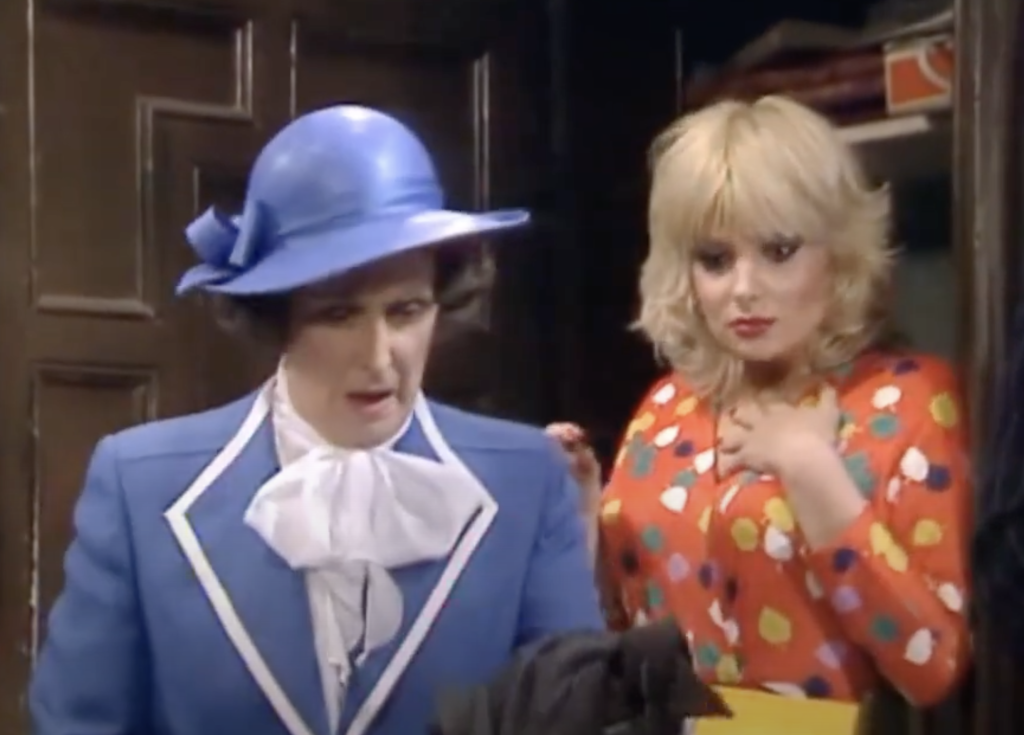
Then came 1983, the year Candy snagged the part that would cement her cult status: Miss Belfridge, a secretary in Are You Being Served?—the sitcom equivalent of a sugar-high punch to the funny bone. The Sun’s Page 3 didn’t prepare the nation for prime-time television, but Candy’s big hair, bigger smile, and barely-there clothing translated seamlessly from the tabloids to the BBC’s sets. She brought the kind of bombshell charm that made audiences squirm in their armchairs and laugh like they’d swallowed a cartoon.
Miss Belfridge wasn’t just a secretary—she was the muse of chaos in Grace Brothers, the fictional department store that was somehow a paradise for men with terrible posture. She flitted around the office, batting eyelashes and dropping innuendo like confetti, while the poor sods she worked for pretended to be productive. The store’s elderly owner always seemed to have a new young woman in his orbit, which meant Candy got to steal the scene almost every time she sashayed in. Letters were typed sometimes, sure, but mostly she was trying on bikinis, tossing smiles at the floor staff, and demonstrating that the real business of Grace Brothers was distraction and delight.
By today’s standards, the show was unapologetically sexist, slapdash, and absurd—like a clown car crashing into a tea shop—but back then, Britain lapped it up. Candy Davis became a household name not just because she looked like a golden promise of trouble, but because she could sell a joke with the same conviction she sold a page-three pose. She lasted only two series, but damn if she didn’t leave an imprint, like lipstick on a coffee cup—bright, sticky, and impossible to ignore.
Candy didn’t stop there. The comedy circuit of the 1980s was a playground for the attractive and the reckless, and Candy hopped onto every ride. She popped up on The Benny Hill Show and The Two Ronnies, shows where the joke was almost always “the hot girl does something dumb” and the audience guffawed like it was Shakespeare. She appeared in a Comic Strip Presents special called Five Go Mad on Mescalin, and even did slapstick with Cannon & Ball, proving she could take the joke and run with it, laughing all the way to the wardrobe department.
She knew the gig—blonde, sexy, a little clueless, but never actually stupid. There was a sly wink in her performances, a “I know you know what I am, and I know you love it” quality. She poked fun at herself, twisted the ridiculousness of her bombshell image into comedy gold. On The Two Ronnies, she even got credited as “Miss Exotica Stormtrooper,” which might sound like a bad acid trip, but Candy owned it. Sexy and silly weren’t opposites in her world—they were the same weapon, aimed straight at the audience’s sense of propriety.
By the mid-’80s, Candy Davis had carved herself a niche that was part glamour icon, part comedic assassin. She strutted across screens with the same audacity she once brought to the page, a woman who understood the joke, lived in it, and made everyone else laugh even as they blinked at her hair, her smile, her eyes that suggested she knew things most people weren’t ready to see. In an industry obsessed with looks and timing, Candy had both in spades—and she wielded them like a bartender with a bottle of cheap whiskey: carelessly, dangerously, but beautifully.

Tabloid Darling and Public Perception
During her 1980s heyday, Candy Davis wasn’t just an actress and model – she was a tabloid staple. The British press, ever ravenous for cheeky headlines and eye-catching photos, found ample fodder in Candy’s story. Here was a woman who could appear topless on Page 3 one day and in a prime-time sitcom the next, all while unabashedly declaring aspirations of beauty pageant glory. The public loved it. Newspapers and gossip columns followed her moves, chronicling everything from her glamorous photo shoots to her television appearances. She had the kind of fame where a nightclub outing or a new hairstyle could prompt a little blurb in the next day’s paper. Candy’s marriage in 1985 to actor Gary Olsen (star of sitcom 2point4 Children) also drew press attention – a real-life coupling of two TV personalities was too good a morsel for the tabloids to resist. (Never mind that the marriage was short-lived, ending in a quick divorce by 1990; the papers had already milked the “blonde bombshell weds sitcom star” angle for all it was worth.)
Candy’s image in the press was that of a carefree glamour girl living the high life, but behind the scenes she was growing restless. By the late ’80s, after Are You Being Served? ended, Candy continued to do some topless modeling and even dabbled in hosting risqué video series (Electric Blue, a softcore video magazine, had her as a guest presenter for outdoor segments). Yet, despite the flashy life that the tabloids loved to showcase, Candy was feeling the wear of being pigeonholed. Rumors swirled in gossip pages about what became of her after she slipped out of the limelight. One particularly odd piece of scuttlebutt even claimed she had taken an academic job at a university – a far-fetched idea given her public persona, and one she later dispelled as false. In reality, Candy Davis was about to embark on a far more unconventional next chapter, one that no tabloid or fan could have predicted. The bombshell was about to disappear, and in her place, a much darker storyteller was waiting to emerge.
Enter Mo Hayder: A Novel Reinvention
Candy Davis quit the lights, the cameras, and the fake applause by the late ’80s, like a drunk walking out of a bar before last call. The little sitcom that made her a household name had vanished from screens, her marriage to Gary Olsen was just another sentence in a tabloid, and the offers to play another bikini-clad punchline had stopped being funny. She was twenty-five, an age when most actresses are polishing their smiles and their résumés, but Candy decided to burn the whole thing down instead. She bought a one-way ticket to Japan in 1987, left Britain behind, and disappeared. One day, she was Miss Belfridge, blonde and lethal in her comic timing; the next, she was gone, swallowed by Tokyo neon and bad sushi.
People wondered what the hell she was doing. Candy herself had a laugh about it later: “I had a mad fantasy that I was going to be a geisha call-girl… Instead I became a gei-no-nai geisha, which means ‘geisha with no talent.’” She had the knack for mocking herself, even when life was grinding her teeth down to the gum line. In truth, Clare—yes, she was probably clawing back her real name—taught English to anyone willing to pay, and worked as a nightclub hostess to keep her head above water. No glitz, no lights, no tabloid photographers—just hard, slow work that left her hands and heart tired at the end of the night.
Japan didn’t turn out like a travel brochure. Life there was raw, violent, and merciless. One friend was murdered. Another raped. Candy herself became a witness to death in ways that would make most people curl up in bed for weeks: a man dropped dead of a heart attack in a café, a construction worker fell like a puppet with a broken string, and a boy was bitten by a snake and gone before anyone could blink. Three deaths, random as dice, and all in her line of sight. It left marks. Deep ones.
The glamour girl who once tossed quips across the department store floor now stared straight at mortality, male violence, and the kind of cruelty no one wants to name. The switch in her head flipped. Life’s curtain pulled back, and there was nothing but shadows behind it. Candy Davis—the bright, shiny, brazen Miss Belfridge—was gone. In her place was someone willing to look into the dark and not blink.
After Japan, the wandering continued. Los Angeles offered film schools and short films; she made a claymation piece so gory it could make grown men vomit. Heads eaten. Blood smeared like ketchup in a cheap diner. By now, the old Candy was just a memory, a press photo in a pile of dusty magazines. She wasn’t chasing beauty or applause anymore. Somewhere in those years, she legally became Dunkel, shedding the last scraps of her former identity, and started to write—writing drawn from nightmares, from death, from the grind of real life.
Candy—or Clare, or Dunkel, or whatever you want to call her—was fusing sweetness with darkness, tabloid blonde with death-streaked horror, into a new life that no one could have predicted. The woman who once charmed Britain with smiles and big hair was now a student of terror, a collector of shadow, quietly turning her own misadventures into stories that would one day make readers slam their books shut and shiver. The limelight was gone, the jokes were gone, and in their place was something far more dangerous: truth.
Dark Imagination Unleashed: Gore, Grit, and a New Voice
Mo Hayder didn’t show up to play nice. Birdman wasn’t a fluke, it was a warning. She had more darkness tucked under her sleeve than most writers keep in a drawer. By 2001, she dropped The Treatment, and suddenly the world realized she wasn’t in the business of polite mysteries or tiptoeing around evil. DI Jack Caffery was back, wading into the kind of horror nobody wants to think about: pedophilia, child abduction, the stuff that turns your stomach and makes your teeth ache. If Birdman nudged readers into discomfort, The Treatment shoved them headfirst into it. The San Francisco Chronicle called it a “disturbing journey into the pedophile mind,” and they weren’t wrong.
Mo didn’t dance around the nastiness. She dragged it into the light, kicked off its mask, and let readers stare at the raw, ugly truth. Critics murmured about ultra-violence and “shock value,” wondering if she was just splattering gore for fun. Mo laughed at them, or maybe she just scowled. She got “cross” at genteel crime writers like P.D. James and Ruth Rendell because, as far as she was concerned, they never showed the blood, the vomit, the chaos of real life. Mo wanted reality in her fiction, even if it made people’s stomachs churn. She wanted her readers to grow up fast, face what most of us avoid, and maybe feel something real for once.
To do it right, she obsessed. Morgues, forensic labs, murder investigations—she dove in, elbows deep, to make sure every detail was correct. She knew which fly laid eggs where, the exact moment flesh went black, and she wore that knowledge like a badge. “I have this kind of compulsive need to wriggle my toes in life’s gutters,” she said once, and it sounded like a promise more than a quip. Mo Hayder didn’t flinch at decay; she kissed it on the mouth. Candy Davis had spent years polishing skin and smile for the cameras. Mo went under the skin, literally and figuratively, peeling back the flesh to see what crawled underneath.
People didn’t always like it. They called it “torture porn” or accused her of going too far. Mo shrugged. If your stomach’s weak, put the book down. “If people don’t like the blood and violence in my books, fine, they can always … maybe read a romance instead,” she said, blunt as a punch to the jaw. Reality, she knew, was worse than anything she could make up. Compared to the crimes she researched, most fiction looked like children’s stories.
And there was a method to the madness. Beneath the guts, the blood, the slow churn of horror, she was illuminating something real: the violence, the fear, the dark corners of society we pretend aren’t there. Tokyo had left its marks, and Mo funneled it all into her fiction—the terror, the trauma, the cruelty men inflicted on women, and the way it rippled through lives. Her books didn’t just tell stories; they showed the aftermath, the mess left behind, and maybe, if you were paying attention, the faint spark of survival too.
Mo Hayder made crime fiction bite, make you spit, make you hurt. She made it human again—ugly, brutal, and impossible to look away from.
From Bestseller to “Edgar” Winner: Thrills, Chills, and Critical Acclaim
Mo Hayder didn’t play by the rules. Her books stirred unease, made the critics squirm, and yet people couldn’t put them down. After Birdman and The Treatment, she ditched DI Jack Caffery for a while, went rogue, and wrote what a lot of folks call her masterpiece. Tokyo—or The Devil of Nanking if you crossed the Atlantic—was a messy, brilliant thing. A thriller wrapped around one of history’s nastiest episodes, the 1937 Nanjing Massacre. Dark? Absolutely. Violent? At times painfully so. Ambitious? You bet. She wasn’t just telling stories; she was shoving the skull beneath the skin in your face and grinning while you squirmed. Mark Billingham called it her masterpiece, and he wasn’t wrong. Death in Mo’s world isn’t a cameo; it’s a constant shadow, a character that doesn’t leave, even when the living wish it would. Critics praised it. Readers bought it. And just like that, Mo cemented herself as one of Britain’s heavy hitters in thrillers.
But she couldn’t stay away from Caffery for long. Pig Island brought him back, tangled him up in cults and cryptic creatures, and then came the “Walking Man” series: Ritual, Skin, Gone, Poppet, Wolf. New characters, new angles, new ghosts in Caffery’s life. Violence, horror, the full stomach-churning menu—still on display, still unapologetic. She wasn’t sanitizing anything. By the time Gone snagged the Edgar Award in 2012, the nod from the ghost of Poe himself, it felt like justice: her horror, alive and kicking, recognized by the master of macabre.
Fifteen years, ten novels, over six and a half million copies sold. Awards, nominations, respect from peers who admitted, often through gritted teeth, that she could twist a reader’s imagination into the kind of alleyways nightmares hide in. Mo had a knack for forcing people to look at the ugly and admit it exists. She became, in a quiet way, a feminist voice in horror—not with banners and speeches, but by showing violence against women, the aftermath, the survival, the grit, all laid bare. Her readers, especially women, often said they found a strange relief in it, like staring danger in the eye and refusing to blink.
Her personal life? Almost entirely underground. Candy Davis had been a bright, glossy thing—models, cameras, lights. Mo Hayder? Shadows, avoidance, letting the work speak. Stage fright kept her from festivals, TV, interviews. Friends said she was shy, polite in turning down invitations, preferring the company of her own imagination over crowds. When she did appear, the model in her past still lingered—a striking woman, elegant, surprising people with the contrast between the face they saw and the darkness she conjured on the page. Some laughed, some stared, some felt the cognitive dissonance like a punch to the gut. And Mo? She loved it. She had always loved it.
She didn’t parade Candy around, didn’t need to. Journalists eventually dug it up, sure, but Mo sidestepped, steered the conversation back to crime, death, forensics, survival. The irony wasn’t lost on anyone paying attention: the girl who posed in swimsuits now dissected humanity’s worst impulses. She stripped away the gloss to find the bone, the rot, the truth. A literary vengeance on her own past, maybe. A mission, absolutely.
Off the page, Mo’s life was full in quieter ways. Two master’s degrees—film in Washington, DC, creative writing at Bath Spa. She became a mother, lived in the countryside, far from the London media grind. Near the end, she married a former police sergeant, Bob Randall, in 2021—perfectly fitting for a woman who spent decades dancing with crime on paper. Mo Hayder had seen both the glamorous and the grotesque, and she’d turned all of it into stories that didn’t flinch, that didn’t apologize, that looked at the darkness and laughed just enough to make you shiver.
Final Chapters: Legacy of a Double Life
December 2020 hit Mo Hayder like a fist to the gut. Motor neurone disease. ALS. Lou Gehrig. A name that sounds calm but eats you alive from the inside. She didn’t have time for slow deterioration; it came fast, merciless. By July 27, 2021, she was gone, 59 years old, her body giving out while her mind still had stories to spit out. People cried, writers bowed their heads, fans cursed the unfairness of it all. “We’re left with her books… ten dark, ruthless novels. Not enough,” someone said. And they were right. Not enough. Never enough.
But even with death whispering in her ear, Mo didn’t stop. She wrote one last manuscript, The Book of Sand, under another mask—Theo Clare. Weird, supernatural, a ghostly twist on her usual carnage. Even as her flesh failed, her brain was still hungry, still clawing at the edges of imagination. Candy Davis, Clare Dunkel, Mo Hayder, Theo Clare… four lives, one soul, never quiet, never done.
Then, 2023 came. The BBC plucked Wolf off the shelf and shoved it onto screens, giving Jack Caffery a new audience. People binged the suspense, unaware that the woman behind it all had once grinned under flashbulbs and flashed a Page 3 smile. Sitcom laughter. Sequins. And now this darkness. Life’s weird that way—funny, ironic, cruel.
Candy and Mo have melted into one legend. Light and dark in the same body. Flashbulbs and gore. Laughter and monsters. Her names told the story if you squinted: Davis to Dunkel, a path from light to literal darkness. Fate winked and she walked it anyway.
In the end, she was chaos and discipline, sparkle and blood, glamour and terror. She lived loud when it suited her, quiet when it suited her. Beauty queen and horror maven. Comedian and grotesque poet. Rebel and writer who won awards. A human kaleidoscope. Life threw its punches, and she threw back words sharper than any fist. And in the end, we were all just lucky to read the aftermath.
