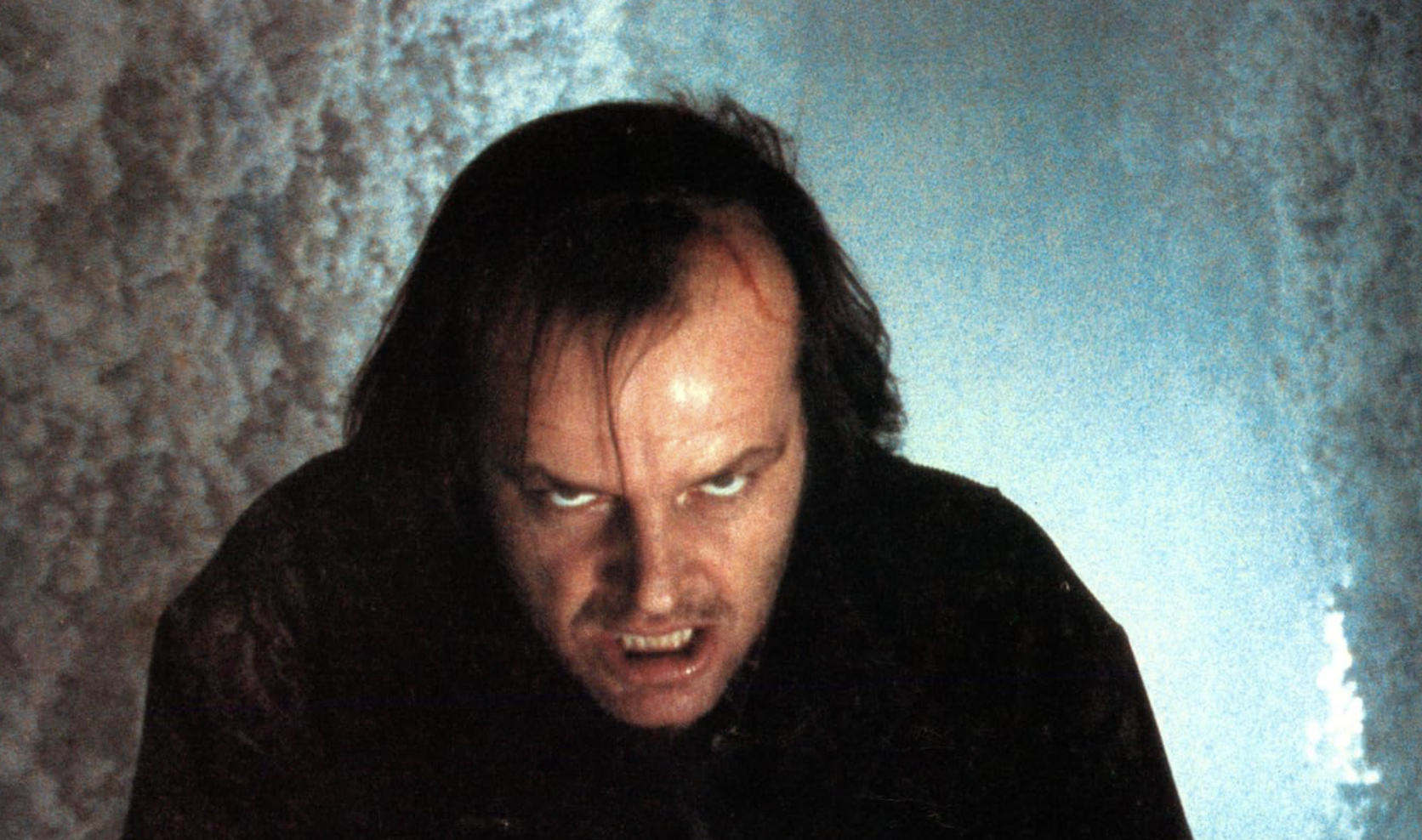
Stanley Kubrick’s The Shining isn’t just a horror movie – it’s a full bottle of nightmare fuel served neat, with a whiskey chaser of artistic genius. From its opening frames, the film declares itself different: expansive aerial shots of a car snaking through Colorado mountains, as if the camera were a disembodied spirit tailing the Torrance family. There’s a poetic menace in those vistas, a sense that something ancient and hungry lies in wait. By the time the family reaches the Overlook Hotel, we already feel the oppressive solitude settling in. Kubrick, ever the meticulous bartender of cinema, mixes atmosphere and imagery with a heavy hand, intoxicating the viewer. It’s the kind of film that can make even a jaded barfly feel a cold finger down the spine.

The Shining pours out a simple premise: a struggling writer, his wife, and their young son move into an isolated hotel for the winter. Jack Torrance (Jack Nicholson) is the writer – and a “recovering alcoholic” to boot– taking on the job of winter caretaker at the Overlook. With him are his wife Wendy (Shelley Duvall), all nerves and earnest optimism, and little Danny (Danny Lloyd), who carries an uncanny psychic gift called “the shining.” The stage is set for a season of solitude. But isolation can play hell with a man’s mind. As snow piles high and contact with the outside world is cut off, the Overlook begins to work its dark charms. Stephen King’s original story was about an evil hotel and a man’s descent into madness; Kubrick takes that and swaps the jump scares for slow-burn dread, like replacing cheap beer with top-shelf bourbon. The result hits harder. Conspiracy theorists have picked apart Kubrick’s film for hidden meanings – there’s even a documentary Room 237 full of wild claims that the film is about everything from Native American genocide to faked moon landings. I’ll raise a glass to Kubrick’s complexity, sure, but I call that reading tea leaves in spilled whiskey. Strip away the crackpot theories and you’re left with a pure, visceral tale of cabin fever, ghosts (perhaps of the mind, perhaps real), and the poisonous allure of violence. And man, does Kubrick make it beautiful to look at.
Haunted Hallways
One of the film’s most mesmerizing recurring images is young Danny pedaling his Big Wheel tricycle through the Overlook’s empty corridors. Kubrick’s camera stalks close behind the boy at floor-level, our perspective shrunk to the child’s eye view of this labyrinthine hotel. It’s an unnervingly smooth glide – Kubrick employed the then-new Steadicamrig for these tracking shots, letting us silently hover and follow Danny as if we’re ghosts ourselves. The effect is claustrophobic and intimate. The sound design makes a morbid game out of Danny’s innocent play: the plastic wheels thump on wood, then whisper on carpet, then thump on wood again, a rhythmic “carpet—wood—carpet”pattern that becomes its own suspense motif. Each turn of a corridor feels momentous. Kubrick toys with us, stretching the tension like a rubber band: surely something awful lurks around the next bend? But often it’s just another long, empty hall. The Overlook reveals itself slowly. Patterns on the carpet swirl, light fixtures hum, and the silence of those endless halls is broken only by the rattling wheel and Danny’s breathing. It’s the art of anticipation – in these moments, nothinghappens, and yet you find yourself gripping your seat, dreading the possibility that hides behind each corner. Kubrick knows, as any seasoned drunk knows about life, that it’s the waiting for the blow that hurts more than the blow itself.
The spell finally breaks when Danny rounds a corner and encounters the Overlook’s most infamous residents: the Grady twins, two little girls in powder-blue dresses holding hands in the corridor. They stand unnaturally still, a matched set of dead-eyed innocence. In any other context they might seem cute – here, they’re an omen that freezes your blood. “Come play with us, Danny,” they coo in unison, voices echoing down the empty hallway. In a flash, Kubrick intercuts a vision of their bodies lying in pools of blood, a fate that befell them at their father’s hands years ago. It’s a jarring, almost subliminal gut-punch of gore in the middle of an otherwise quiet scene. Dark humor seeps in around the edges: what could be more bitterly ironic than the embodiment of childhood innocence beckoning from a corridor painted with slaughter? Danny, mouth agape, knows better than to accept this particular playdate. The twins are a masterstroke of unsettling imagery – a sick joke of symmetry. Two perfectly poised children, as stiff as dolls, framed by Kubrick’s one-point perspective so all the lines of that gaudy hallway carpet lead straight to them. They don’t lunge or snarl like typical horror villains; they just stand there. And somehow that’s worse. In their blank faces is the suggestion that evil can wear the guise of the innocent. The Overlook Hotel is full of ghosts, but none lodge in the mind quite like those twin girls. They are the kind of vision that sticks with you long after the film, popping into your head in the dark corners of your night – the cinematic equivalent of a bar song you can’t shake, only far more morbid.
Spirits and Isolation
While Danny explores the halls and encounters ghosts of the past, Jack Torrance slowly unravels under the weight of solitude and his own demons. Jack is a man one bad day away from a barstool relapse – a former drunk trying to prove he can go sober in seclusion. It’s a losing battle. As the weeks pass with no one around but his family and the long shadows of the Overlook, Jack’s cheerful facade peels off like old varnish. He’s supposed to be writing a novel, but creative inspiration curdles into frustration and rage. In one eerily relatable scene (at least for writers and other crazed souls), Jack sits at his typewriter in the cavernous Colorado Lounge, staring at a blank page, surrounded by silence. You can almost hear the tinnitus of his creative blockage. When Wendy interrupts his “work,” he lashes out with the venom of an addict deprived of a fix. Nicholson’s portrayal hits unnervingly close to the bone – those wild eyes, the wolfish grin that slowly overtakes his face – it’s the look of a man dancing on the razor’s edge of sanity. Kubrick doesn’t jump-scare us here; he lets us witness the death of Jack’s patience. Each day, Jack grows a little more distant, a little less human, as if the Overlook is sucking out his soul drop by drop.
Jack’s descent is marked by one hell of a barroom reunion – only the bar in question might not even exist. Lloyd, the ghostly bartender, appears one evening when Jack is at his lowest. Desperate for a drink, Jack wanders into the hotel’s gold ballroom and finds it suddenly alive with spectral music and clinking glasses. Lloyd (Joe Turkel) stands ready to serve him an imaginary bourbon on the rocks. The dialogue between them is darkly comic, one lost soul talking to another. “Hi, Lloyd. Little slow tonight, isn’t it?” Jack drawls, casual as old buddies. In reality, the bar is dry and empty – Jack is talking to thin air, or perhaps directly to the Overlook’s evil itself. As he tosses back that phantom whiskey, his moral restraints burn away like alcohol fumes. The Overlook is essentially handing Jack the bottle and whispering, “Have another.” It’s seduction in the form of a booze-fueled hallucination. Anyone who’s wrestled with addiction could tell you how persuasive an old habit can be when you’re isolated with your thoughts. This sequence has a grim wit to it: here’s Jack, supposed to be guarding the hotel, and instead he’s literally consuming spirits with a spirit. Kubrick films the scene with a steady, ominous symmetry – the vast ballroom bathed in an eerie golden light – making us question what’s real. By the time Jack’s “medicine” is finished, he’s noticeably changed. There’s a fresh cruelness in his voice when he later confronts Wendy, as if the booze (real or not) unlocked the mean drunk he always had inside. The Overlook Hotel, like the world’s worst dive bar, has served Jack the poison he craved.
Wendy, meanwhile, begins to sense the danger. In a moment that remains the nightmare of anyone who loves a writer, she ventures to read Jack’s manuscript, hoping to gauge his progress. What she finds is a masterpiece of madness: reams of paper covered with a single repeating sentence – “All work and no play makes Jack a dull boy,” typed over and over in twisted configurations. It’s an absurd and chilling sight that delivers a bleak punch of dark humor. (Kubrick, ever the perfectionist, reportedly had that ominous mantra typed out on hundreds of pages – dedication to the bit.) Wendy flips through stack after stack, horrified as it dawns on her that her husband’s cheese has slipped well off its cracker. In Bukowski’s barfly terms, Jack’s finally fallen off the wagon of sanity and is driving headlong down Delirium Avenue. When Jack appears behind her in that scene, quietly asking, “How do you like it?” it’s one of the most skin-crawling moments in the film – not because he yells, but because he doesn’t. He’s eerily calm, as if a switch flipped and he’s decided to embrace the crazy. Wendy’s distraught confusion (played with raw terror by Duvall) only fuels his contempt. Soon after, all hell breaks loose: Jack, now fully in the grip of whatever evil animates the hotel or his own shattered psyche, lunges at Wendy in a murderous rage. It’s the ultimate domestic nightmare – the spouse you trusted suddenly turning into a homicidal stranger. She fends him off with a baseball bat in a messy, desperate scuffle that ends with Jack tumbling down the stairs, knocked cold. For a brief moment, the spell is broken and our breath releases. Wendy, in her panic, locks Jack in the kitchen pantry, buying time. But the Overlook isn’t done with them yet, and neither is Jack’s wrath.
Then there’s Room 237, a scene that makes you question whether the Overlook is a hotel or some sadistic burlesque. Jack, drawn by that gnawing curiosity only a man teetering on the edge can muster, finds himself in a bathroom where a nude woman rises from the tub like some predatory Venus. The scene is pure, uncut Kubrick: slow, deliberate, and coated with a sheen of erotic menace. Jack’s expression is equal parts awe, confusion, and that unmistakable glint of a man who’s about to drink poison but can’t resist the taste. The humor in it is bitter, like sipping scotch from a chipped glass: here’s Jack, already spiraling into madness, now face-to-face with temptation made flesh, and you can almost hear Bukowski muttering from the sidelines, “There’s the hell you wanted, asshole. Go ahead, take it all in.” The bath becomes both a literal and metaphorical trap—Jack succumbs to a hallucination that seduces, lures, and mocks him all at once. Kubrick shoots it with the same clinical precision as the hotel’s endless corridors, and yet it pulses with an almost pornographic absurdity, a grotesque dance of desire and decay. It’s one of those moments where horror and dark humor entwine, and you find yourself laughing and cringing in the same breath, because the Overlook doesn’t just break men—it makes a show of it while they’re being dismantled.
Redrum and Madness
Up in their suite, as a raging snowstorm howls outside, little Danny proves that the line between an innocent child and a conduit of evil can be alarmingly thin. In the dead of night, Wendy awakens to the sound of her son croaking the eerie mantra “Redrum… Redrum… REDRUM,” in a voice not entirely his own. Danny, seemingly in a trance and under the influence of his imaginary friend “Tony,” has found a lipstick and scrawled the word REDRUM in crude, bloody red letters on the bathroom door. It’s murder spelled backward, as Wendy realizes in a shock when she sees the mirror – a brilliant literal reflection of the horror about to erupt. The kid, effectively, delivers a one-word premonition of what’s coming, like a pint-sized prophet of doom. The dark humor isn’t lost here either: what child writes on walls with crayon? Danny writes on doors with lipstick – and not “I ❤️ Mom,” but a death omen. That’s some next-level rebellious phase. Wendy’s face when she pieces it together says it all: sheer, primal terror. No sooner does she grasp the message than Jack comes howling through the halls with an axe, having been supernaturally freed from his locked pantry (the ghost of a past caretaker let him out – the hotel truly has joined the chat). In this moment, The Shining shifts into a higher gear of horror. Jack is beyond reason, a rabid dog in a human mask. He starts chopping through the apartment door where Wendy and Danny have holed up. The splintering “THWACK” of the axe and Jack’s guttural grunts create a perverse rhythm – here is Johnny, and he’s not here to deliver punchlines. Kubrick cranks up the tension masterfully: a terrified Wendy manages to shove Danny out a tiny bathroom window to safety (a rare win for small bathroom windows), but she’s trapped inside, frantically swinging a kitchen knife at the door.
What follows is one of the most iconic and terrifying sequences in cinema, equal parts horror and grim comedy. Jack pokes his head through the jagged hole in the door he’s created and, eyes alight with insanity, serves up that famous line in a singsong voice: “Here’s Johnny!” It’s a bizarre, ad-libbed quip (Nicholson’s twisted idea of a joke, borrowing Ed McMahon’s catchphrase) that somehow makes the moment even scarier. His grinning face – all wild eyes and maniacal glee – framed by cracked wood, is an image you don’t easily forget. It’s monstrous and darkly funny in the most disturbing way. A man who has completely lost his mind still hamming it up like a late-night TV announcer. Wendy certainly isn’t laughing. Her response is to slash at Jack’s intruding hands with her knife, shrieking in absolute terror. And can we blame her? Moments like these show why Shelley Duvall’s performance, once oddly maligned, is now recognized as brutally effective – her fear is so raw you almost want to reach through the screen and pull her to safety. By luck or providence, Wendy buys just enough time with her desperate swings, and a distant noise distracts Jack from delivering the killing blow. (Hallorann, the kindly cook with the psychic shine, has returned to the hotel – his timing is unfortunate for him, but a godsend for Wendy and Danny.) Jack stalks off to intercept this new “guest,” leaving Wendy trembling but alive.
It must be said: Jack Nicholson’s portrayal of Jack Torrance here is one for the ages. He starts the film as a man trying to keep it together, throwing on friendly smiles like ill-fitting jackets, but by the end he’s a pure force of nature – fury incarnate with a wicked grin. Nicholson’s performance has a feral, cartoonish edge that somehow still feels real. The way his face contorts, those “teeth-gritting grins” and the wild-eyed stare of a lunatic on a bender – it’s terrifying because it suggests that Jack was always teetering on this precipice. The hotel just gave him a little push. In the hands of a lesser actor, Jack Torrance could’ve been a flat villain or (worse) an unintentionally comedic figure, but Nicholson turns him into a nightmare that walks and talks. There’s a moment after he’s killed Hallorann (poor Scatman Crothers gets an axe to the chest for his troubles) and is pursuing Danny in the hedge maze outside: Jack is limping, wheezing, covered in snow and snot, wielding that axe with numb hands – he’s grotesque and pitiful and horrifying all at once. That is the genius of Nicholson in this film: you fear Jack, but you also see the pathetic shell of a man he’s become, utterly consumed by rage and the Overlook’s influence. It’s the kind of performance that leaves bite marks on the film. A cynical soul might tip the hat to that – this is a man who has stared into the dark heart of humanity and decided to play it for all it’s worth. The result is equal parts tragedy and terror.
A Flood of Terror
Just when you think The Shining has hit its peak of insanity, Kubrick delivers a final image that slams into you like a hallucination after one drink too many: an elevator door opening to unleash an ocean of blood. This vision has been haunting little Danny’s psyche throughout the film, and in the climax it becomes Wendy’s nightmare as well. In a surreal montage of horrors as Wendy runs through the hotel looking for her son, she rounds a corner and sees it – the Overlook’s lobby bathed in unnatural light, the elevator at the end of the hall trembling before vomiting out a tidal wave of red. The blood comes in a slow-motion cascade, gallons upon gallons, painting the elegant lobby into a slaughterhouse. Chairs and tables are swept aside as the red tide gushes forward, even splashing up onto the ceiling. It’s a scene as visually stunning as it is horrifying, and it lasts only a few seconds, but it sears into your memory. Kubrick’s choice to film it static, almost serene in its framing, makes it all the more ghastly. There’s no frantic camera shake or loud sting of music; instead, a dull, droning sound builds as the blood flows, like the hotel itself humming in dark ecstasy. The moment is shockingly beautiful in a twisted way – the rich crimson against the Overlook’s ornate interior, the symmetry of the composition nearly perfect as chaos erupts. You could call it the Overlook’s soul made visible: all the violence and horror that transpired in its halls over the decades, distilled into one grotesque elevator catastrophe. It’s also a bravura feat of practical effects (hundreds of gallons of fake blood were dumped through that set, reportedly). Dark humor creeps into our reaction here too. Part of you is thinking: Who’s gonna clean up that mess? But another part of you recognizes the poetic justice – the building is bleeding, as if the Overlook can no longer contain the evil within it. Wendy, already on the brink of hysteria from encountering various ghosts in the hotel (including a man in a bear costume in one of the more bizarre WTF flashes), can only stare in mute horror. The blood flood is like the period at the end of a long, gruesome sentence – the final proof that this place is damned and wants them all dead. It’s incredible that Kubrick even got this scene into a trailer back in 1980 (the censors apparently didn’t realize the “waterfall of blood” was actually, well, blood). Even divorced from context, it terrified audiences. In the film, it’s the coup de grâce of the Overlook’s assault on the Torrances, an image so extreme and symbolic that it borders on art installation. And like everything in The Shining, it’s done with an unnerving, icy control. Kubrick makes horror into high art here, without ever losing the primal kick. You watch that river of blood and feel a sick awe – it’s horrific, yes, but you can’t look away.
Closing Time at the Overlook
By the end of The Shining, the Overlook Hotel has claimed its place in our psyche – as alive and unforgettable as any character. The film concludes with Jack frozen in the maze, a wicked snarl still etched on his face, and a final enigmatic photo hinting that Jack’s soul may have been absorbed by the hotel’s eternal party. But the real endnote of The Shining is the feeling it leaves you with. It’s that unnerving cocktail of admiration and dread, the sense that you’ve witnessed something deeply disturbing and darkly beautiful. In the years since its release, the film’s reputation has only grown. Hard to believe critics and even Stephen King himself once had mixed feelings about it, because today The Shining is rightly hailed as a masterpiece of the genre. Its imagery – those forlorn hallways, the ghastly twins, “REDRUM” on the door, Jack’s crazed face in the splintered gap, the geyser of blood – has seeped into pop culture’s very foundation. You see echoes of The Shining everywhere, from Halloween costumes to countless homage scenes in other movies. Why? Because it still works on us, even on the most hard-boiled, seen-it-all cynics. The film has a way of getting under your skin, crawling into that primitive part of your brain that fears being alone, trapped, and at the mercy of someone who has lost their mind. Its horror isn’t just about ghosts or gore; it’s about the slow cracking of the human psyche under pressure. Kubrick achieved a rare thing: a horror film that’s as impeccably crafted as a Swiss watch, yet as gut-level terrifying as a midnight visit from the reaper.
I raise a figurative glass to The Shining. It’s a film that understands monsters can be human, that ghosts of the past can drink you under the table, and that true terror sometimes arrives with a polite smile and outstretched hand (or in the form of twin girls asking you to play). The atmosphere Kubrick conjures is so thick you could pour it over ice; the visuals are so striking they linger like cigarette burn marks on your memory. This is one of those movies that ages like fine whiskey – burning more, not less, as time goes on. It reminds us that great horror, like great literature, can be both brutally unflinching and poetic. The Shining may take place in a luxurious mountain hotel, but it speaks to the most guttural, common fears: isolation, madness, violence, the breakdown of family. The Shining endures because it doesn’t just go for the jugular – it goes for the mind. It is the rare horror film that can flay your nerves and linger in your subconscious for decades. In the grand tapestry of cinema, The Shining stands out like a dark, stained patch that refuses to wash out. It’s a hell of a film – bleak, beautiful, and savagely effective – and it will unnerve even the most jaded of souls long after the credits roll, like the last call that leaves you with more questions (and goosebumps) than answers.
