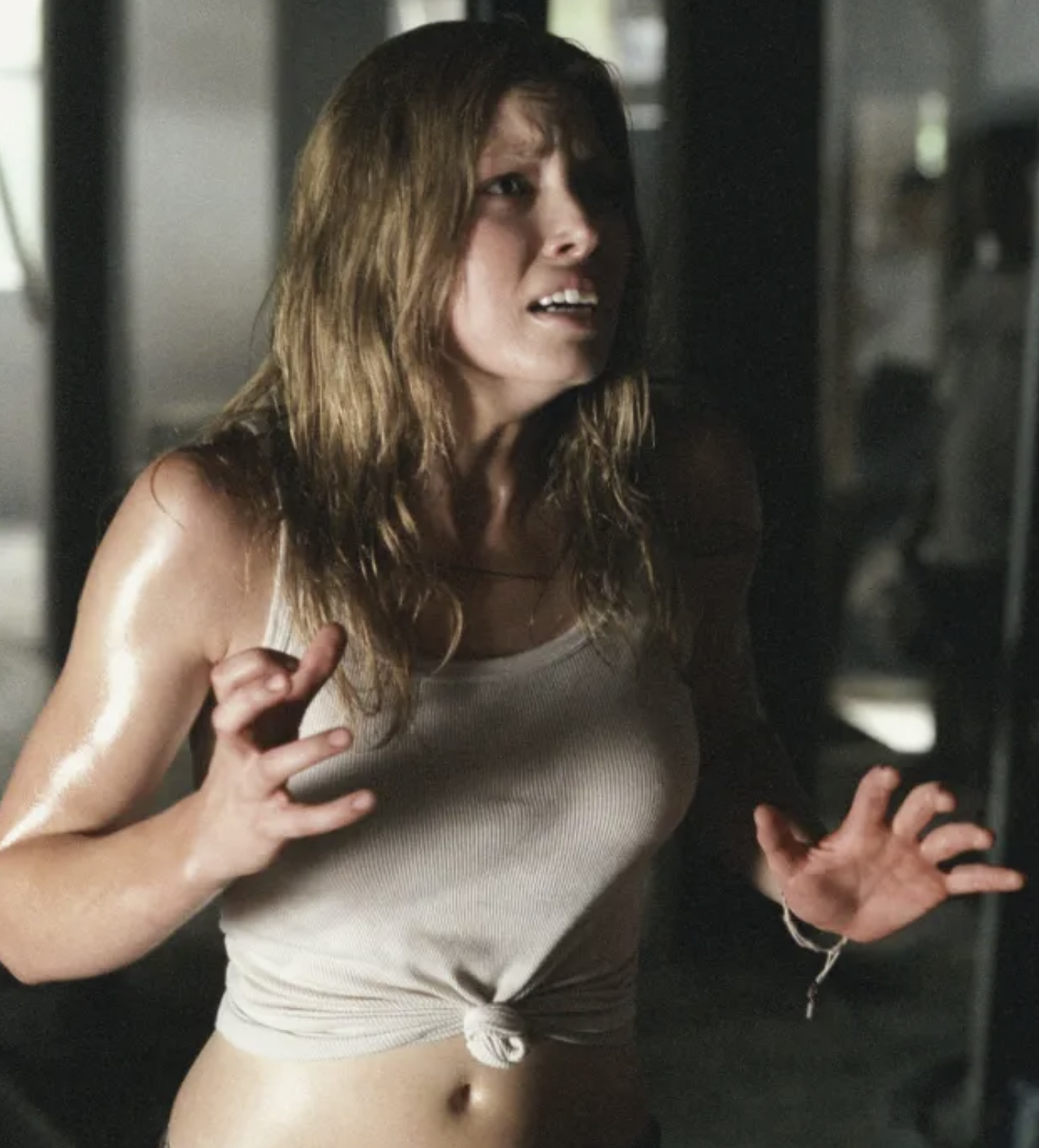
A Love Triangle with One Too Many Heartbeats
Some horror films give us ghosts that rattle chains, some give us demons that hiss Latin incantations, and then there’s Nina Forever — a film that gives us a dead girlfriend who won’t stop making fun of your new one during sex. It’s a bold choice, and one that immediately separates this twisted gem from the endless parade of jump-scare mediocrity clogging the genre. Written and directed by British brothers Ben and Chris Blaine, Nina Forever is a pitch-black romantic comedy that dares to ask: what if love really did last forever — to the point of awkwardly interrupting every orgasm?
At its core, this is not just a horror movie. It’s a meditation on grief, intimacy, and the mess we make when we try to move on from tragedy. But it’s also funny. Uncomfortably, hilariously funny. The kind of humor that makes you question your moral compass as you laugh at a blood-soaked ghost sniping from the bedsheets.
The Resurrection of Emotional Baggage
Rob (Cian Barry) is a young man whose girlfriend Nina (Fiona O’Shaughnessy) died in a car crash. In the wake of her death, Rob attempts suicide — unsuccessfully — and spends his days drifting through a cloud of quiet misery, working at a supermarket where the produce section seems livelier than he is. Enter Holly (Abigail Hardingham), a coworker who finds his sadness oddly magnetic, like a moth drawn to a candle that smells faintly of despair.
Their romance is slow, sweet, and very British — until it’s not. The first time they have sex, the mood is shattered when Nina literally claws her way out of the bedsheets, bloodied and sardonic, offering biting commentary on the proceedings like the ghost of girlfriends past.
This isn’t the usual spectral haunting. Nina isn’t there to scare anyone. She’s there to linger — in the bedroom, in Rob’s memories, and in Holly’s growing sense that she’s competing with a corpse who refuses to be forgotten. It’s the ultimate metaphor for emotional baggage, except this baggage drips blood on your carpet and mocks your pillow talk.
Fiona O’Shaughnessy: The Queen of Posthumous Sass
Let’s get one thing straight — Fiona O’Shaughnessy steals this movie like a ghost with sticky fingers. Her Nina is equal parts tragic and terrifying, a woman who can’t move on because she’s as stubborn in death as she was in life. But rather than play her as a wailing banshee, O’Shaughnessy infuses her with bitter wit and biting intelligence. She’s the ex who knows exactly how to ruin a date — except now she doesn’t need a text message; she can just materialize mid-coitus.
There’s an undeniable power in Nina’s presence. She’s not some slasher villain or vengeful spirit out for revenge. She’s heartbreak incarnate — the part of your soul that won’t shut up when you’re trying to fall in love again. O’Shaughnessy plays her with a razor-sharp smirk, and it’s that smirk that keeps Nina Forever from descending into melodrama.
Love, Sex, and the Supernatural: A Bloody Good Time
The Blaine brothers take a premise that sounds like a bad indie punchline and turn it into something surprisingly profound. The film’s tone is a delicate high-wire act — balancing eroticism, absurdity, and genuine emotional pain without ever losing its sense of humor. It’s a love story soaked in blood, but never in self-pity.
The sex scenes are darkly comedic masterpieces — intimate, awkward, and punctuated by the casual reappearance of a dead woman cracking jokes from the foot of the bed. It’s not erotic in the traditional sense, but it is honest. Love after loss is messy, and the Blaines literalize that mess with gallons of fake blood and uncomfortable truths.
Grief: The Real Monster
For all its absurdity, Nina Forever treats grief with refreshing sincerity. Rob’s pain is palpable, not because he cries into mirrors or screams at the sky, but because he keeps trying to rebuild himself from the ruins. Holly’s fascination with him is equally human — she wants to fix him, maybe even redeem him, but soon discovers that sharing a bed with trauma means you’re never really alone.
Nina’s haunting isn’t just supernatural punishment; it’s a manifestation of the guilt and memory that refuse to die. Every time she appears, she’s a reminder that grief isn’t something you “get over.” You just learn to live with the ghost.
Abigail Hardingham: The Living’s Revenge
Abigail Hardingham’s Holly is the audience’s entry point into this bizarre love triangle, and she handles it beautifully. She begins as a bright, curious woman intrigued by the wounded poet archetype of Rob, only to discover she’s entered a relationship that comes with its own undead third wheel. Her transformation from timid admirer to determined partner is both compelling and darkly hilarious.
Hardingham’s chemistry with both Barry and O’Shaughnessy creates an uneasy triangle that pulses with tension and bitter humor. When Holly finally faces Nina directly, it’s less a showdown and more an emotional exorcism — two women fighting for control over one man’s heart, with neither willing to admit that he might not be worth the trouble.
Bleak, Beautiful, and Weirdly Romantic
Visually, Nina Forever is stunning in its own grisly way. The Blaine brothers shoot with the precision of undertakers who really care about presentation. Every frame feels damp, claustrophobic, and strangely intimate. The color palette — all bruised blues and deep reds — mirrors the emotional decay at the heart of the story.
The gore, while frequent, is never gratuitous. It’s not about shock value but texture — the physical embodiment of grief’s persistence. Blood becomes the connective tissue between love and loss, desire and death. And somehow, amid all the dripping viscera and sardonic ghost banter, the movie finds moments of fragile beauty.
The Humor of the Horrible
What truly elevates Nina Forever is its gallows humor. The dialogue crackles with dry wit, and the film embraces the absurdity of its premise without ever winking at the audience. It knows it’s ridiculous — that’s the point. Life after loss isridiculous. We’re all haunted by our pasts; it’s just that most of us don’t have to share a bed with ours.
At times, the humor veers into the painfully uncomfortable, but that’s where it shines. When a movie can make you laugh at something you’d normally cry about, it’s doing something right. Nina Forever is that rare horror comedy that’s as psychologically insightful as it is gleefully inappropriate.
Death Becomes Her (and Him, and Everyone Else)
In the end, Nina Forever isn’t about ghosts or gore. It’s about learning to coexist with pain — to accept that love leaves scars, some of which refuse to heal. It’s a horror movie for anyone who’s ever tried to move on and found themselves haunted by memory, guilt, or a particularly vindictive ex.
The film’s closing moments manage to be both tragic and hopeful — suggesting that while the past never truly leaves us, it doesn’t have to define us either. Sometimes letting go isn’t about forgetting the dead; it’s about forgiving yourself for surviving.
Conclusion: Love Hurts (and Bleeds, and Moans from the Wardrobe)
Nina Forever is a darkly funny, deeply affecting meditation on romance, regret, and resurrection. It’s part ghost story, part relationship autopsy, and part black comedy so audacious you can’t help but admire its nerve.
Ben and Chris Blaine have crafted something truly special — a film that proves love doesn’t die; it just sticks around to critique your life choices. With strong performances, macabre humor, and an emotional honesty rare in the genre, Nina Forever earns its place as one of the most original British horror comedies in years.
Final Verdict: 4.5 out of 5 resurrected exes — because sometimes, “till death do us part” just isn’t enough of a commitment.