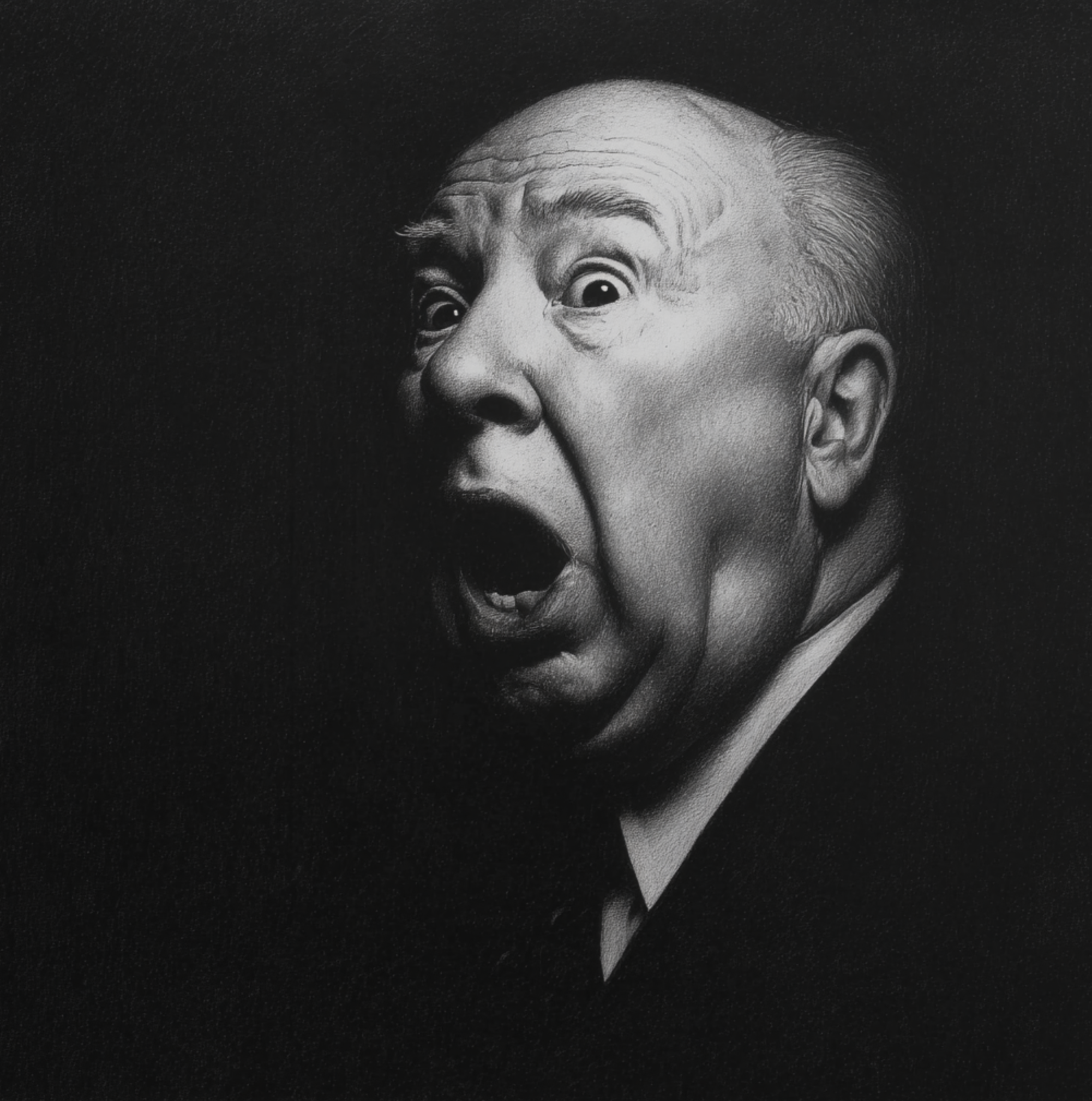
When people talk about Hitchcock, they talk like he was God with a camera — the fat man of fear, the “Master of Suspense,” the priest of the perfectly timed scream. They go on about the angles, the shadows, the genius of it all. But they never talk about the smell of the room when the doors closed. They never talk about the women — the blondes, the saints, the sacrifices.
Behind the smoke and celluloid, there was a man pulling strings like a bored child tearing wings off flies. The studios called it “direction.” The actresses called it work. But what it really was — what it’s always been — was power, the dirty kind that hides behind art and gets away with everything because people like to call monsters “visionaries.”
So this isn’t a story about suspense. It’s about control. It’s about the hands that held the camera and the women who paid the price for the shot. It’s about what happens when Hollywood crowns a man king and never checks what’s buried under the throne.
1. The Myth vs. the Man
Hitchcock’s reputation is complicated. On one hand, he directed classics like Vertigo, Rear Window, and The Birds, maintaining a meticulous eye and a certain charm in public. On the other hand, increasing evidence reveals a director deeply invested in controlling his female stars, sometimes through manipulative, exploitative, or abusive practices.
Hitchcock himself acknowledged how he viewed actors. He famously said: “I don’t hate actors, but I prefer directing them. They come on the day, they do it—and leave.” This quote hints at one of the central issues: in Hitchcock’s vision, actresses were more objects of his manipulation than creative collaborators.
2. Power, Control, and the Female Actor
2.1 Treating actresses as “blond props”
Laurence Leamer’s book Hitchcock’s Blondes: The Unforgettable Women Behind the Legendary Director’s Dark Obsession argues that Hitchcock treated the women he cast as part of his visual scheme—often blond, idealised, rigidly controlled. One article states: “For the famed auteur, women … were props to be controlled and molded with the sole purpose of realising his vision.”
2.2 Psychological manipulation & professional control
Beyond the aesthetic control, Hitchcock also notoriously practiced professional leverage and psychological pressure. For example, in his treatment of actors such as Joan Fontaine and Kim Novak, there exist accounts of him being dismissive, withholding support, or manipulating their roles and appearances in ways many consider abusive.
Despite this, Hitchcock remained untouchable for decades. When questions arose about his behaviour, some defended him as a harsh but necessary artist. Others cited that these allegations had not been legally proven.
3. The Tippi Hedren Case: From Star to Survivor
Perhaps the most widely documented account of Hitchcock’s abusive behaviour comes from actress Tippi Hedren, star of The Birds (1963) and Marnie (1964). Her published memoirs and remarks have opened up public discussion of Hitchcock’s conduct.
3.1 The story
Hedren reports that Hitchcock became infatuated with her soon after casting her as Melanie Daniels in The Birds. She recounts that he placed her in situations where she was isolated, supervised, and essentially treated as his possession rather than a creative partner.
Key incidents she describes:
-
He guided her personal life, telling her whom to see, what to eat, and how to live. He assigned staff to monitor her.
-
On one occasion, during the filming of The Birds, he substituted live birds for mechanical ones without warning, subjecting Hedren to repeated terrifying takes until her reaction satisfied him. She believes the misuse of live birds—one of which injured her—was at least partially retaliatory.
-
On Marnie, she says Hitchcock’s obsession escalated. He reportedly made explicit sexual propositions: “from this time on, I expected you to make yourself sexually available and accessible to me — however and whenever and wherever I wanted.”
-
After she refused his advances, he reportedly blacklisted her, kept her under contract doing nothing, and claimed he would ruin her career. She says this effectively ended her major film opportunities.
3.2 Impact and legacy
Hedren later stated: “He ruined my career, but he didn’t ruin my life.” Still, her experiences illustrate how power imbalances—contractual, financial, reputational—enabled Hitchcock to exert abusive control.
Her account forced the film world to reconsider Hitchcock’s mythic reputation. While some colleagues, such as Kim Novak, disputed the severity or version of events, Hedren’s story became a key example in discussions of abuse in Hollywood.
4. A Broader Pattern of Treatment
4.1 On-set cruelty and psychological games
Hitchcock’s behaviour wasn’t limited to one actress. For example, during the production of Strangers on a Train (1951), actress Ruth Roman was reportedly forced to wear thick eyeglasses that severely impaired her vision, solely to serve Hitchcock’s visual agenda. Another actor, John Granger, recalled Hitchcock “had to have one person in each film he could harass.”
Hitchcock’s method of controlling the women in his films often involved isolating them from other actors, forbidding conversations or friendships, controlling wardrobe and hair, and demanding perfection through repeated, emotionally draining takes. Scholars have described this as psychological abuse, enabled by his fame and the studio contract system.
4.2 Sexism, objectification, and auteurism
Critics of Hitchcock note that many of his films revolve around vulnerable or prey-like blonde women in peril. While these films are celebrated for their suspense, they also reflect problematic visions of femininity and power. Indeed, critics argue that Hitchcock’s off-camera treatment of his actresses parallels the onscreen victimisation. Carlyn McAvoy writes that Hitchcock’s women were often seen as idealised objects to be viewed, manipulated, and destroyed on screen—and sometimes in real life.
In an age now increasingly alert to sexual harassment and abuse in entertainment, Hitchcock’s behaviour is revisited less as myth and more as documented pattern, albeit with the complexity that arises in evaluating figures from a different era.
5. Why This Matters
5.1 The power game
Back then, the movie set was a kingdom, and Hitchcock was the fat little god sitting on top of it, barking orders through a megaphone. The studios kissed his ring. The actors signed their souls away on contracts written in invisible ink and blood. You did what the man said or you disappeared. Nobody wanted to end up broke, or worse—forgotten. So they smiled through the fear, through the takes, through the madness. That’s how it worked. You called it “direction.” They called it “the business.” What it really was—was a long con wrapped in celluloid.
5.2 The myth of the genius
They called him an auteur, which is French for “gets away with murder.” The critics ate it up. The man could torment a woman for twelve weeks straight, and the papers would call it “commitment to the craft.” They said he was a visionary. Maybe he was. But even visionaries need a target, and his were always blonde, fragile, and terrified. The myth was simple: if you’re brilliant enough, they’ll forgive anything. Throw a tantrum, ruin lives, crawl into your starlet’s nightmares—it’s all part of the show. People love a madman with a camera, as long as he delivers a hit.
5.3 When the lights finally came on
Years later, the curtain slipped. The #MeToo wave rolled in like a long-overdue hangover, and suddenly everyone pretended to be shocked—shocked!—that the dream factory ran on exploitation and silence. Tippi Hedren had been shouting it decades ago, but no one wanted to hear a woman screaming off-screen. Now the world listens, sometimes. But the ghosts are still there, rattling around the rafters of old soundstages. The truth is, it didn’t start with Hitchcock, and it sure as hell didn’t end with him. Power’s a disease, and Hollywood’s been patient zero since the first roll of film spun.
6. The Complexity, the Legacy, the Ambiguity
It’s important to maintain nuance. Hitchcock was undeniably a master filmmaker whose works remain cinematic landmarks. Some women who worked with him—such as Ingrid Bergman in Notorious (1946)—described him as “a gentleman.” So why did his behaviour differ so dramatically depending on the actress and era?
Some scholars argue that Hitchcock’s fascination with a certain blonde aesthetic, his mid-career insecurity after massive successes, and his studio contract obligations all conspired to create environments where personal obsession blended with professional control. Others propose that the very style he sought—an immaculate, controlled, stylised chaos—mirrored the psychological control he exercised over his sets.
Whatever the explanation, the behaviours recounted by Hedren and other women cannot simply be excused as “the way things were.” That argument fails contemporary ethical scrutiny and ignores the personal harm inflicted.
7. A Fat Ass Bully
Hitchcock left behind a stack of films that still crawl under your skin like ants with knives — Psycho, Vertigo, all that elegant madness dressed up in black-and-white and fear. The critics call it genius. The crowds call it art. But the women who stood in front of his camera, they called it something else — a trap, a job, a slow suffocation.
He built a kingdom out of panic and blondes. And when the lights went down, he played god — the kind that didn’t believe in mercy. You can see it in the way he frames a woman: cold, beautiful, cornered. You can almost hear him breathing behind the lens. Tippi Hedren talked about the price of his obsession — how she said no to the man and he buried her career like a dog hides its bone. Hollywood shrugged. “That’s genius,” they said. “That’s art.”
But there’s always a cost for brilliance, and it’s usually paid in someone else’s blood. You can still watch Psycho or Vertigo. But watch them with the lights on. See the fingerprints on the celluloid. Feel the bruises in the frame. Those screams didn’t just come from the script.
In the end, Hitch taught us something ugly: talent can be a weapon, and people will forgive almost anything if it looks good in the dark. The man turned cruelty into craft and called it cinema. And maybe that’s the real horror — not the knife in the shower, but the smile behind the camera.


