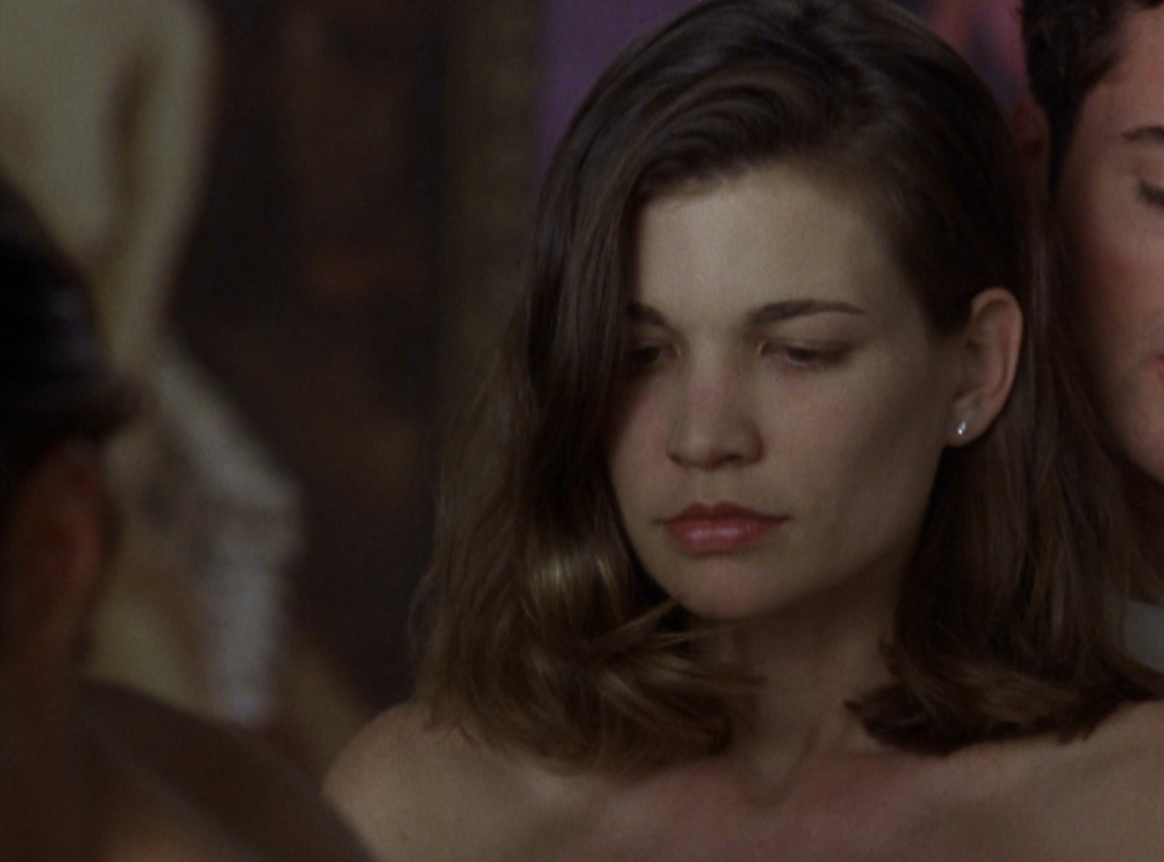
Adrienne Marie “Audie” England was born in Los Angeles in 1967, into a city that trains people early to understand how images work. LA teaches you where to stand, how to turn your face toward light, how to become an idea before you become a person. England didn’t just absorb that knowledge—she studied it. She went to UCLA and focused on cinematography, learning how stories are shaped from behind the camera, how framing can seduce, distort, or protect. That detail matters. She didn’t walk into acting blind. She knew how the machine functioned.
That awareness would become both her leverage and her burden.
When she was twenty-six, Zalman King saw her. That kind of seeing isn’t casual. King specialized in a particular gaze—erotic, literary, soft-focus intimacy marketed as sophistication. He cast England in Delta of Venus, his film adaptation of Anaïs Nin’s erotic stories. The material was explicit, yes, but also aspirational in its own way, sold as sensual rather than exploitative. England stepped into it knowing exactly what kind of lens was pointed at her.
For many actresses, that would have been the beginning and the end. For England, it was an entry point she refused to pretend was something else.
She became a recurring presence in King’s world, appearing in Red Shoe Diaries, a franchise built on whispered fantasies and carefully lit skin. The roles were designed to be archetypal rather than dimensional—woman as catalyst, woman as mystery, woman as invitation. England played them with composure, never embarrassed, never coy. She understood the assignment and executed it cleanly.
But there’s a tax attached to being associated with erotic imagery, especially in American culture. You’re visible but not taken seriously. Desired but not trusted. England paid that tax quietly.
Long before Delta of Venus, she had already appeared in one of the most iconic images of 1980s pop culture: the music video for Don Henley’s “The Boys of Summer.” That video, all sun-bleached melancholy and unresolved longing, won Video of the Year at the MTV Video Music Awards. England’s presence in it was brief but indelible. She wasn’t the center of the story; she was the memory that haunted it. That’s the role she played best—something felt more than explained.
She didn’t chase mainstream stardom. Instead, she took roles that hovered at the edges of cult culture. Fourteen films in total. Guest appearances on television. Work that paid, work that kept her present, work that didn’t pretend to redefine cinema. The role she became best known for outside the Zalman King orbit was Claire in Free Enterprise, a film steeped in nerd culture, pop obsession, and romantic disillusionment. It was a different register—less stylized, more conversational. England fit into it easily, proving she wasn’t limited by the erotic label that followed her.
Still, Hollywood loves boxes. Once you’re placed in one, it expects you to decorate it, not escape it.
In 1998, People magazine named her one of its “Most Beautiful Stars.” These lists always arrive with a strange aftertaste. They confirm visibility while flattening complexity. Beauty becomes the headline. Everything else becomes footnotes. England accepted it without turning it into a personality trait. She had already learned how fleeting that kind of attention is.
What makes Audie England’s story different is what happened alongside—and eventually after—the acting.
She was never just in front of the camera. She was learning how to control it.
Photography became her second language, then her primary one. The same instincts that made her compelling onscreen—stillness, awareness, comfort with vulnerability—translated into her work behind the lens. But now she was the one deciding where to stand, when to click, what story an image told. The power dynamic shifted. The gaze belonged to her.
That shift matters in a career like hers. Too many actresses associated with erotic work are trapped by it, unable to redirect the narrative without public penance or reinvention theater. England didn’t disavow her past. She didn’t apologize for it. She simply expanded beyond it.
Her education in cinematography wasn’t a trivia detail—it was a blueprint. She understood how images are constructed, how they seduce, how they lie. She had lived inside those lies long enough to recognize their mechanics. As a photographer, she reclaimed authorship.
Audie England’s acting career doesn’t read like a rise-and-fall arc. It reads like a sidestep. She participated in a specific moment of 1990s erotic cinema, left her imprint, and then refused to linger in nostalgia. She didn’t trade on scandal. She didn’t disappear either. She transitioned.
That kind of move confuses people who prefer clean narratives. We like our actresses either triumphant or tragic. England chose neither. She chose autonomy.
There’s also something quietly subversive about her presence in the Zalman King universe that often gets overlooked. Those films and series were marketed to male fantasy, but they were also written, adapted, and performed by women who understood desire as interior, not just visual. England’s performances never felt empty. They felt self-aware. That self-awareness is dangerous to systems that rely on illusion.
She was never reckless with her image. She was deliberate.
Hollywood didn’t know what to do with deliberation disguised as sensuality. It prefers innocence or ambition, not clarity. England had clarity early. That’s why she didn’t stay trapped in the industry’s idea of her.
Today, she exists less as a celebrity and more as an example. An actress who entered through a narrow door, walked the hallway without panic, and then opened another exit when the air got stale. A woman who understood that being seen is not the same thing as being known—and that controlling the frame is the only way to survive both.
Audie England didn’t reject the camera.
She learned how to look back at it without flinching—and then how to turn it in her own hands.
That’s not a comeback story.
That’s ownership.
