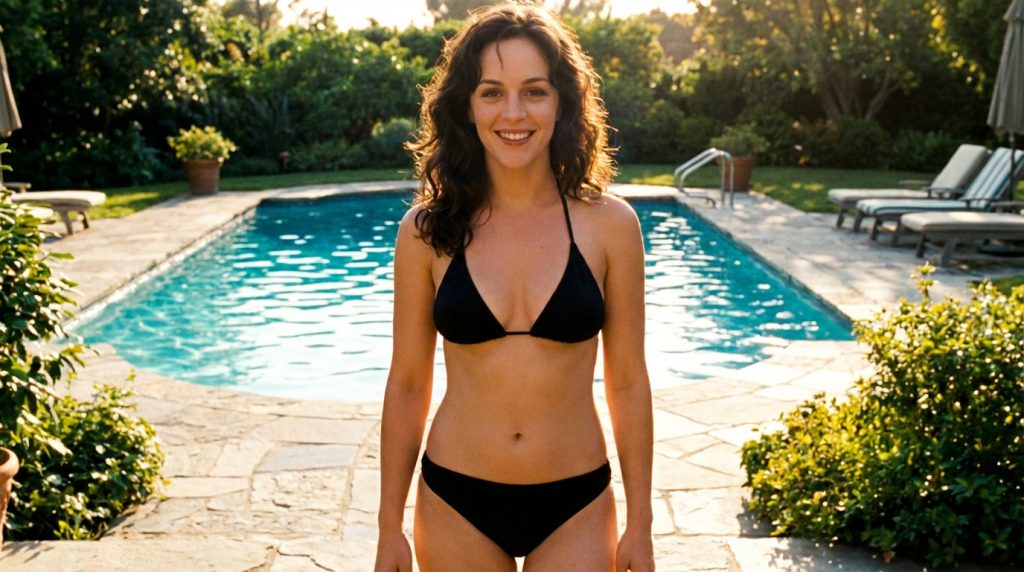
 From ballet prodigy to marathon-dancing survivor to the wife who wouldn’t stay in the background — a quietly ferocious actress whose career was built on grit rather than glamour.
Bonnie Bedelia has always been the kind of performer who slips into a story instead of stepping on top of it. She didn’t need a fuss, didn’t need a spotlight dragged across the floor just to find her; she simply showed up and worked, the way a person does when she’s lived through a childhood that taught her nothing comes easy. Born Bonnie Bedelia Culkin on March 25, 1948, in New York City, she entered the world at a moment when her family’s finances were collapsing and the walls around her childhood were as drafty as the old cold-water flat they lived in. Her father’s business had just gone bankrupt. Her mother was holding together the scraps of a creative, chaotic household. And Bonnie — quiet, observant, wiry with ambition she wouldn’t name yet — was already learning how to survive.
Her mother died when Bonnie was just fourteen, leaving the teenager with an ulcer-ridden father who spent a year hospitalized from the grief. The family was scattered emotionally, although physically they stayed in the same orbit: brothers, a sister, a lineage that would eventually sprout a generation of Culkin actors in Bonnie’s nephews. But at that time, the idea of Hollywood was as foreign as the moon. What Bonnie had was dance — the clean discipline of ballet, the geometry of movement, the silence of the studio where you spoke through muscle and breath instead of words. She trained at the School of American Ballet and appeared in early productions with the New York City Ballet, even performing as Clara in the televised Nutcracker in 1958.
Dance could have carried her, but acting came calling. She trained at HB Studio, and by the early 1960s she was working — really working — on Broadway. In 1962, she debuted in Isle of Children opposite Patty Duke, and four years later she won a Theatre World Award for her performance in My Sweet Charlie. It was the kind of early acknowledgement that tells an actor: your instincts are real, keep going, stay stubborn.
Television found her next. From 1961 to 1967, she played Sandy Porter on the CBS soap Love of Life. It was a steady gig, the sort that teaches a young performer endurance and craft but doesn’t let her burn out. Then came film. Her debut, The Gypsy Moths (1969), introduced her to a wider audience, but it was They Shoot Horses, Don’t They? — Sydney Pollack’s bleak dance-marathon masterpiece — that showed what Bonnie Bedelia really had inside her. She played Ruby Bates, a pregnant contestant in a competition built on desperation, and the camera caught that mix of fragility and toughness in her face: a young woman with dreams already bruised, hanging on with dancer’s strength.
She bounced from comedies like Lovers and Other Strangers to moody dramas on television and in film throughout the 1970s, carving out a place in an industry that rarely makes room for actresses who look like people instead of fantasies. Her characters were grounded, complicated, restless; they felt like women who had lived entire lives offscreen before walking into the shot.
And then, in 1983, she drove a dragster straight through Hollywood’s expectations. As Shirley Muldowney in Heart Like a Wheel, Bedelia delivered a fierce, scrappy, unpolished performance that earned her a Golden Globe nomination. She embodied Muldowney’s grit, her stubbornness, her refusal to stay in the lane assigned to her — and you could feel the personal resonance. Bedelia didn’t act Muldowney; she inhabited her, frame by frame, like someone who had run her own gauntlet.
But to most of the world, Bonnie Bedelia became immortal in 1988 when she stepped into the role of Holly Gennero McClane, the estranged wife who refuses to let her chaos-magnet husband dictate her life, in Die Hard. She reprised the role in Die Hard 2, quietly grounding one of cinema’s greatest action franchises in something most blockbusters ignore: a believable marriage. Bedelia didn’t play Holly as a damsel. She played her as a woman with a job, a spine, and a limited tolerance for nonsense. She was every bit John McClane’s equal — which is why audiences still argue she should’ve appeared in more sequels.
The 1990s brought Presumed Innocent, in which she played Barbara Sabich opposite Harrison Ford. Again, Bedelia didn’t reach for melodrama; she played the role with an icy, contained rage that made the quiet moments more dangerous than any explosion.
She also had a knack for the eerie, which Stephen King adaptations recognized early: Salem’s Lot in 1979 and Needful Things in 1993. Television, too, kept pulling her in for strong, heavy roles. She was nominated for Emmys for Fallen Angels (1993) and Locked in Silence (1999), and starred in a string of TV movies that ranged from ripped-from-the-headlines dramas to character-centric stories about mothers, survivors, and complicated women carrying invisible weight.
From 2001 to 2004, she anchored The Division as Capt. Kate McCafferty — a tough, moral, deeply human leader who walked into every scene like she had a ledger of every mistake and every victory tucked into her jacket. Bedelia’s work there was some of her best: understated, authoritative, resonant.
And then came a late-career second wind in Parenthood (2010–2015), where she played Camille Braverman, the matriarch of a sprawling, imperfect, beautifully human family. Bedelia’s Camille wasn’t the sugary grandmother archetype. She was introspective, artistic, sometimes resentful, sometimes restless — a woman still figuring herself out while raising grown children. It was a role that allowed Bedelia to age on screen with honesty, grace, and humor.
Her personal life was quieter but marked by the same resilience. She married scriptwriter Ken Luber in 1969, had two sons, divorced in 1980, and remarried actor Michael MacRae in 1995. Behind the scenes, she lived without the scandal or spectacle that often trails Hollywood families. She didn’t need it. Her work spoke louder.
In her later years, Bedelia continued to appear in films, shows, and even Hallmark projects, proving she never saw herself as “retired” — only between roles. She popped up on Designated Survivor, What/If, and kept working steadily into her seventies.
Bonnie Bedelia is one of those actresses audiences recognize instantly, even if they can’t always name the film. She’s the emotional spine, the unshowy truth, the steady hand. She built a career on immersion rather than flash, on character rather than celebrity.
She didn’t chase the spotlight. She just kept showing up. And the work — still sharp, still precise, still alive — has outlived every trend around her.
