By the time Christine rolled into theaters in December 1983, John Carpenter was licking his wounds from The Thing—a masterpiece now, but a box office disaster then. So he did what any journeyman genius with bills to pay would do: he took the wheel of a Stephen King adaptation about a car with a jealous streak. The result was Christine, a supernatural slasher on four wheels, part love story, part demolition derby, and all 1950s rock ‘n’ roll menace.

Detroit’s Devil in Chrome
The film doesn’t waste time explaining Christine’s origins. In 1957, at the factory assembly line, she’s already bad to the bone—slamming hoods on workers’ hands and suffocating cigar-smokers just for scuffing her seats. Forget Satan, aliens, or cursed Indian burial grounds. Christine is born mean, a Plymouth Fury with a bloodlust baked into the steel. From that point on, the audience knows one thing: this isn’t just a car, it’s a rolling predator.
The Geek, the Jock, and the Girl
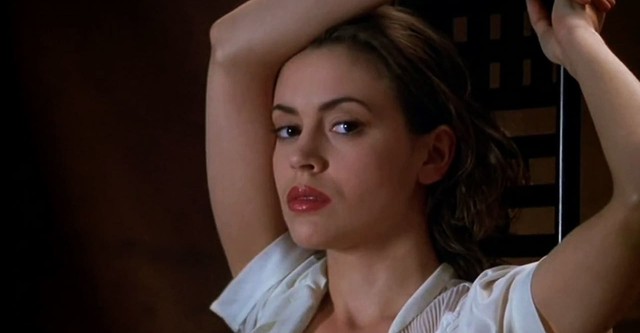
Fast forward to 1978. Meet Arnie Cunningham (Keith Gordon), a high school punching bag with glasses thick enough to stop buckshot. His best friend Dennis (John Stockwell) is the golden-boy quarterback, and Leigh Cabot (Alexandra Paul) is the new transfer student who looks like she stepped out of a Coppertone ad. Arnie has acne, Dennis has biceps, and Leigh has no idea she’s about to compete with a jealous automobile for affection.
Arnie stumbles across Christine in a yard sale hosted by George LeBay (Roberts Blossom), who delivers one of the creepiest monologues about cars this side of Twin Peaks. Arnie sees potential; Dennis sees tetanus. Against all advice, Arnie buys the rusted husk, parks her in Darnell’s garage, and begins the restoration project that doubles as his transformation from nerd to leather-jacketed menace.
And here’s where Carpenter flexes. The more Christine gleams, the more Arnie darkens. Suddenly the stammering dweeb is slick-backed, sharp-tongued, and full of contempt. He’s no longer asking for respect—he’s demanding it, with Christine idling in the background like a mob enforcer waiting for the word.
Love Triangle with a Tailpipe
Christine isn’t just a car. She’s Arnie’s first real romance. Leigh Cabot quickly finds herself in competition with two tons of chrome and jealousy. Their drive-in date is Exhibit A: Leigh nearly chokes to death on a hamburger while Christine locks her doors, preventing Arnie from saving her. That’s not just possessive—that’s psychotic. Imagine your girlfriend glaring at you while you flirt with someone else, except she’s also a 5,000-pound killing machine.
Christine doesn’t slash tires—she slashes throats. When Buddy Repperton and his gang vandalize her with sledgehammers, Christine regenerates in front of Arnie’s eyes in one of the film’s greatest practical effects sequences. Rubber molds and hydraulics reverse-crumpled the bodywork, shot in reverse to make her “heal.” It’s still a showstopper today, the kind of effect CGI could never give weight to. Arnie whispers, “Show me,” and Christine obliges, sealing their pact. What follows is a blood-red revenge tour, with Buddy’s gang mowed down one by one, capped by a gas-station explosion that would make Michael Bay blush.
Harry Dean Stanton vs. a Plymouth Fury
The adults in Christine are either useless or suspicious. Robert Prosky chews scenery as the gruff Darnell, whose “no smoking, no drinking, no drugs” policy seems wildly optimistic for a garage full of teen punks. Harry Dean Stanton shows up as Detective Junkins, a cop who clearly suspects Arnie but can’t get a Plymouth to testify in court. “Cars don’t just fix themselves,” Junkins mutters, staring at Christine’s flawless paint job. Maybe not, but in Carpenter’s world, they also don’t just sit quietly in the garage waiting for prom night.
Carpenter’s Direction: Restraint and Rock ‘n’ Roll
For a director famous for Halloween and The Fog, Carpenter plays it cool here. Christine isn’t flashy—it’s measured, patient, even tender in places. The camera lingers on reflections in chrome, headlights igniting like demonic eyes, and radios crooning Buddy Holly as the soundtrack to murder. Carpenter even co-scored the film, layering his signature synths with 1950s doo-wop. The contrast is perfect: nostalgia weaponized, innocence re-tuned into menace.
And the kills—oh, the kills. Christine doesn’t just murder; she humiliates. She chases Moochie through an alley too narrow for a car, proving physics is no obstacle for the possessed. She stalks victims while burning alive, a rolling inferno of spite. And when she crushes Darnell in his own garage, it’s less homicide, more performance art.
Arnie’s Tragedy
The real horror isn’t Christine’s body count—it’s Arnie’s. Keith Gordon nails the descent from insecure geek to swaggering sociopath. By the third act, Arnie isn’t a victim of Christine; he’s her co-conspirator. He caresses her dashboard like a lover, snaps at Dennis, and snarls at Leigh like a man possessed. By the finale, when Arnie impales himself on Christine’s windshield shard, it’s less an accident and more a consummation of their doomed romance. He dies in her arms, metaphorically and literally, while she purrs “Pledging My Love” on the radio. It’s as absurd as it is chilling.
Flattening the Fury
The climax pits Dennis and Leigh against Christine in Darnell’s garage. Dennis commandeers a bulldozer, because what else do you use against an undead Plymouth? The showdown is part demolition derby, part exorcism, with Christine lunging and regenerating until she’s finally crushed into a cube. Carpenter wisely leaves a final twitch of the grille—evil doesn’t die, it just waits for the next gullible gearhead.
Legacy
Christine made a modest $21 million, enough to keep Carpenter’s career idling until his next cult classic. Critics at the time were lukewarm, but the film has aged like fine gasoline. Today it’s a cult darling, celebrated for its practical effects, moody atmosphere, and sly humor. More importantly, it’s proof that Stephen King’s absurd premises (killer laundry machines, evil corncobs) can still work in the right hands.
And Christine herself? She’s the real star. Forget Gordon, Stockwell, or Paul—this movie belongs to a Plymouth Fury with better curves than Kelly Preston. In a decade that gave us Freddy, Jason, and Michael Myers, Christine remains the only slasher villain with tailfins.
Final Verdict
Is Christine scary? Sometimes. Is it silly? Often. Is it fun? Absolutely. Carpenter took a ridiculous premise and turned it into a gothic romance on wheels, a love story between a boy and his car that just happens to leave a trail of corpses. It’s camp and craft welded together with chrome and blood.
So the next time you see a ’58 Fury gleaming under the streetlights, don’t get too close. She’s taken. And trust me—you don’t want to be the side piece in Christine’s relationship.