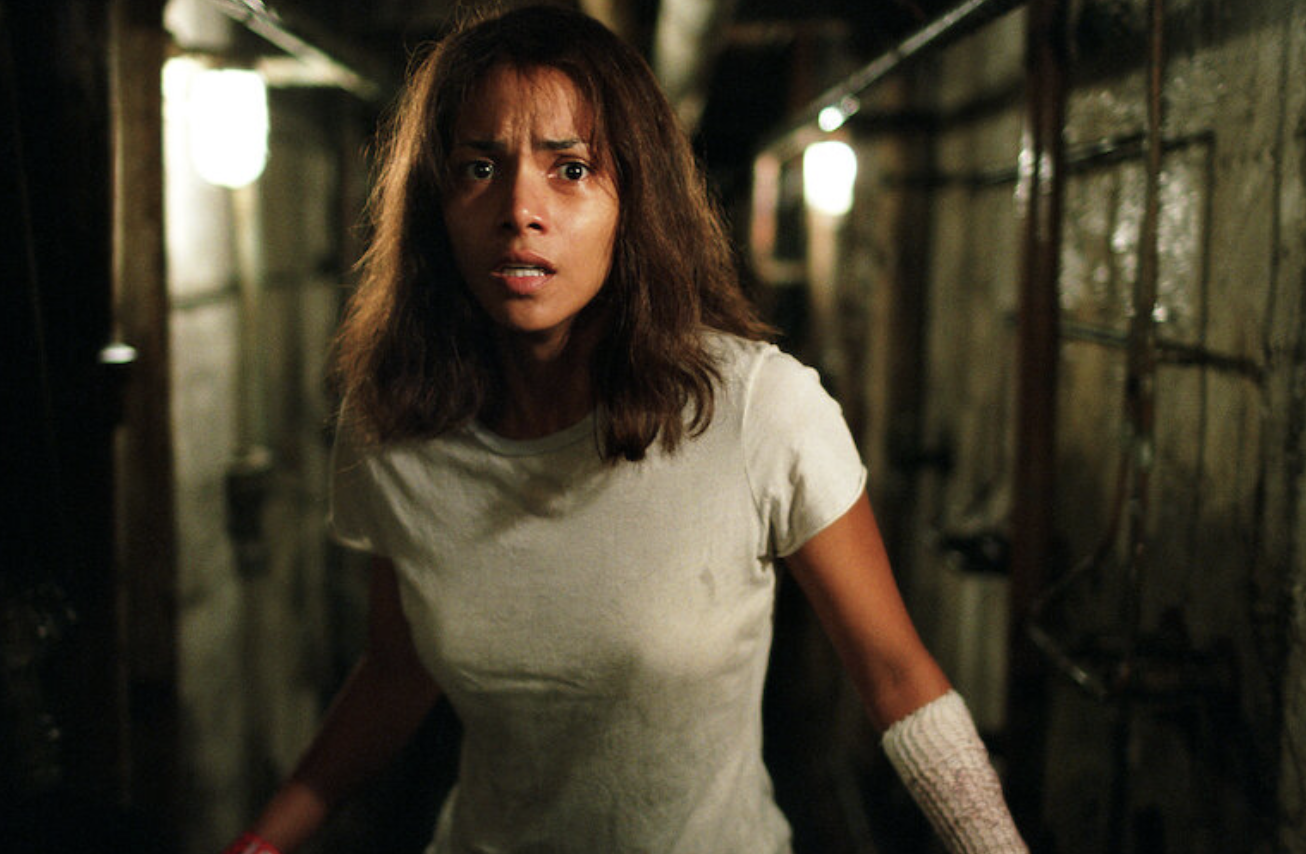
There’s a moment in Gothika where Halle Berry’s character, Dr. Miranda Grey, wakes up strapped to a gurney in the very asylum where she used to work. She looks around, dazed, horrified, disbelieving, and you know what? That’s the exact same face you’ll make watching this entire film.
This was supposed to be a slick psychological horror-thriller with a prestige cast and a spooky supernatural hook. What we got instead was a messy casserole of clichés, plot holes big enough to drive a prison bus through, and dialogue so flat you’d swear it was ghost-written by a bored poltergeist. Gothika is proof that you can throw Oscar winners, Robert Downey and Penélope Cruz into a blender and still end up with a lukewarm can of SpaghettiOs.
The Premise: Sounds Cool, Until It Isn’t
On paper, Gothika has the makings of a great horror-thriller: a psychiatrist wakes up accused of her husband’s murder, locked in the very penitentiary where she treated patients. She’s haunted by visions of a ghostly girl, scribbles “Not Alone” into her own arm (or so it seems), and starts to unravel a conspiracy of abuse, murder, and possession.
It’s Shutter Island meets The Sixth Sense meets Law & Order: Special Ghosts Unit. But instead of a gripping puzzle, what we get feels like a hastily microwaved casserole of tropes: corrupt cops, creepy ghost kids, a “maybe she’s crazy” gaslighting arc, and—of course—the “it was the husband all along” twist. Shocking? Not really. Predictable? About as predictable as the turkey coma after Thanksgiving dinner (which, fun fact, is when this thing was released).
Halle Berry: From Oscar to Overacting
Halle Berry had just won her Oscar for Monster’s Ball when she signed on for this. You’d think her agent would’ve read the script beforehand. Instead, she spends most of the film running around barefoot in wet hallways, screaming at flickering lights, and trying to make lines like “She’s inside me!” sound profound instead of like an ad for Pepto Bismol.
Berry is pretty when she’s dolled up. But her acting chops are overrated and she certainly doesn’t have the gravitas to salvage a crap script like this.
Robert Downey Jr.: The Pre-Iron Man Slump
Robert Downey Jr. shows up as Dr. Pete Graham, Miranda’s colleague-slash-potential savior. This was 2003, smack in the middle of his career slump, and it shows. He spends most of the film squinting like he’s trying to squelch a popcorn fart. His chemistry with Berry? About as electric as a wet toaster unplugged from the wall.
There’s a subplot where you think he might be in on the conspiracy, but no—the film’s not that clever. He’s just there to pop in occasionally, deliver a line with mild concern, look smarmy, and then disappear until the climax like he’s punching a timecard.
Penélope Cruz: Ghosted by the Script
Penélope Cruz plays Chloe, one of Miranda’s patients, and she deserved better. Way better. She spends most of her screen time shrieking about being raped by unseen forces, covered in sweat, and mumbling ominous one-liners like “You’re not alone.” It’s the kind of underwritten, thankless horror role that screams, “We wanted a big star in the trailer, but we didn’t actually know what to do with her.”
It’s less a character and more a plot device wearing eyeliner.
The Ghost: Discount Kayako
Rachel Parsons, the ghost girl haunting Miranda, should be terrifying. Instead, she looks like the clearance-rack version of The Grudge’s Kayako: stringy hair, pale skin, permanent scowl, and the personality of a wet blanket left on a radiator. She pops up in the mirror, she carves things into people’s skin, she plays peek-a-boo with the lights—yawn.
By 2003, we’d already seen this ghost schtick a dozen times in better films. Here, it feels about as scary as someone yelling “boo” from under a Walmart comforter.
The Big Twist: Wait, That’s It?
So what’s the grand revelation? Miranda’s husband Douglas (Charles S. Dutton) was secretly a serial rapist and murderer, running a torture basement with his buddy Sheriff Bob Ryan (John Carroll Lynch). Rachel’s ghost possesses Miranda to kill Douglas, then sticks around for round two with the sheriff.
That’s it. That’s the payoff. Two middle-aged men in rural Connecticut running a snuff film Airbnb. Yawn.
The Logic (Or Lack Thereof)
This movie collapses under its own nonsense:
-
Miranda is possessed long enough to brutally murder her husband, but she doesn’t remember it until it’s convenient for the plot.
-
Nobody notices the literal dungeon full of blood and sedatives in Douglas’s barn for years. Apparently, rural zoning laws in Rhode Island are very relaxed.
-
The sheriff tattoos a giant Anima Sola on his chest—a literal incriminating clue—and then proceeds to walk around shirtless in front of his victims. Because, dammit, subtlety is for suckers.
-
Ghost logic is inconsistent: Rachel can possess Miranda, scribble messages, appear in mirrors, and cause explosions, but she still needs a living woman to solve her murder. What’s the point of being a vengeful spirit if you outsource the vengeance?
The Direction: All Style, No Substance
Mathieu Kassovitz, making his American directorial debut, clearly wanted to prove he could do “moody psychological horror.” So he cranks the blue filter to eleven, drenches every hallway in dripping water, and lights the whole thing like a Calvin Klein ad for misery.
It looks slick, sure. But after ninety minutes of watching Halle Berry run through wet hallways in a tank top, you start to feel like you’re stuck in an endless Evian commercial from hell.
The Ending: Just Kill Me Already
After the sheriff bursts into flames and gets shot by Miranda, we get a tacked-on epilogue where she sees another ghost child in the city. Because apparently the filmmakers thought, “Hey, maybe we’ll get a sequel.” Spoiler: they didn’t. Thank God.
The final shot of Berry looking shocked and confused at yet another ghost isn’t chilling—it’s just exhausting. By that point, when the credits came I felt like a prisoner who just got paroled.
Final Thoughts
Gothika is the cinematic equivalent of buying a haunted house on Craigslist. It looks promising from the outside, it’s got famous names attached, but the second you step inside, you realize it’s all rotting floorboards and flickering lights held together with duct tape.
Yes, it made money at the box office, but so did Deep Throat. Commercial success doesn’t mean quality. What Gothika proves is that even an A-list cast can’t save a script that feels like it was cobbled together from rejected X-Files episodes and leftover scenes from 13 Ghosts.
