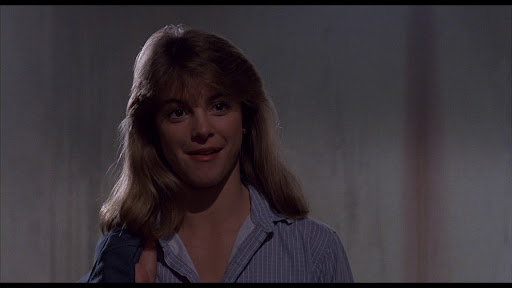
If you’ve ever wondered what would happen if someone tried to make a Slender Man / Babadook mashup using half a script, a pile of clichés, and whatever was left in the Blumhouse prop closet, Mercy Black is pretty much your answer.
This 2019 Netflix-dropped-with-zero-fanfare horror movie feels less like a fully formed film and more like a group project that was due at midnight and exported at 11:57 p.m. It has all the ingredients for a solid psychological/supernatural horror flick—urban legend, childhood trauma, creepy kid, unreliable memories—and then just sort of… stirs them listlessly until it’s technically “content.”
The Legend of Mercy Black (Now With 80% More Generic)
Our story begins in the golden age of bad decisions: adolescence.
Teen Marina Hess and her friend Rebecca stab a classmate as a sacrifice to a ghost called Mercy Black, who they believe can cure Marina’s sick mom. This has big “we read one creepypasta and went way too hard” energy. It’s clearly meant to echo real-world cases like the Slender Man stabbing, except without the social commentary, nuance, or sense that anyone did research beyond “kids + internet = trouble.”
Fast forward fifteen years: Marina is released from a psychiatric hospital and sent to live with her sister Alice, who is that special kind of horror-movie guardian: well-meaning but wildly unprepared for the fact that she has just invited trauma, infamy, and a fully grown former child stabber into a house that also contains a young boy.
Shockingly, this does not go well.
Welcome Home, Please Ignore the Viral Myth About Your War Crime
Marina emerges into a world where Mercy Black has become a full-blown urban legend. There are books, online theories, and videos. Kids whisper about her at school. True-crime culture has turned Marina’s psychotic break into spooky fandom lore, and the film briefly flirts with a cool idea: how media and myth exploit real suffering.
Then it remembers it mostly just wants to show you a mask and a dark hallway.
Alice’s son Bryce, of course, is obsessed with Mercy Black, because children in horror movies are contractually obligated to fixate on the most dangerous thing within a five-mile radius. He recites the rules, he draws creepy images, he goes to school and does increasingly worrisome things, and everyone reacts with the level of concern usually reserved for “forgot their homework.”
Marina, meanwhile, stumbles around like a walking trigger warning: traumatized, fragile, and constantly confronted with people treating her life’s worst moment like a campfire story. There’s a genuinely interesting angle here about guilt, mental illness, and becoming a monster in the public imagination. The movie glances at it and then sprints back to “creepy figure in the corner.”
Rebecca, The Map, and the Nuclear Fallout Bunker of Exposition
Marina decides to unravel her past in order to help Bryce avoid making the same mistakes. Good instinct. Shame the script doesn’t help her much.
She visits Rebecca, her former partner in stabbing, and finds her in a catatonic state after a failed hanging. It’s sad, unsettling… and mostly just a vehicle to get Marina into Rebecca’s room so she can find an old map.
Because of course there’s a map. There’s always a map.
Following it, Marina trudges into the woods and discovers a nuclear fallout shelter, which is exactly the kind of place you design a fake ghost in if you want to guarantee someone will one day find it and say, “Ah, yes, trauma origin point.” Inside is “the book you cannot read,” which apparently means “the notebook you wrote your edgy middle-school lore in.”
Here, Marina remembers the truth: she and Rebecca made Mercy Black up. It was never real. It was just a construct they cobbled together out of delusion, desperation, and probably way too much unsupervised time.
This could have been the pivot into a fully psychological horror story—no ghost, just the devastating consequences of belief. Instead, the movie shrugs and goes, “Lol or IS she made up?” and tries to have it both ways until the end credits roll.
Bryce, Behavioral Red Flags, and Adult Denial
Meanwhile at school, Bryce is acting increasingly possessed-by-pop-culture. He hurts a friend and blames “her.” When asked who told him to do it, he gives the classic creepy-kid line: “She told me to.” Horror screenwriters treat this line like it’s a revelation. At this point, it might as well be printed on every child actor’s contract.
Marina tries to intervene, but the movie is in a rush to get to the “scary” parts. Bryce’s escalating fixation should feel like a tragedy: history repeating itself as a child absorbs and reenacts a myth that was born from another child’s breakdown. Instead, it plays like a checklist: Drawing? Check. Weird behavior? Check. Unheeded warnings? Check.
The adults treat Mercy Black like a spooky meme instead of an incredibly specific trauma attached to the woman currently sleeping down the hall. If someone stabbed a girl in your town and the associated ghost became an internet phenomenon, maybe—just maybe—you don’t hang fanart of it where your recently discharged sister can see it.
Mercy Black: Now You See Her, Now You Wish You Didn’t
Eventually, the movie caves and gives us true-blue visual encounters with Mercy Black. Bryce and Alice are alone in the house when they’re attacked by a figure that smells like studio notes: “Can the ghost be more visible? And also more like every other streaming original monster?”
Alice gets knocked over a stair rail. Marina rushes in. Mercy attacks her too. The sequences are competently shot but flavorless. There’s no unique logic to how Mercy moves, appears, or acts. She’s just another lank, shadowy figure with a mask and a tendency to be wherever the lighting is most dramatic.
You don’t walk away from these scenes thinking, “Wow, Mercy Black is terrifying.” You walk away thinking, “I have 100% seen this ghost in at least five other movies and one Netflix thumbnail.”
Ah, So the Real Monster Was Trauma AND Also a Librarian
In a twist that might’ve landed harder in a better movie, Bryce flees the house and runs directly into the arms of the librarian—who turns out to be Lily Bellows, the girl Marina and Rebecca meant to sacrifice fifteen years earlier.
Lily did not, in fact, die. Instead, she’s grown up stewing in festering resentment and untreated mental illness. She’s furious that Marina didn’t kill her as “promised” and repressed the memory. So Lily has basically adopted the Mercy Black myth as her personal religion and has been hurting people to force Marina to remember.
On paper, that’s dark and kind of great: the would-be victim becomes a zealot for the lie that almost killed her. In practice, it’s rushed and clunky. Lily appears, info-dumps, stabs Marina, threatens Bryce, and tries to force the story into a finale it hasn’t really earned.
Marina overpowers her but decides not to kill her, in a rare moment of moral clarity. Then Bryce, who has been watching all of this, calmly stabs Lily in the eye and says, “I made a promise,” as Mercy Black appears behind him.
The final image is meant to be haunting. Instead, it mostly confirms that nobody learned anything and the film really, really wanted that “boo!” beat before credits.
Missed Chances and Misfired Promises
There are so many interesting threads in Mercy Black that get clipped short or never woven properly:
-
The commodification of real-life tragedy through urban legends.
-
The way children absorb and reenact violent myths.
-
The ethics of forgiveness and recovery when you were the monster as a kid.
-
The blurry line between shared delusion and supernatural reality.
Any one of these could’ve carried a thoughtful, unsettling horror film. Instead, they all just brush past each other in the hallway, nod politely, and hurry off to their B-plot obligations.
Even the supporting cast is underused. Janeane Garofalo shows up as a psychiatrist and then mostly vanishes. Austin Amelio is there as a guy named William who you will forget exists until the credits remind you. The film barely uses its actors as anything other than exposition mouths and reaction shots.
Final Diagnosis: Shallow Cut, No Stitches
In the end, Mercy Black isn’t offensively bad—it’s worse than that. It’s aggressively mediocre. It’s a horror movie that constantly gestures at deeper trauma and mythology but never does the work to earn its big swings.
If you’re very forgiving and just want something vaguely spooky with a vaguely cool mask to watch while you scroll your phone, it will do the job. The pacing moves along, the performances are serviceable, and you won’t be mad you watched it. You probably also won’t remember much of it a week later.
For a story about a made-up ghost that got out of control, it’s ironic that Mercy Black never really escapes feeling made-up itself—a stitched-together patchwork of other, better films. In a streaming landscape haunted by derivative horror, this one is less a deadly curse and more a mildly inconvenient buffering circle.