
A Low-Key Horror Classic That Only Needed a Bit More Star Power
John Carpenter’s Prince of Darkness exists in a strange corner of horror cinema—a film filled with unsettling ideas, chilling visuals, and a mood so dense it practically suffocates you. Released in 1987, the movie marked the second entry in Carpenter’s loose “Apocalypse Trilogy” (bookended by The Thing and In the Mouth of Madness), and while Prince of Darkness never enjoyed the same cult status as its sibling films, it remains one of the most ambitious and intellectually provocative horror films of the ’80s.
In short, it’s a Lovecraftian nightmare buried under a pile of quantum theory and Catholic mysticism. And while its cast doesn’t quite bring the same charisma as, say, Kurt Russell or Kim Cattrall would’ve, Prince of Darkness still manages to get under your skin — and stay there.
Opening the Gates: What’s It About?
Set in a seemingly unremarkable Los Angeles church, the plot centers around a group of university physics students and their professor (Victor Wong) who are invited by a priest (played by Donald Pleasence) to study a mysterious canister hidden beneath the church altar. Inside this swirling, green liquid lies something ancient and horrifying — the physical embodiment of evil. Not just Satan in the biblical sense, but an entity beyond our comprehension. A force of anti-matter. The Devil, through the lens of science.
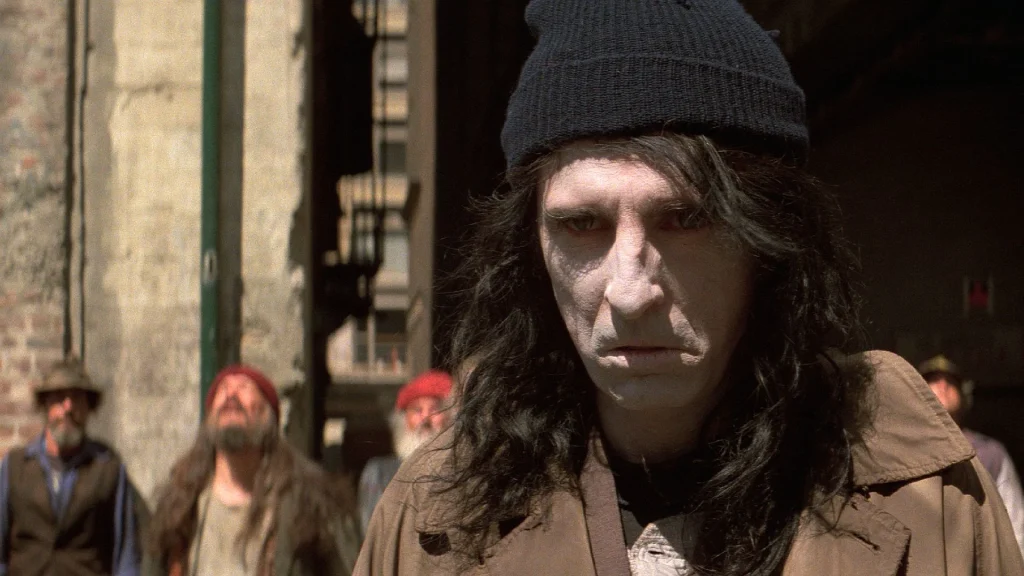
As they study this otherworldly substance, the group becomes trapped inside the church while the liquid starts to exhibit terrifying properties: influencing dreams, warping minds, and eventually possessing and transforming members of the team. Outside, homeless figures act as possessed sentinels, preventing escape. Inside, the terror mounts. One by one, the students fall victim to something they were never meant to uncover.

A Different Kind of Apocalypse
Prince of Darkness isn’t flashy horror. It’s not interested in gore for gore’s sake, nor does it throw jump scares at you every ten minutes. It’s slow-burning dread, growing steadily like the green liquid itself, bubbling with unease until it reaches a boiling point. Carpenter dials back spectacle in favor of philosophy and existential horror. It’s a film of big ideas cloaked in B-movie atmosphere.
The central conceit — that evil is not just a concept, but a sentient force of physics, an ancient alien-like intelligence waiting for the right time to break into our dimension — is brilliant. Carpenter threads science and religion together in a way that’s equal parts heretical and genius. The characters talk of tachyons, quantum uncertainty, and anti-gods with an urgency that makes even the silliest line sound believable. This isn’t pseudo-science horror; it’s pseudo-theology horror backed by brainy conviction.
And don’t forget those dream transmissions — haunting VHS-style visions sent from the future. They are cryptic, terrifying, and oddly prophetic. Few horror films dare to be this cerebral.
The Atmosphere: Carpenter in Top Form
Where the acting may fall short, Carpenter’s mastery of mood and atmosphere does not. The film is drenched in an ominous tone from the very first frame. Whether it’s the unsettling, synth-heavy score (co-composed by Carpenter and Alan Howarth), or the framing of the abandoned church and its labyrinthine shadows, everything screams dread. Carpenter lets the silence breathe. He lets us sit with characters in moments of confusion and fear.
Lighting plays a big role here — the green hue of the canister illuminates the dark stone walls like some unholy neon altar. The dreamlike pacing, paired with Carpenter’s use of slow pans and still shots, makes the whole film feel like it exists slightly out of phase with reality.
You’re never comfortable watching Prince of Darkness, and that’s exactly the point.
The Cast: Serviceable But Missing a Spark
Here’s where we need to be honest: the acting is uneven. Donald Pleasence, as the skeptical priest, brings his usual gravitas and bug-eyed urgency. Victor Wong is memorable as Professor Birack, the man trying to make rational sense of metaphysical evil. But the younger cast? They’re mostly flat.
Jameson Parker as the lead — physicist Brian Marsh — doesn’t have the charisma to anchor a movie like this. Lisa Blount, playing his love interest Catherine, fares better, especially in the third act, but even she feels slightly underwritten. The supporting cast, while competent, doesn’t pop.
And that’s where a hypothetical recast enters the conversation. Imagine Kurt Russell as Brian Marsh — scruffy, skeptical, cracking dry jokes in the face of hell itself. Or Kim Cattrall as Catherine, bringing a bit of glamor and edge to the ensemble. It’s not to say the current cast ruins anything, but star power might have elevated Prince of Darkness from cult classic to all-timer. The material deserves it.

Gore and FX: Lo-Fi, High Impact
Despite its modest budget, the film delivers a few memorable practical effects — most notably the death of Susan, who becomes an infected host for the Anti-God’s essence. Her slow transformation, slashed throat, and unnerving smile are burned into the retinas of horror fans.
Then there’s the iconic mirror climax — a last-ditch effort to stop evil from entering our world. It’s a masterclass in tension and sacrifice, underscored by one of Carpenter’s most mournful music cues. The use of reverse footage and practical effects is brilliant and haunting.
Carpenter has always excelled in doing more with less. Prince of Darkness may not be a gorefest like The Thing, but it doesn’t need to be. Its horror is existential — the terror of realizing the universe might just be hostile to our very existence.
Legacy and Influence
Prince of Darkness was not a massive success upon release. Critics were divided, audiences were confused, and it was largely dismissed as minor Carpenter. But time has been kind to the film. Very kind.
Today, it enjoys a well-earned reputation as one of Carpenter’s most underrated gems — a cult classic with a unique identity. Its themes of institutional distrust, metaphysical dread, and scientific overreach are more relevant than ever. In a world constantly negotiating the border between science and spirituality, Carpenter’s horror fable feels eerily prescient.
And those dream sequences? They laid the groundwork for found-footage horror before the genre even existed.
The Anti-God and The Real Monster
What sets Prince of Darkness apart is the ambiguity of its evil. There’s no slasher here. No vampire. No werewolf. Just a canister of fluid with unknowable power. The true horror is the collapse of order, the encroachment of something too big and alien for the human mind.
It’s a quiet apocalypse.
Snake Plissken might’ve lit the place on fire. Jack Burton might’ve punched the canister. But this cast? They can only study, panic, and ultimately pray that someone — anyone — is willing to sacrifice everything to stop the breach.
Final Thoughts: A Slow-Burn Masterpiece Missing Just One Piece
Prince of Darkness is an audacious film. It’s not easy, it’s not slick, and it certainly isn’t concerned with pleasing everyone. But it’s exactly that uncompromising vision that makes it linger.
Carpenter paints in dread, and here he uses science as his brush. The film’s only major flaw is a lack of magnetic lead performances. Had Kurt Russell and Kim Cattrall stepped into this world of quantum evil, we might be talking about this as one of the best horror films ever made — not just a cult darling.
Still, what’s here is extraordinary. The mood. The music. The menace. It may be Carpenter’s most cerebral film, and easily his most misunderstood. But in a horror landscape increasingly filled with noise, Prince of Darkness stands as a rare thing: a quiet scream into the abyss.
Final Score: ★★★★☆ (4/5)
Underrated, thought-provoking, and unnerving — Prince of Darkness is Carpenter’s thinking man’s horror film. All it’s missing is a little more star power to take it over the top.
🔗 Further Viewing: John Carpenter Essentials
💀 Halloween (1978)
The classic that started it all.
👉 Explore the horror of Halloween
🧊 The Thing (1982)
A masterclass in tension, paranoia, and practical effects. Carpenter’s sci-fi horror masterpiece remains unmatched in atmosphere and execution.
👉 Read our breakdown of The Thing
👓 They Live (1988)
Before The Matrix, there was this sunglasses-wielding, capitalist-smashing cult classic. Roddy Piper sees the truth — and it isn’t pretty.
👉 Check out our full feature on They Live
🚛 Big Trouble in Little China (1986)
Jack Burton drives straight into supernatural chaos in this kung-fu western fantasy. It’s wild, weird, and all in the reflexes.
👉 Revisit Big Trouble in Little China
🚀 Escape from New York (1981)
Snake Plissken sneers, fights, and grumbles his way through dystopian Manhattan in one of the coolest genre mashups of the ’80s.
👉 Our full review of Escape from New York
💔 Starman (1984)
Proof that Carpenter could do more than horror. A heartfelt road movie with a cosmic twist and an unforgettable synth score.
👉 Dive into Starman with us
🚬 Christine (1983)
High school. First love. Murderous muscle cars. Carpenter’s adaptation of King’s novel mixes chrome and carnage.
👉 Read our full take on Christine
💀 Prince of Darkness (1987)
A sinister blend of science, religion, and apocalypse — and one of Carpenter’s most underrated creepers.
👉 Explore the depths of Prince of Darkness
🧛 John Carpenter’s Vampires (1998)
Western grit meets bloodsucking evil. It’s dusty, gory, and one of his last real flashes of style.
👉 Ride into Vampires with us
🌫️ The Fog (1980)
Ghosts, guilt, and a killer radio DJ. Carpenter’s seaside nightmare is all about mood and mist.
👉 Step into The Fog
🎥 Elvis (1979)
Kurt Russell channels the King in this surprisingly emotional biopic. Carpenter’s first team-up with his future muse.
👉 Read our look at Elvis
📡 Someone’s Watching Me! (1978)
A proto-feminist thriller from the master of suspense. Not quite Hitchcock, but there’s charm and early promise.
👉 Our full thoughts on Someone’s Watching Me!
🚀 Dark Side Picks & Misfires
📺 Memoirs of an Invisible Man (1992) – Cheesy and disjointed
🔥 Ghosts of Mars (2001) – Needed Kurt Russell to save the day
🩸 Cigarette Burns (2005) – Meta-horror gone murky
🚨 Pro-Life (2006) – Heavy-handed and unbalanced
🧠 In the Mouth of Madness (1994) – Brilliant in theory, muddled in practice
👻 The Ward (2010) – Stylish but hollow
☎️ Phone Stalker (2023) – When even Carpenter can’t scare us

