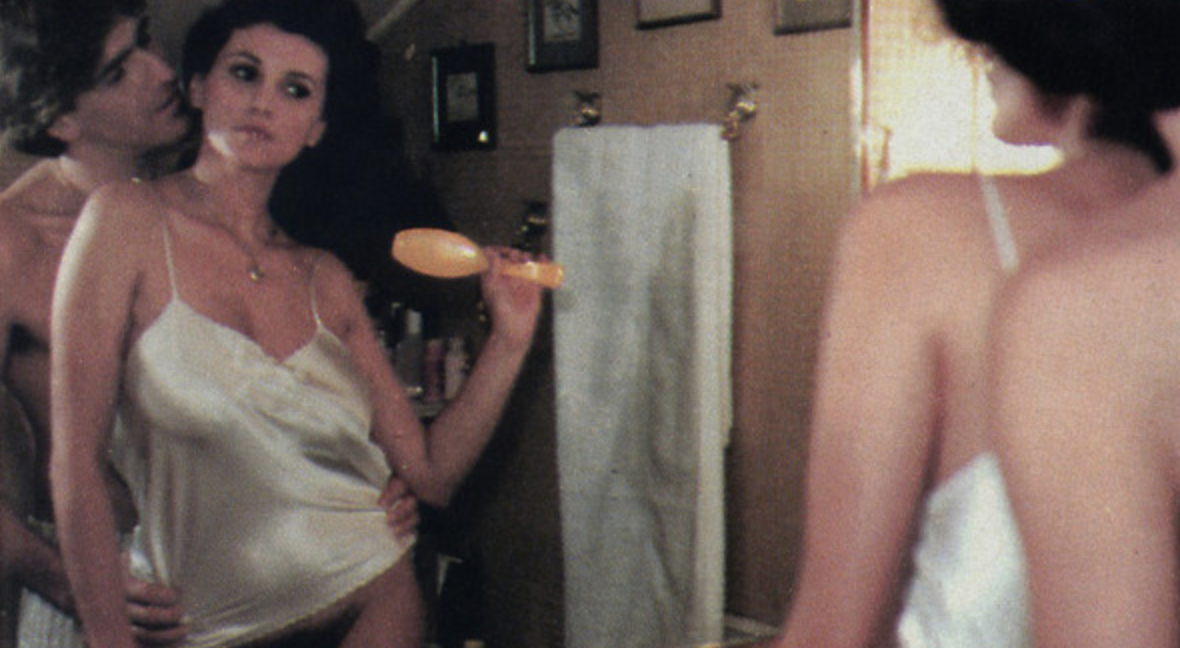
When people talk about Italian cinema of the 1980s, the conversation usually shifts to the likes of Fellini, or maybe to the tail end of the giallo craze. But for many fans, especially those who prowled the video store shelves in search of something dangerous and decadent, the name Serena Grandi conjures its own distinct world—smoky, sensual, and unapologetically lurid. Born Serena Faggioli on March 23, 1958, in Bologna, she would grow into the screen persona known as Serena Grandi: a sex symbol who stood at the crossroads of Italian erotic cinema, pulp horror, and late-night television, and who became as infamous for her off-screen scandals as for the cinematic fever dreams she helped bring to life.
From Computers to Cinema
Grandi’s story doesn’t begin with red carpets and camera flashes. In fact, she started her professional life as a computer programmer, a field far removed from the boudoirs and blood-soaked sets she’d later inhabit. Working in a scientific analysis laboratory, she seemed destined for a stable, conventional career. But fate, or perhaps the chaos of post-1970s Italian cinema, had other plans.
In 1980, she landed a small role in La Compagna di viaggio by Ferdinando Baldi. That same year she played Maggie in Joe D’Amato’s notorious gore-fest Antropophagus, a film so grotesque that even hardened horror buffs sometimes look away. While her role was small, the film’s cult reputation ensured her name was whispered in horror circles. It was an unconventional start: not many actresses launch their careers with a cannibal movie where the audience leaves the theater feeling in desperate need of a shower. But Grandi, even in supporting parts, carried herself with the kind of screen presence that screamed, “Remember me.”
Becoming an Italian Sex Symbol
If D’Amato put her name on the exploitation map, it was Tinto Brass who turned Serena Grandi into a phenomenon. In 1985, she starred in Miranda, a film that cemented her status as Italy’s new sex goddess. Brass, often compared to Italy’s answer to Russ Meyer, knew how to build careers around voluptuous, unapologetically sensual women, and Grandi was his perfect muse.
Miranda gave her not just exposure but cultural legitimacy within the world of erotic cinema. Unlike the horror grindhouses where she first appeared, this was a role that allowed her to command the screen, to seduce, and to tease in a way that made her the talk of Italy. She wasn’t simply an actress; she was a national pin-up. Her photographs circulated in men’s magazines, her curves were plastered across posters, and her name became shorthand for sensual excess in the country’s pop culture.
During the 1980s, Grandi was a one-woman industry. She starred in nearly 20 films across genres, but most leaned into the “commedia sexy all’italiana” format—erotic comedies that thrived in a permissive cinematic environment where suggestive humor and nudity were reliable box office draws. If Italy needed someone to embody sensuality with a wink and a laugh, Serena Grandi was the go-to.
The Horror Connection
Though she’s often remembered for her erotic roles, Grandi also became a recognizable figure in horror. After Antropophagus, she later starred in Delirium (1987), directed by Lamberto Bava. Horror fans will recall Delirium not only for its surreal dreamlike killings but also for Grandi’s central role as Gloria, a former centerfold stalked by deranged admirers.
Delirium is one of those quintessential Italian horror films that defies neat categorization: part giallo, part slasher, part fever dream. And at the heart of it was Grandi, bringing her mix of glamour and vulnerability to a role that could have been little more than cheesecake. Instead, she gave Gloria depth, and in doing so secured herself a place in the pantheon of cult horror stars.
Fame, Family, and Scandals
Grandi’s off-screen life was often as colorful as her on-screen persona. In 1991, she married antiquarian Beppe Ercole, a man 20 years her senior. The couple had a son, Edoardo, before divorcing in 1998. For a time, Grandi stepped away from cinema, retreating to television series in the 1990s as the Italian film industry shifted and the era of erotic comedies waned.
But the tabloids weren’t finished with her. In 2003, she found herself under house arrest for 157 days, accused of selling small amounts of cocaine. The case was eventually dismissed, but the spectacle only added to her larger-than-life persona. If you were going to be Serena Grandi, you had to embrace chaos, both in art and in life.
In 2006, she dabbled in politics, running as a candidate for Social Action, the right-wing party led by Alessandra Mussolini. It was a short-lived experiment—she was not elected—but it underscored her willingness to reinvent herself. That same year she published her first novel, L’amante del federale, proving she had ambitions beyond acting and modeling.
A Return to the Spotlight
After nearly a decade away from the cameras, Grandi returned in 2008, reminding audiences that she was not finished yet. Though she never regained the same level of superstardom as the 1980s, she remained an icon. In 2017, she stepped into the modern world of reality television by joining Grande Fratello VIP, the Italian version of Celebrity Big Brother. The sight of a woman once considered the ultimate 1980s sex symbol now navigating reality TV drama was surreal, but also fitting. Serena Grandi never played by anyone else’s rules—why start now?
The Iconography of Serena Grandi
What makes Serena Grandi endure as a cultural icon? Part of it is, of course, her physicality—her image as the voluptuous, unapologetic woman who embodied Italy’s erotic imagination. But to reduce her to mere pin-up status undersells her impact. Grandi was part of a transitional moment in Italian cinema, where the erotic, the comedic, and the horrific overlapped.
She bridged the gap between horror cult favorites like Antropophagus, high-profile erotic works like Miranda, and late-night TV melodramas. She gave herself to these projects fully, without irony, and in doing so became both muse and myth.
Her scandals, her legal troubles, even her misadventures in politics—they all add to the Serena Grandi legend. Unlike Hollywood stars who carefully curate their images, Grandi’s career has been messy, unpredictable, and deeply human. Perhaps that’s why she resonates so strongly with fans: she is not an airbrushed fantasy but a woman who embraced extremes.
Legacy
Today, Serena Grandi occupies a strange and fascinating place in film history. She is remembered as one of Italy’s great sex symbols, a woman who lit up the 1980s with her screen presence. To horror fans, she is a cult figure whose performances in films like Delirium ensure her place on midnight movie marathons. To others, she is a reminder of a cinematic era where rules were few, excess was celebrated, and actresses could become legends by daring to go too far.
If Sophia Loren represented the classy, international face of Italian femininity, Serena Grandi was its wild, unruly cousin—the one who didn’t care what polite society thought, and who understood that cinema at its best isn’t always about restraint but about audacity.
Conclusion
From her beginnings as a computer programmer in Bologna to her transformation into Italy’s reigning pin-up queen, Serena Grandi has lived a life as operatic as the films she starred in. Whether she was being stalked in a horror film, seducing on screen in a Tinto Brass opus, or weathering legal troubles and political experiments, she remained defiantly herself.
In the end, Serena Grandi may never have been a conventional actress, but she was never meant to be. She was, and remains, a symbol of the chaotic, sensual, and unfiltered world of Italian popular cinema. And for that, she will always be remembered—not just as an actress, but as an icon.

