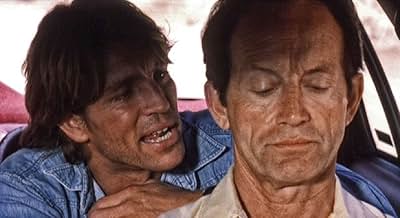
There’s a moment about 20 minutes into The Dark where you realize the scariest thing about the movie isn’t the monster. It’s the fact that someone greenlit this radioactive burrito of a film and then handed it over to John “Grizzly Adams Ate My Career” Cardos after Tobe Hooper jumped ship like it was the Titanic—only with worse lighting and more polyester. What began as a horror mystery mutated into a cinematic Frankensteined mess of UFO lasers, cop drama, and fog machine abuse. The result is The Dark, a film that is somehow both dull and incoherent, a shuffling corpse of half-formed ideas and made-for-TV ambition dressed in the tattered trench coat of a real movie.
Let’s try—just try—to untangle the plot. Something is stalking the streets of Los Angeles, preying on innocent people at night. Is it a serial killer? A mutated human? An alien? A disgruntled extra from Columbo? The answer: all of the above, kind of, and also none of the above, depending on which version of the film you’re watching or which producer had control of the cocaine tray that day.
You see, the movie was originally supposed to be about a mentally deranged zombie brute who stalks the night killing folks with his bare hands. But somewhere in post-production, possibly during a head injury or séance, the producers decided that wasn’t exciting enough. So they reshot scenes to give the monster glowing red eyes and the power to shoot laser beams out of his face.
Laser beams. Out of his face.
This was 1979, mind you—not 1959. The Star Wars hangover was already inducing nausea across studios, and The Darkresponded like a drunk uncle at Thanksgiving: by adding lasers to everything and hoping nobody noticed the smell. So instead of a slow-burn urban horror film, we get a creature that looks like a deformed mime in a Halloween wig, zapping people into flaming heaps of charcoal like he’s on loan from the Mos Eisley cantina.
The monster—called “The Dark,” because creativity had clearly left the building—is barely seen, and when he does appear, it’s usually in silhouette or while dramatically illuminated like a stage magician with a glandular disorder. His laser-zapping powers are the visual equivalent of someone blowing into a Lite-Brite. People explode, sort of. They catch fire, kind of. Mostly, they just scream and fall over while the screen strobes like a rave at a retirement home.
The rest of the film is a revolving door of washed-up cops, twitchy reporters, and victims who exist solely to pad the body count. The main characters—if we can call them that—include a grizzled police lieutenant (Richard Jaeckel, who acts like he’s filing for unemployment between takes), a father (William Devane) investigating his daughter’s death, and a psychic (Jacquelyn Hyde, whose name alone should’ve been a red flag) who spouts vague nonsense and wanders in and out of scenes like a ghost with a bad agent.
Nobody has chemistry. Nobody seems to know what movie they’re in. It’s as if the cast showed up on set and were given lines from three different scripts stapled together by a chimp on Red Bull. Devane tries to play it serious, but you can see the disappointment in his eyes—the look of a man who’s realizing, mid-shoot, that his agent just bought a new boat with the money he should’ve been paid. Jaeckel, meanwhile, smokes more than he speaks, delivering his lines like a man narrating his own prostate exam. And the psychic? She’s like someone doing a bad impersonation of someone doing a bad impersonation of Zelda Rubinstein.
The pacing is glacial. You’d think a movie about a laser-eyed death creature would be fast-paced. Instead, the film creaks along like an arthritic centipede. Endless scenes of cops walking, talking, and sighing into phones. Repeated shots of L.A. streets drenched in blue light and fog. There’s more smoke in this movie than at a 1970s funeral parlor, and about the same energy level.
Even the kills, which should be the saving grace of a film like this, are weirdly anti-climactic. Victims stand still while a red beam flashes across the screen and then either combust or disappear. There’s one shot where a guy’s head explodes in slow motion, but it’s less “terrifying horror” and more “fruit salad in a microwave.” If Scanners was a gourmet steakhouse, The Dark is a gas station hot dog that’s been spinning under a heat lamp since Carter was president.
The music, courtesy of Roger Kellaway, sounds like someone trying to recreate the Jaws theme from memory using a kazoo and a broken piano. It lurches and moans and occasionally tries to build tension, only to collapse into a puddle of sad brass. It doesn’t help that the sound editing is about as subtle as a shotgun to the kneecap. Every time the monster appears, the soundtrack kicks in like it’s auditioning for Close Encounters—loud, dissonant, and completely out of sync with what’s actually happening.
And then, of course, there’s the ending.
No spoilers, but suffice it to say: it’s not satisfying. It’s not logical. It’s not even coherent. The film just… stops. Not climactically. Not ironically. Just abruptly. Like someone accidentally tripped over the projector cord and everyone decided, “Eh, good enough.” The monster gets dispatched (sort of), people stare into the distance, and the credits roll like they’re embarrassed to be associated with what just happened.
Final Verdict:
The Dark is what happens when a horror movie is made by committee, abandoned by its director, and possessed by the ghost of every bad production decision possible. It’s a thriller that forgets to thrill, a creature feature that forgets the creature, and a laser horror movie where the lasers look like they were added in post by a blindfolded intern using an Etch A Sketch.
Watch it only if:
-
You’ve ever wondered what a low-budget X-Files episode directed by a guy who thinks fog = fear looks like.
-
You need something to play at a party while everyone’s already drunk and half-asleep.
-
You lost a bet.
Everyone else? Step away from the screen, put the laser down, and go rewatch The Thing. At least that monster earned its fog machine.