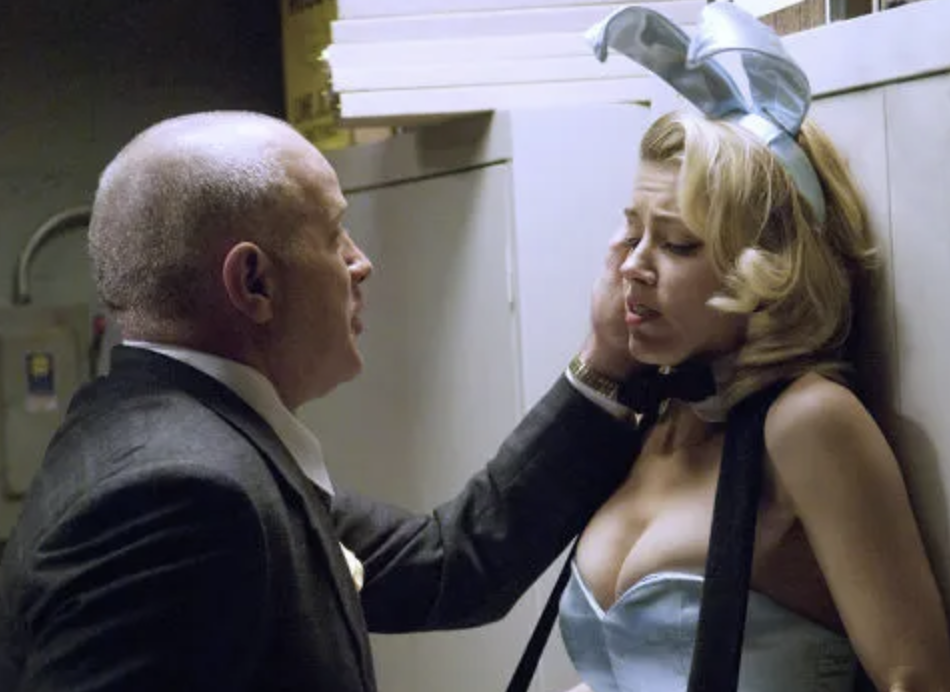
Television is a lousy bar at closing time. You walk in thinking you’ll get something strong, something to burn your throat and remind you you’re alive. Instead, The Playboy Club hands you a tall glass of melting ice. It clinks, it glimmers, it looks good from across the room. Then you take a sip and wonder if the bastard behind the counter forgot the bottle.
NBC in 2011 thought they could stitch a pair of rabbit ears on hot chicks and call it new. They dressed the set in satin and smoke and poured the same empty drink again and again, hoping you wouldn’t notice there was nothing at the bottom.
Amber Heard floats through it all, glowing like a neon sign on a dead-end street. She’s beautiful enough to stop you mid-sentence, but the show keeps her trapped in tray-service motions. Smile, turn, drop the line, disappear. Charisma treated like background noise. A cinematic sin.
And yeah, maybe she left behind a few turds without flushing…Who doesn’t in a mess like this? But the stink wasn’t hers. It came from the kitchen, from scripts cooked without a lick of salt, then served with a straight face, daring you to call it dinner.
That’s The Playboy Club: a pretty corpse in a tailored suit. Looks good in photographs, but it’s dead the second you touch it.
No Mad Men Here
The pilot tries to have it both ways: a glossy music montage on the outside, a noirish murder story on the inside. That’s not a terrible idea. A soapy crime engine could have powered a weekly hour, with Bunnies and key-holders slipping between velvet rope fantasy and back-room menace. Instead, the machine sputters. The mob plot—complete with dead body, clean-up panic, and a smooth operator fix-it lawyer—feels like it was checked out from the prop department along with the bamboo cigarette holders. Scenes don’t build; they merely happen. Stakes rise because the music swells, not because choices collide.
Eddie Cibrian is serviceable as Nick Dalton, the slick attorney with dirt in his pocket and secrets in his cufflinks. But the show positions him like a network note: “Can we get a Don Draper, but with less therapy?” Nick glides, smirks, and dispenses favors; he’s the moral center purely because the camera says so. Laura Benanti, by contrast, keeps threatening to walk off with the series as Carol-Lynne, the aging-original-Bunny-turned-mother-hen who sees the writing on the club wall and tries to repaint it in her own cursive. She brings wit, ache, and an old-school showbiz steeliness that hints at a better show underneath. You can almost feel her begging for dialogue with edges sharp enough to cut.
The ensemble is dotted with promising threads. Naturi Naughton’s Brenda—aiming to be the first Black Playmate—could have anchored a rich arc about ambition, respectability, and integration. Leah Renee’s Alice, closeted and married to a closeted man while quietly organizing with the Mattachine Society, offers a window into 1961 queer life that frankly this show’s target audience would be repelled by. Jenna Dewan’s Janie, juggling love and inconvenient vows, is tailor-made for week-to-week melodrama. Problem with all of this is that the ingredients don’t match the recipe. The audience wants to ogle Amber Heard. Instead, it gets a subplot about a gay dude.
Tone is where The Playboy Club face-plants as well. The series wants to be “fun, sexy soap” with a moral of the week and a shimmying encore. But its central claim—that the Bunnies “hold the power”—is mostly told, not shown. The show gestures vaguely at empowerment while enforcing a rigid visual grammar: women framed as spectacle, men framed as agents. Yes, the Bunnies get clever one-liners and the occasional small victory against grabby hands. But the club’s foundational rules—bodied up, corseted, inspected, and disciplined—sit there like a neon footnote. A more daring show might have leaned into that hypocrisy, mined it for acid humor or sharp social commentary. Instead, the dialogue keeps applying the word “choice” like a Band-Aid on a bullet hole. “The men have the keys, but the women hold all the power,” chirps the tagline. Great. Now show it. Repetition is not representation.
Visually, the production designers did their homework and then some. The sets gleam with lacquered wood and chrome. The bunny suits—lovingly recreated—look expensive. The music cues are a jukebox of well-cleared comforts. But the prettiness backfires. When the plotting thins, the show retreats into pageantry, deploying another musical number like an air freshener. After the third performance montage in forty minutes, you start to suspect the series thinks smoke machines are character development.
About those protests: the Parents Television Council and a handful of activists tried to boycott the series before episode one aired, on the grounds that Playboy equals sin equals think of the children. Here’s the irony—the show needed more sin. Not salaciousness for its own sake, but the complexity that comes with adult themes on an adult platform. The Playboy Club wasn’t felled by pearl-clutchers; it was kneecapped by network timidity. If you’re going to build a weekly hour around a brand synonymous with sex, the worst thing you can be is sexless. NBC asked a costume drama about commodified desire to be somehow edgy and family-friendly. The result is a show that plays chaperone at its own party.
Maybe it belonged on HBO?
Could it have thrived elsewhere? Maybe. On cable, with fewer content handcuffs and a writer’s room willing to sharpen its knives, the series might have found a pulse. Imagine a version that embraces the contradictions: the moneyed glamour versus the hourly grind, the faux-liberation marketing versus the real labor politics, the jazz and the jagged edges. Get rid of Brenda and Alice and her gay dude. It would have been interesting if the writers et Carol-Lynne fight, tooth and lacquered nail, against ageism with actual stakes. Also, they had Amber Heard for fuck sakes. Let her be less coy and more strategic survivor, using her sex appeal as a weapon.
As it stands, the show flinches from its own premise. It wants to sell empowerment but can’t risk making the men truly small or the women truly dangerous. It wants to placate the lefties; the racial integration of the club, the quiet gay-rights stirrings but doesn’t acknowledge who actually bought Playboy magazines. The result is mediocrity. And that’s the part that makes the lobbying to cancel (Parents Television Council & Gloria Steinem) it feel doubly silly. Why mobilize a moral panic when gravity will do the job? The ratings cliff wasn’t a protest; it was a shrug.
Get your rabbit ass out of here
The Playboy Club didn’t die from the protestors, or from Don Draper’s ghost shaking chains at the window. It died because it had nothing inside. A hollow promise dressed up in sequins, danger worn like a rental tux, a blade with no edge. The moral brigades protested, the pearl-clutchers clutched, the feminists burned their bras. None of it mattered. mediocrity doesn’t need enemies. It puts the gun to its own head the second the cameras roll.
Three episodes in and the plug was pulled. Not a culture war, not a victory, just a mercy killing. The thing stank from the start. A pretty wrapper hiding the rot. By the end it was akin to one of Amber Heard’s turds dressed up in mink, the smell of perfume trying to cover shit. 
