Directed by Bernard Rose | Starring Virginia Madsen, Tony Todd, Vanessa Williams
The Setup: Urban Legends and Academia—A Match Made in Horror Hell
Candyman opens with the kind of earnest academic nonsense that only exists in horror movies or very expensive liberal arts schools. Helen Lyle (Virginia Madsen), a grad student with more curiosity than survival instinct, decides to investigate urban legends in the Chicago projects for her thesis. Naturally, she settles on the story of Candyman—a hook-handed ghost who kills you if you say his name five times into a mirror.
This is the horror equivalent of touching the electric fence just to see if it’s really on. Spoiler: It is.

Virginia Madsen: Wide-Eyed and Way Too Curious
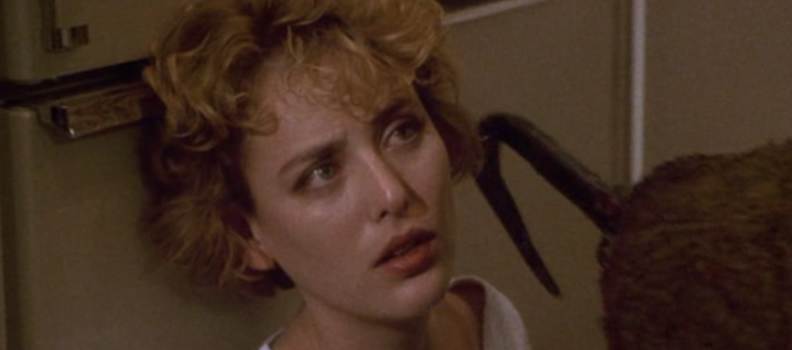
Virginia Madsen, playing Helen, floats through the film like she’s in a dream—or possibly still high from a bad wine tasting in Napa. She’s gorgeous, sure, but she makes one questionable decision after another. She breaks into housing projects. She chases after ghost stories. She mouths off to gang members. She touches evidence with her bare hands.
She’s like a Final Girl with a death wish and a tenure-track position.
To her credit, Madsen gives it her all. There are long, moody scenes of her staring at things—mirrors, graffiti, bees—with the kind of intensity usually reserved for hostage negotiators. Her performance carries an air of “I signed up for something smarter than this,” and she’s not entirely wrong.
Tony Todd: The Ghost with the Most Baritone
Tony Todd’s Candyman is hands down the most elegant, poetic, and terrifying slasher to ever rise from a pile of bees. While other horror villains grunt, snarl, or wear masks like emotionally repressed mascots, Candyman talks. He recites gothic monologues in a voice so rich it makes Morgan Freeman sound like he’s clearing his throat.
“Be my victim,” he whispers, which is horror movie code for “You’re about to die, but with elegance and a soft jazz score.”
He doesn’t chase. He doesn’t run. He just shows up in a fur coat, like Dracula got a soul patch and a master’s in literature. It’s unsettling, dignified, and just a little fabulous.
The Horror: Blood, Bees, and Bathroom Graffiti
The film delivers a few solid jolts—mutilations, decapitations, and a public restroom that would make a raccoon wince. There’s also a baby abduction subplot and one extremely intense scene involving a dog that I won’t describe, except to say: Don’t get attached.
But much of Candyman trades gore for dread. It’s more interested in mood than mayhem, which works—until it doesn’t. Some scenes feel like they’re building toward something shocking and instead wander off into philosophical musings about belief and identity.
It’s as if Hellraiser got into a book club with The English Patient and decided to make a movie together.
Cabrini-Green: Urban Decay as Haunted House
Cabrini-Green, the real-life Chicago housing project, is used here not just as a backdrop, but as a character itself. It’s grimy, broken, and full of both real and supernatural danger. The filmmakers clearly want to say something about poverty, race, and fear—but the message gets tangled up in the fog machine.
One minute we’re exploring systemic neglect and racial profiling, the next we’re watching Virginia Madsen get seduced by a ghost with bees coming out of his mouth. Tonal whiplash is real, folks.
The Bees: Buzz Off
No discussion of Candyman is complete without the bees. Oh yes, real bees. In your mouth. On your face. All over your naked chest. It’s the kind of acting choice that screams, “My union rep stopped taking my calls.”
Tony Todd famously had a clause in his contract that paid him $1,000 per sting. He got stung 23 times. That’s $23,000 just to look like a walking apiary. Suddenly, method acting doesn’t seem worth the insurance premiums.
Pacing: Mirror, Mirror on the Wall… Please Speed Up
The first half of the film works beautifully—suspenseful, unsettling, and crawling with atmosphere. But the second half? It kind of falls apart like a soggy beignet.
Helen ends up framed for crimes she didn’t commit, loses her marriage, gets tossed into a psych ward, and has conversations with Candyman that feel more like weird break-up texts than threats. By the time she’s crawling into a bonfire to save a baby, the film’s original promise has burned up alongside her.
It wants to be both ghost story and social commentary but ends up being a little too heavy-handed with both.
Final Verdict: More Honey-Glazed Than Hell-Raised
Candyman is ambitious, moody, and occasionally brilliant. It has a haunting score by Philip Glass, a powerhouse performance by Tony Todd, and a bold willingness to take horror somewhere cerebral. But it also gets a little lost in its own fog. It’s like watching a really well-dressed guy give a TED Talk on fear while someone bleeds out behind him.
Virginia Madsen is game, the bees are committed, and Tony Todd should’ve gotten a Shakespearean monologue to recite before each murder. But the movie doesn’t quite stick the landing. It’s a gothic fairy tale trapped in a slasher’s body—and sometimes, those two genres don’t want to share the mirror.
Rating: 6.5/10 – A beautifully shot, thematically overstuffed haunted tale that buzzes more than it bites.
Say his name five times and you’ll summon a film with charm, ambition, and just enough clunky moments to keep it from being legendary.