A Monster Without Myth: Real-World Horror at Its Most Relentless
Stephen King has conjured up demons, haunted hotels, killer cars, and interdimensional clowns. But in Cujo, it was a rabid St. Bernard that delivered some of the most unrelenting and nerve-shredding terror in King’s long and legendary career. The 1983 film adaptation, directed by Lewis Teague, captures the primal fear at the heart of the novel—a fear not of the supernatural, but of being trapped, helpless, and preyed upon by something you used to trust.
With its single-location setting, slow-building tension, and powerhouse performance by Dee Wallace, Cujo may seem modest compared to other King adaptations. But don’t mistake scale for impact. This is a film that sinks its teeth in and doesn’t let go, as suffocating as the summer heat it portrays and as psychologically devastating as any ghost story.
It’s sweaty, claustrophobic, and gut-wrenchingly human—a horror film about survival, motherhood, and losing control, both literally and metaphorically.
The Setup: Domestic Turmoil Meets Viral Madness
The film begins not with a bark but a buzz—a bat bite, to be exact. In a chilling prelude, the titular Cujo—a massive, gentle St. Bernard—gets bitten on the nose by a rabid bat while chasing a rabbit. The transformation is slow but inevitable, as Cujo’s once-loving demeanor is gradually overtaken by foaming rage and confusion.
Meanwhile, in nearby Castle Rock, the Trenton family is falling apart. Donna Trenton (Dee Wallace) is unhappily married, juggling the guilt of an affair and the stress of suburban malaise. Her husband Vic (Daniel Hugh Kelly) is preoccupied with saving his floundering advertising business, and their young son Tad (Danny Pintauro) is terrified of imaginary monsters hiding in his closet.
The film takes its time establishing these characters, grounding us in their emotional lives before the horror takes over. This approach pays off in spades once Donna and Tad find themselves trapped in a broken-down Ford Pinto, besieged by a now-rabid Cujo. What begins as a repair trip to the mechanic’s farm turns into a three-day siege of blood, sweat, and desperation.
It’s in this suffocating space—where fear, dehydration, and primal panic set in—that Cujo reveals its fangs.

Dee Wallace: A Tour de Force in Terror
Make no mistake: Cujo belongs to Dee Wallace.
Already a familiar face in horror thanks to The Hills Have Eyes and The Howling, Wallace gives what is arguably her greatest performance here. As Donna, she’s complex, conflicted, and completely human. She’s not a superhero mom. She’s not a flawless victim. She’s someone you believe in—someone real—which makes her eventual breakdown and fight for survival all the more wrenching.
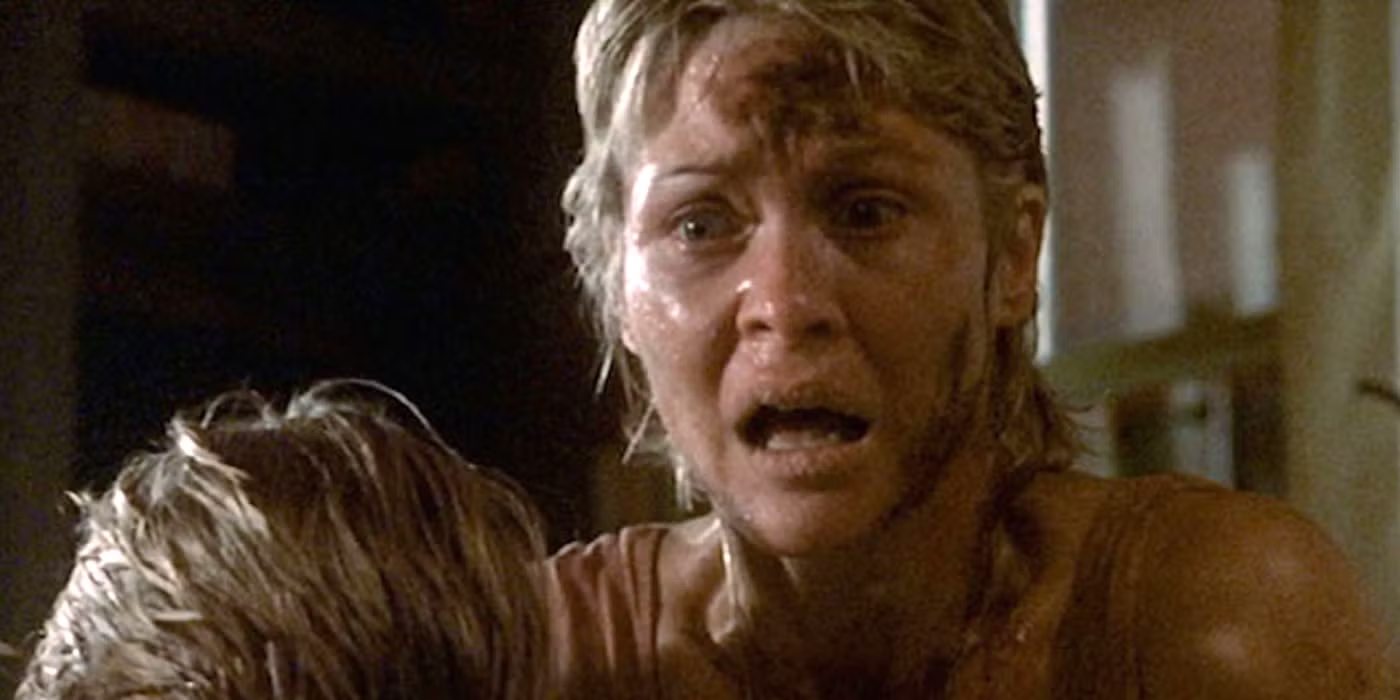
Wallace doesn’t just scream—she emotes. She projects terror, fatigue, guilt, determination, and finally, the feral instinct to protect her child at all costs. The scenes in the car, where she sweats, sobs, and strategizes while her son slips into unconsciousness, are some of the rawest and most emotionally grueling in 1980s horror cinema.
It’s easy to dismiss Cujo as “that killer dog movie,” but Wallace’s performance elevates it to something more. This is a film about maternal sacrifice, about being pushed beyond your mental and physical limits. It’s not about the monster outside—it’s about the will to keep going when everything inside you says to give up.
If there were any justice in horror awards, Dee Wallace would’ve taken home an Oscar.
Pint-Sized Panic: Danny Pintauro as Tad
Let’s also give credit to Danny Pintauro, who plays Tad with a heartbreaking blend of innocence and terror. Child performances in horror can often feel grating or artificial, but Pintauro is remarkably believable, especially in the later scenes where heat and dehydration begin to take their toll.
He cries like a real child would. He clings to his mother, not with theatrics, but with genuine fear. His terror isn’t just for Cujo—it’s for being forgotten, for dying in a metal box in the middle of nowhere. The chemistry between him and Wallace is genuine and palpable, which makes their ordeal all the more affecting.
Cujo the Canine: A Beast Born of Tragedy
It’s worth noting that Cujo is not a “villain” in the traditional sense. He’s not evil. He’s not malicious. He’s sick.
That’s what makes his transformation so tragic—and so terrifying. We see glimpses of Cujo before the madness: playful, affectionate, eager to please. The horror comes from the loss of that innocence, from watching a beloved pet turn into a killer with dead eyes and blood-matted fur. There’s no supernatural force at work—just biology and misfortune.
The effects team, aided by several well-trained St. Bernards, animatronics, and occasionally even guys in dog suits, manages to create a believable and deeply unsettling monster. The camera often puts us in Cujo’s perspective—low, panting, aggressive—which makes the attacks all the more visceral.
The sound design helps immensely. Cujo’s growls are guttural and wet. His snarls feel dangerous. And when he lunges at the car windows, it’s not just a jump scare—it’s a visceral jolt, because it feels real.
Cinematography and Direction: Trapped in a Pressure Cooker
Director Lewis Teague does a remarkable job with what is essentially a two-character, single-location story. The majority of Cujo takes place inside that sweltering Pinto, and yet the tension never slackens. Teague uses every angle he can find—tight close-ups of Donna’s sweat-soaked face, wide shots that show how desolate and far away help is, and POV shots that put us right next to the monster.
The heat becomes a character in itself. You feel the sun baking the metal, the windows steaming up, the air growing thinner. Tad’s hallucinations, Donna’s moments of panic—these are filmed with a frantic, almost documentary style that draws you deeper into their suffering.
The editing is tight and purposeful. There’s no fat on this film. Once Donna and Tad are trapped, the tension ratchets up and never truly releases until the final moments.
A Departure from King’s Bleaker Ending
Fans of the novel will note a significant change in the film’s climax. In King’s book, Tad dies—a gut-wrenching, brutal moment that underlines the randomness and cruelty of fate. But the film spares him, letting Donna rescue her son at the very last moment.
Some purists objected to this change. But honestly? It works.
This isn’t a film that needed more hopelessness. Donna’s journey is already harrowing enough, and the sight of her carrying her barely-conscious son out of the wreckage feels earned, not cheap. It’s a rare case of a Hollywood change that enhances rather than undermines the emotional impact.
Flaws? Sure, But They’re Forgivable
No film is without blemish, and Cujo has a few. The first act, with its focus on Donna’s affair and Vic’s advertising woes, drags in places. While it helps establish character and normalcy before the horror hits, some viewers might find it meandering.
Also, the subplot about the monster in Tad’s closet, while thematically interesting, never fully pays off. It feels more like a thematic motif than a fully realized arc.
And yes—some of the effects shots involving Cujo (especially the animatronic head) haven’t aged perfectly. But these are minor quibbles in a film that otherwise hits like a punch to the throat.
Themes: Fear of Losing Control
Beneath the surface of this simple siege story lie layers of metaphor. Cujo represents more than a rabid dog—he’s chaos incarnate, the embodiment of how quickly life can spiral out of control. Donna can’t fix her marriage. She can’t control the weather. She can’t keep her car running. And now, she can’t even protect her child.
The car, once a symbol of freedom and mobility, becomes a metal coffin, trapping them in a situation with no easy exit. The horror isn’t just Cujo—it’s helplessness, guilt, and the overwhelming pressure to do something—anything—to save your child.
Cujo taps into that deep parental fear: what if I can’t save them? What if I’m not enough?
It’s not supernatural. It’s not theatrical. It’s just life, turned sideways and ramped up to 11.
A Final Bite: Why Cujo Still Matters
Cujo may not have the mythic grandeur of The Shining or the fantastical elements of It, but it remains one of the most grounded, emotionally brutal Stephen King adaptations ever made. It doesn’t rely on jump scares or elaborate kills. It builds its horror the old-fashioned way—with tension, character, and real-world fear.
For fans of psychological horror, survival thrillers, or character-driven terror, Cujo delivers in spades. And for anyone who’s ever felt trapped, helpless, or scared for someone they love, it cuts to the bone.
This is not a film about a killer dog.
It’s a film about people who’ve run out of options. And in that space—where love, guilt, and fear collide—it finds something truly terrifying.
Rating: 8.5/10 – A visceral, tightly-wound thriller powered by Dee Wallace’s tour-de-force performance and a concept that turns the familiar into the horrifying. Cujo is a howling success in slow-burn, real-world horror.

