Linda Doucett arrived in Hollywood the way a lot of women do—quietly, attractively, and with people already deciding what she was worth before she opened her mouth. She didn’t kick the door down. She didn’t need to. The door was already half open, held there by other people’s expectations, and that’s often worse.
She was born Linda L. Durst on July 2, 1954, in Pittsburgh, Pennsylvania, a city that teaches you early about steel and gravity and how nothing bends unless it absolutely has to. Pittsburgh doesn’t hand you fantasies. It hands you weather and work. By the time Doucett left, she already understood something Hollywood spends years trying to hide: looks can open rooms, but they don’t protect you once you’re inside.
She started modeling in high school, which is another way of saying people noticed her before she was old enough to control what that noticing meant. Modeling teaches you stillness. It teaches you how to be seen without being heard. It also teaches you how disposable beauty is once it stops behaving the way it’s expected to. Those lessons come early and they stick.
Her first steps toward acting weren’t glamorous. Extras work. Music videos. Background faces in songs that weren’t about her. Toto. The Beach Boys. Sunlight, smiles, nothing permanent. Hollywood always starts people there, in the blur, to see who’s willing to wait.
By the late 1980s and early 1990s, Doucett drifted into television—the kind of television that didn’t pretend to be noble. She appeared on shows like Herman’s Head and Tales from the Crypt, places where tone mattered more than prestige and timing mattered more than sincerity. She learned how to hit a mark and disappear. That’s a skill no one applauds.
Then came The Larry Sanders Show.
If you want to understand Linda Doucett’s career, you have to understand that show. It wasn’t a sitcom. It was an autopsy. A slow, clever dissection of ego, insecurity, and power in entertainment. It pretended to laugh while it cut.
From 1992 to 1994, Doucett played Darlene Chapinni, the devoted assistant to Hank Kingsley, the sidekick who lived off crumbs and resentment. Darlene was loyal, competent, and mostly invisible—the kind of woman who keeps things running while the men fall apart in public. Doucett played her without irony. She didn’t wink at the camera. She didn’t ask for sympathy. She understood that the joke was never on her character—it was on the system that required her.
For three seasons, she was part of the machine. Regular appearances. Familiar face. A role that didn’t dominate scenes but anchored them. That’s harder than it looks. Comedy like Larry Sanders depends on gravity. Someone has to keep the orbit stable while everyone else spins.
And then she was gone.
In 1994, after the first episode of the fourth season, Doucett was replaced. No long goodbye. No narrative closure. Just absence. In Hollywood, disappearance is often explained as “creative direction,” which is another way of saying no one wants to talk about it.
Offscreen, the situation was messier. Doucett had been in a relationship with Garry Shandling from 1987 to 1994. Relationships in Hollywood have a shelf life, but power dynamics don’t expire so easily. When the relationship ended, her job did too. Cause and effect are rarely acknowledged out loud, but everyone understands the math.
Doucett didn’t stay quiet.
She filed a lawsuit alleging sexual harassment and wrongful termination against Shandling and the production company behind The Larry Sanders Show. That alone separated her from the crowd. Hollywood forgives almost everything except women who talk. The case was settled out of court in 1997 for a reported one million dollars. Settlements don’t mean innocence or guilt. They mean silence was purchased.
The industry moved on. It always does.
There’s an irony in the timing that feels almost scripted. In 1993, Doucett posed for Playboy. The issue came out the same time as a Larry Sanders episode titled “Broadcast Nudes,” in which her character is asked—fictionally—to pose for Playboy. Art imitating life or life being fed into the machine until it loses all meaning. Either way, the joke lands differently once you know who’s holding the pen.
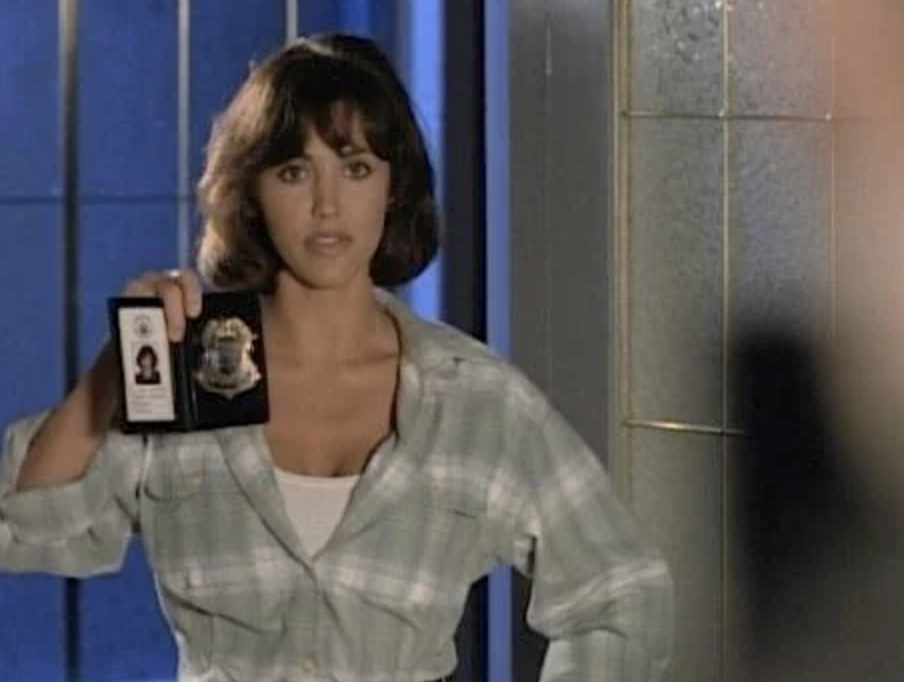
After Larry Sanders, her acting career slowed and eventually stopped. Hollywood is efficient that way. You don’t need to blacklist someone formally. You just stop calling. She appeared in a made-for-television film called Badge of Betrayal and a handful of other projects, then stepped out of the spotlight entirely by the early 2000s.
And that might be the most honest choice she made.
Years later, in 2008, Doucett reappeared publicly as a witness—not in a movie, but in a courtroom. She testified in the federal case against Anthony Pellicano, the private investigator whose career was built on illegal wiretaps, intimidation, and secrets traded like currency. Doucett stood alongside figures like Shandling and Sylvester Stallone, part of a larger story about how Hollywood protects itself by listening in on its own conscience.
That testimony mattered more than any role she played.
Linda Doucett never became a star. She became something more dangerous to the system: a reminder. A reminder that behind every sharp satire about power, there are real people absorbing the consequences. The Larry Sanders Show was praised for its honesty. Doucett lived the version that didn’t make it into the script.
She didn’t reinvent herself publicly. She didn’t chase a comeback tour or sell her story to the highest bidder. She faded into privacy, which is the last refuge for people who understand how little protection fame actually offers.
Hollywood likes women who are agreeable, forgettable, or grateful. It doesn’t know what to do with women who remember exactly what happened and refuse to rewrite it for comfort. Doucett didn’t shout. She didn’t burn bridges on talk shows. She simply told the truth in the one place where it couldn’t be edited.
Her career exists mostly in the negative space now—the roles she didn’t get, the opportunities that quietly evaporated, the scenes that never needed her once she stopped being convenient. But if you look closely, you can still see her fingerprints on a show that pretended to mock power while practicing it.
Linda Doucett understood something early and paid for it dearly:
The joke is never just a joke.
And the punchline almost always lands on the person with the least control over who’s laughing.
She survived the room.
She left without applause.
And she kept her name.