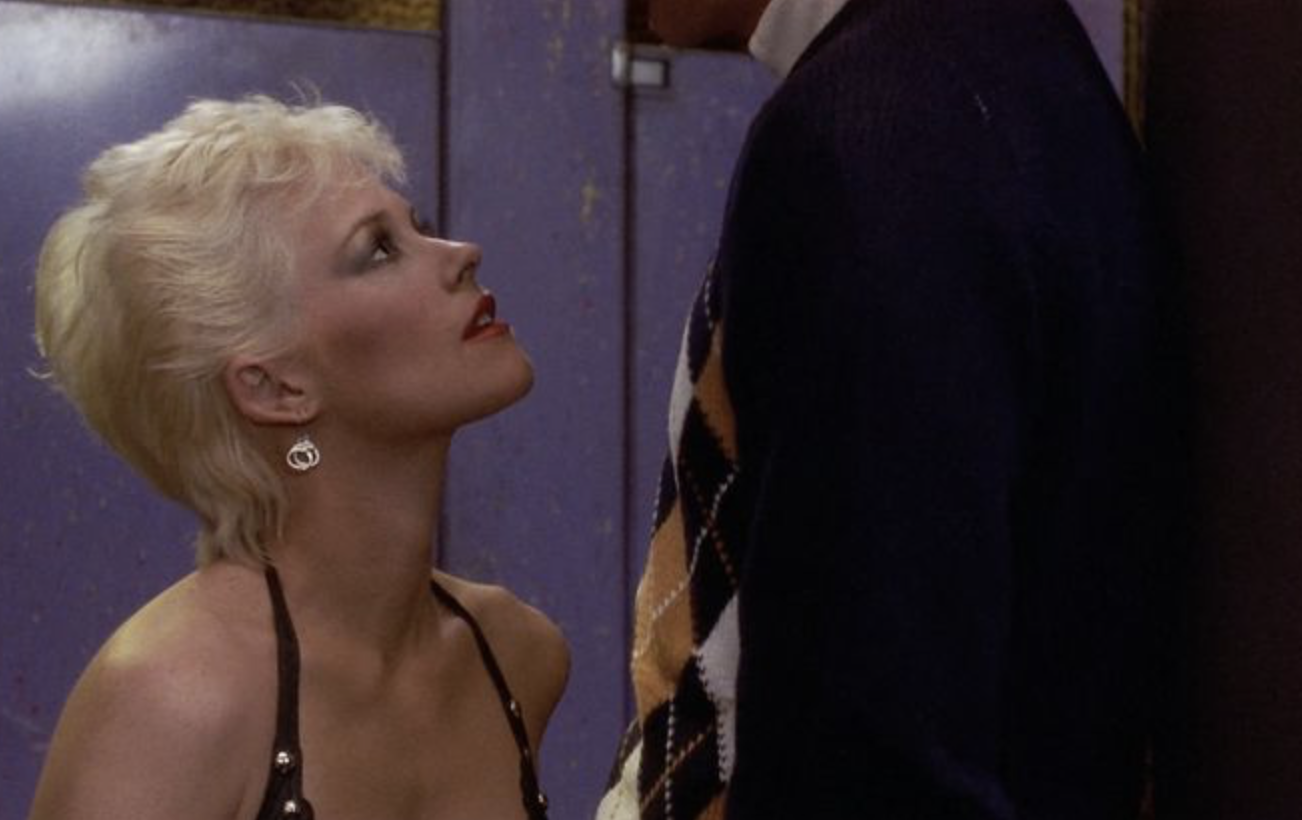
When Brian De Palma’s Body Double slithered into theaters in 1984, audiences didn’t know whether to clutch their pearls or their popcorn. The film was a love letter to Hitchcock and a taunt to middle class morality, drenched in sex, voyeurism, and sleaze. And at the center of it all was Melanie Griffith as Holly Body — the adult film star who ends up being both the movie’s red herring and its unlikely moral compass. It’s one of those roles that could have sunk an actress’s career into the quicksand of exploitation, but Griffith managed to turn it into a defining performance — sly, funny, and even a little tragic.
The Setup: The Girl in the Window
When we first meet Holly, she’s not quite herself. For most of Body Double, the audience — and Jake Scully (Craig Wasson), our hapless claustrophobic actor-turned-voyeur — doesn’t even realize Holly exists. What we think we’re seeing is a beautiful woman (Deborah Shelton) performing a nightly striptease for the telescope across the canyon. De Palma teases us with the image of the perfect cinematic fantasy: a woman alone, framed by the window, dancing in soft light, unaware she’s being watched. But it’s a performance within a performance. That’s not her dance — it’s Holly’s.
The moment Jake discovers that the mysterious woman and the porn actress share the same moves, the entire movie pivots. What had been a dream of erotic mystery turns into a meta-commentary on artifice and exploitation. Holly Body is both a clue in a murder plot and a commentary on Hollywood itself — an actress for hire, a body sold to the camera, playing someone else’s fantasy until the fantasy gets her killed.
The Entrance: A Dirty Movie Queen with Sharp Edges
When Griffith finally enters the story for real, it’s as if she’s arrived from another, better film. Jake tracks her down on a porn set, and the first thing she does is blow cigarette smoke in his face while explaining the economics of fake sex. “I don’t do body doubles,” she says with a smirk — the kind of line that’s both literal and self-referential. Griffith delivers it with a mixture of sass and steel, the confidence of a woman who’s long ago stopped apologizing for what she does.
Her performance here is a small miracle of tone. Griffith gives Holly an almost screwball energy — fast-talking, smart-mouthed, completely self-aware. She’s not the tragic fallen woman of noir tradition; she’s a survivor who’s figured out how to turn men’s fantasies into rent money. But there’s also a tenderness beneath the bravado, a kind of weary good humor that suggests she knows she’s been typecast in life as well as in film.
It’s a razor’s-edge performance — equal parts satire and sincerity. Griffith plays Holly as if she’s perpetually aware that everyone, from the director to the guy behind the lens, sees her as disposable. And yet, by leaning into that, she steals the movie. She’s the one character who feels genuinely alive in a world of mannequins and mirrors.
The Performance: Playing a Character Who’s Playing a Character
De Palma’s film is all about watching — who watches, who gets watched, and what that says about power. Holly is both the watched and the watcher. She understands the mechanics of the gaze better than anyone else in the film. When Jake clumsily tries to seduce information out of her, she dismantles his act immediately. “You’re not a cop,” she says, rolling her eyes. “You’re an actor.” It’s a line that lands like a slap — she sees through him the same way she sees through the men who pay to see her.
What Griffith nails here is Holly’s professional detachment. She’s in an industry where fantasy is the product, and she’s mastered the ability to make intimacy look real without ever surrendering control. That’s what makes her so magnetic — and why the film’s tension depends on her. Jake’s delusion is that he can cross the line from voyeur to savior, from spectator to participant. Holly’s truth is that the line doesn’t exist. In her world, everyone is acting, even when they think they’re not.
Griffith’s Breakthrough: Fearless and Funny
For Griffith, Body Double was both a career risk and a reinvention. Before this, she’d been known mostly for small parts and as the daughter of Tippi Hedren (De Palma’s Hitchcock inspiration, no less). The industry wasn’t kind to actresses who traded in overt sexuality — especially not in the conservative shadow of early-’80s Hollywood. But Griffith turned what could have been a humiliation into a declaration. She brought wit, warmth, and irony to a role that could have been just another male fantasy.
She also understood the movie’s inherent absurdity. De Palma was playing with exploitation tropes, but Griffith plays Holly as if she’s been reading the script along with him. When she parodies herself in the faux-porn sequence “Holly Does Hollywood,” she goes full camp without losing an ounce of charisma. It’s the film’s most honest moment — a woman reclaiming her image through exaggeration.
There’s something quietly radical about how Griffith refuses to moralize Holly’s profession. She doesn’t play her as a victim or a femme fatale, but as a working-class professional — competent, ironic, and maybe a little jaded. In doing so, she gives the film its only human pulse.
The Arc: From Object to Agent
At the start, Holly exists purely as projection — literally a body double, a stand-in for someone else’s fantasy. By the end, she’s the only character with agency. When Jake enlists her help to expose the killer, she does so not out of loyalty but out of practicality — she’s been used enough. The irony, of course, is that she becomes Jake’s savior, rescuing him from the pit of his own delusion.
In the climactic sequence — equal parts satire and nightmare — Holly reclaims control over her image. Dressed in the same red outfit from the film’s opening, she reenacts her earlier striptease, but this time it’s on her terms, with the camera as her ally rather than her predator. The scene loops back on itself — the watched becomes the watcher, the fantasy becomes the weapon. De Palma, ever the provocateur, ends not with moral clarity but with a wink: Holly’s still performing, but now she’s getting paid for it.
A Subversive Star Turn
It’s impossible to overstate how much Griffith’s performance humanizes a film otherwise obsessed with surfaces. Where other actors in Body Double are directed like chess pieces in De Palma’s cinematic machine, Griffith feels spontaneous — unpredictable in the best way. She takes what could have been a caricature (the “dumb blonde porn star”) and turns it into a sly commentary on Hollywood’s commodification of women.
Her Holly isn’t just a porn actress — she’s a mirror held up to the industry itself. She sells illusions, but she’s the only one honest enough to admit it. In that sense, she’s the film’s conscience. The men around her — Jake, the murderer, even De Palma’s camera — are all consumed by desire and fantasy. Holly sees through it all. She’s the only one who knows the punchline, and Griffith delivers it with a knowing smile that says: You wanted a fantasy? You got one.
Legacy: The Birth of a Modern Femme Fatale
In retrospect, Body Double marked the start of Griffith’s most interesting phase as an actress. Her Holly Body walked so her Tess McGill (Working Girl) could run. Both are women underestimated by the men around them, both use sexuality as strategy rather than submission. But Holly’s subversion is darker and funnier — she plays the game because she knows there’s no way to win it.
De Palma’s film may be divisive — leered at by some, dismissed by others — but Griffith’s performance remains a small marvel of irony and control. She made a porn star the smartest person in the room. She turned sleaze into satire. And she did it all while winking at an audience that wasn’t quite ready to laugh at itself.
