
If you’re going to make a steamy melodrama drenched in sweat, satin sheets, and slow-burning stares, you’d better cast someone who can carry it — not with dialogue, but with presence. Someone who can smolder on screen, make you forget the flaws in the script, and sell erotic longing with the tilt of a head or a bitten lip. Two Moon Junction may not be a perfect movie — it’s far from it — but with Sherilyn Fenn at its center, it doesn’t need to be. She is the fire under this otherwise wobbly Southern potboiler, and the reason it has survived, endured, and even been re-evaluated as a cult gem of erotic cinema.
Directed by Zalman King, a filmmaker whose career leaned heavily into the sultry and suggestive (9½ Weeks, Red Shoe Diaries), Two Moon Junction tells the story of April Delongpre (Fenn), a young Southern belle from a privileged family who is engaged to a respectable man, on track for the kind of well-manicured life her grandmother (played by Louise Fletcher) expects. But April’s world is upended when she meets Perry (Richard Tyson), a rugged, motorcycle-riding carnival worker with bedroom eyes and a smirk that would make James Dean raise an eyebrow.
Their attraction is instant and primal. She, porcelain-smooth and tightly wound in lace and expectations. He, shirtless and dripping with sweat and rebellion. From their first glance, the film’s course is set: into the woods, into the sheets, and into the kind of sultry territory where plot is second to mood, and longing matters more than logic.
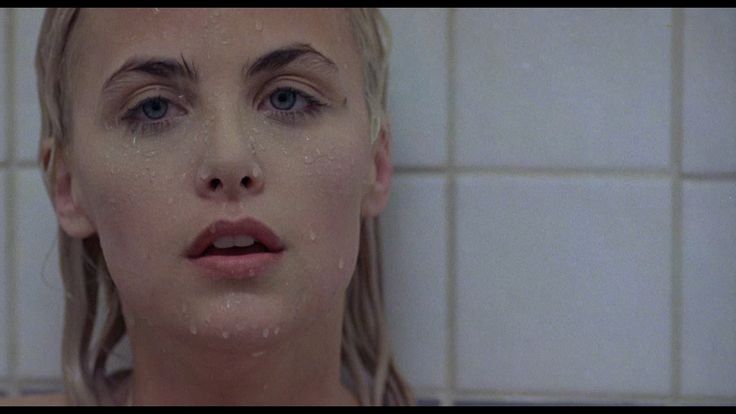
Sherilyn Fenn: A Star is Undressed
Let’s make no mistake: this is Sherilyn Fenn’s movie. Not just because she’s in nearly every scene, but because she dominates every frame. She’s the reason Two Moon Junction works — emotionally, erotically, cinematically. Before her iconic role as Audrey Horne in Twin Peaks made her the poster girl for dangerous innocence, Fenn was already radiating a similar energy here: soft yet electric, wide-eyed but knowing, a dream wrapped in lace who could turn into a storm if you blinked.
The camera loves Fenn — and not just in the voyeuristic way that erotic thrillers tend to linger on bodies. Yes, she’s filmed in flowing negligees and moonlit bathtubs, but she also delivers something deeper, more vulnerable. Her April isn’t just a sex object. She’s a young woman discovering her own desires — often confused by them, frightened of what they mean, but drawn to explore them anyway. Fenn plays her not as a clichéd virgin-on-the-verge, but as someone grappling with internal contradictions: craving rebellion, fearing shame, wanting freedom, but also afraid to give up control.
It’s a tricky performance, one that requires her to sell both the character’s transformation and the heat that propels it. And she nails it. Fenn has an uncanny ability to look simultaneously innocent and sensual — a pout with meaning, a stare that hints at danger. Her scenes with Tyson are charged not just because of the nudity, but because Fenn makes you believe April is awakening to something essential, something primal, and something irrevocable.
A Swampy Southern Fairytale
The setting of Two Moon Junction is less a backdrop and more a character in itself. The American South has long been a go-to locale for tales of repression, desire, and old-money rot. Zalman King knows this, and he leans into it with slow pans over humid swamps, white-pillared mansions, and sultry carnival rides that feel pulled from a Tennessee Williams fever dream.
King’s style is unabashedly lush. He fills the screen with candlelight, chiffon, and shadowy corners. Every shot seems designed to enhance the eroticism of the moment — a slow breeze on silk curtains, the gentle hum of cicadas at night, the hiss of a cold shower hitting sunburned skin. Sometimes it borders on parody, but more often than not, it works. King isn’t afraid of indulgence. He’s trying to create a mood — and mood is where this movie lives.
The cinematography by Elliot Davis is saturated with soft focus and sweat, and the score by Jonathan Elias leans into piano-and-synth slow burns that are more about seduction than suspense. This isn’t a thriller. It’s not even really a drama. It’s a mood piece — a long, erotic sigh wrapped in southern drawls and collarbone shadows.

Tyson and the Trouble With Chemistry
Richard Tyson, as the brooding Perry, is a bit of a mixed bag. He certainly looks the part: chiseled, rugged, smoldering. He’s got the kind of sex appeal that works well in a movie like this — unshaven, sweaty, and just dangerous enough to make you believe a woman like April would risk it all. But Tyson doesn’t quite have the range or nuance to elevate the role beyond its blueprint.
Perry is written as a fantasy — the working-class hunk with an artistic soul — but Tyson never quite sells the “soul” part. He’s good at glowering, great at undressing, but his emotional beats feel clunky. His dialogue scenes are wooden compared to his physical ones. It’s not that he’s bad, per se. He’s just outmatched whenever he shares the screen with Fenn, who injects ten layers of feeling into a single line while he struggles to conjure two.
And yet, somehow, the chemistry works — mostly because Fenn sells it. She makes you believe that April sees something more in Perry. Her desire for him isn’t just lust; it’s projection, rebellion, yearning for something real in a world of pretension. Tyson’s performance might be limited, but it works in the way some silent film stars worked — as an image more than a character. That may not be ideal, but in the context of Two Moon Junction, it’s enough.
Family, Repression, and Southern Decay
Beyond the sex, Two Moon Junction makes stabs — some more successful than others — at commentary on family, class, and repression. April’s life is defined by expectation. Her fiancé is perfect on paper but dead behind the eyes. Her family is wealthy, image-obsessed, and steeped in outdated traditions. Her grandmother, played with Southern Gothic gravitas by Louise Fletcher (yes, Nurse Ratched herself), represents the voice of “respectability,” constantly trying to rein April back into the fold.
These themes are familiar, even well-worn: the good girl torn between duty and desire; the rich family hiding rot beneath the roses; the seductive pull of the “wrong” man. But what keeps it from feeling entirely rote is Fenn’s performance and the film’s visual commitment to its fairytale-meets-sweatbox aesthetic.
Fletcher brings credibility and menace to her scenes, grounding the narrative even when the dialogue gets florid. Her attempts to control April — emotionally, financially, socially — hint at the larger forces at play. This isn’t just a story about sex. It’s about freedom — of body, mind, and life. And even though the film is mostly content to paint in broad strokes, there are moments where it lands a deeper blow.
Criticisms That Stick
For all its sultry pleasures, Two Moon Junction is far from flawless. The pacing is uneven. The dialogue ranges from poetic to cringe-worthy. The supporting characters — including Perry’s jealous ex and April’s uptight fiancé — are one-note and disposable. And as mentioned, Tyson’s performance sometimes leaves Fenn stranded in emotional scenes that could’ve had more resonance with a stronger co-lead.
The movie also doesn’t quite stick the landing. Its final act feels rushed, its emotional payoff undercooked. After such a slow simmer of passion and internal conflict, the ending feels like the filmmakers weren’t quite sure how to resolve April’s journey. There’s catharsis, but it’s murky, more symbolic than satisfying. One wishes the film had dug a little deeper, taken more risks with its storytelling instead of relying solely on its erotic charge.
But here’s the thing: for fans of the erotic drama genre, the film’s flaws are part of its charm. No one comes to Two Moon Junction for airtight plotting. They come for the atmosphere, the forbidden desire, the romance turned all the way up to eleven. They come for Sherilyn Fenn, who elevates every minute she’s on screen, transforming a softcore soap into something dangerously watchable.
The Legacy of Lust and Lace
Two Moon Junction didn’t fare well critically when it came out. Many dismissed it as glossy trash, an R-rated Lifetime movie soaked in baby oil. But over time, it has earned a place in the cult canon — especially among fans of erotic cinema, feminist film scholars interested in female sexual agency, and admirers of Sherilyn Fenn.
It’s easy to see why. While Zalman King’s later work (Wild Orchid, Red Shoe Diaries) would grow more lurid and less coherent, Two Moon Junction maintains a certain innocence. It’s about a woman discovering herself, not just her sexuality but her strength. Yes, it lingers on her body, but it also lingers on her face, her thoughts, her decisions. And in a genre that so often treats women as props, that matters.
Fenn, in particular, gives the film its lasting power. She doesn’t just act — she seduces the camera. She makes vulnerability dangerous, makes beauty strange, makes longing into something you feel instead of just see. For many, this film was the introduction to her — and it’s not hard to see why it left an impression.
Final Verdict: B
Two Moon Junction isn’t perfect. It’s messy, overheated, and uneven. But it knows what it wants to be — and thanks to Sherilyn Fenn, it very nearly gets there. As a piece of erotic cinema, it delivers on atmosphere, sensuality, and Southern heat. As a vehicle for Fenn, it’s essential viewing — a showcase for an actress who could elevate even the most indulgent material with a glance, a touch, a whispered line.
It’s a film about desire — not just sexual, but existential. The desire to be seen, to be known, to break free. And in that sense, Two Moon Junction is a ride worth taking. Preferably with the fan on high and a glass of iced tea close by.
